


Debt traps don’t usually start with one dramatic mistake. They start quietly: a loan to patch a budget gap, a second loan to roll over the first, then a year where growth disappoints and the interest bill arrives like clockwork. In IB Economics, this is the moment a country’s choices shrink. Not because policymakers forget the theory, but because the country’s budget gets eaten by yesterday’s promises.
This matters for your exams because “debt trap” sits at the intersection of macroeconomic objectives, external stability, and development. And it’s also a story you can explain clearly under pressure.
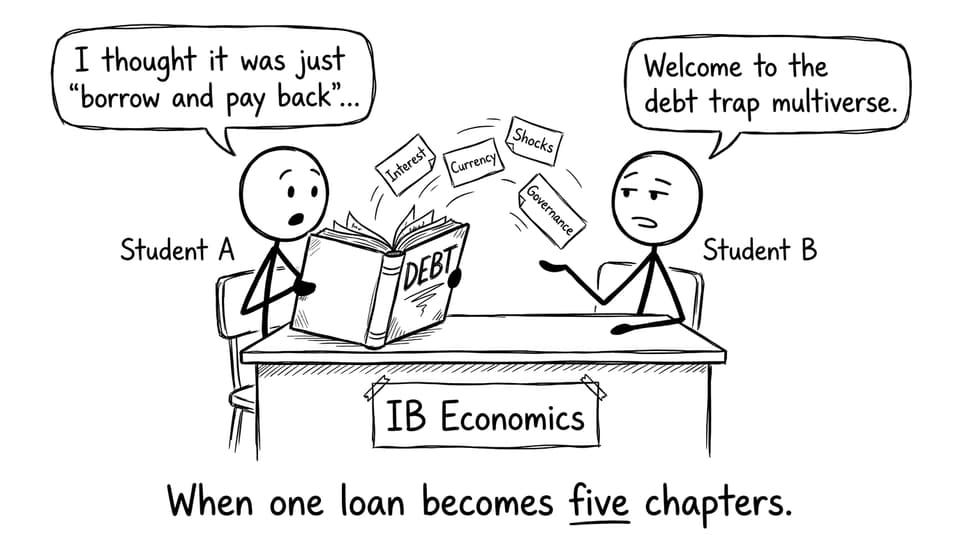
Quick IB Economics checklist: what creates a debt trap?
-
Borrowing to repay existing debt (debt rollover)
-
Low or unstable economic growth (weak tax revenue)
-
Rising interest payments (crowding out public spending)
-
External shocks (commodities, tourism, global recessions)
-
Foreign-currency borrowing plus exchange rate depreciation
-
Weak institutions (waste, corruption, poor project selection)
-
Limited access to affordable finance and tough loan conditions
If you need a syllabus-aligned base, keep IB Economics Resources open while you revise.
IB Economics: the slow squeeze of weak growth and rising interest
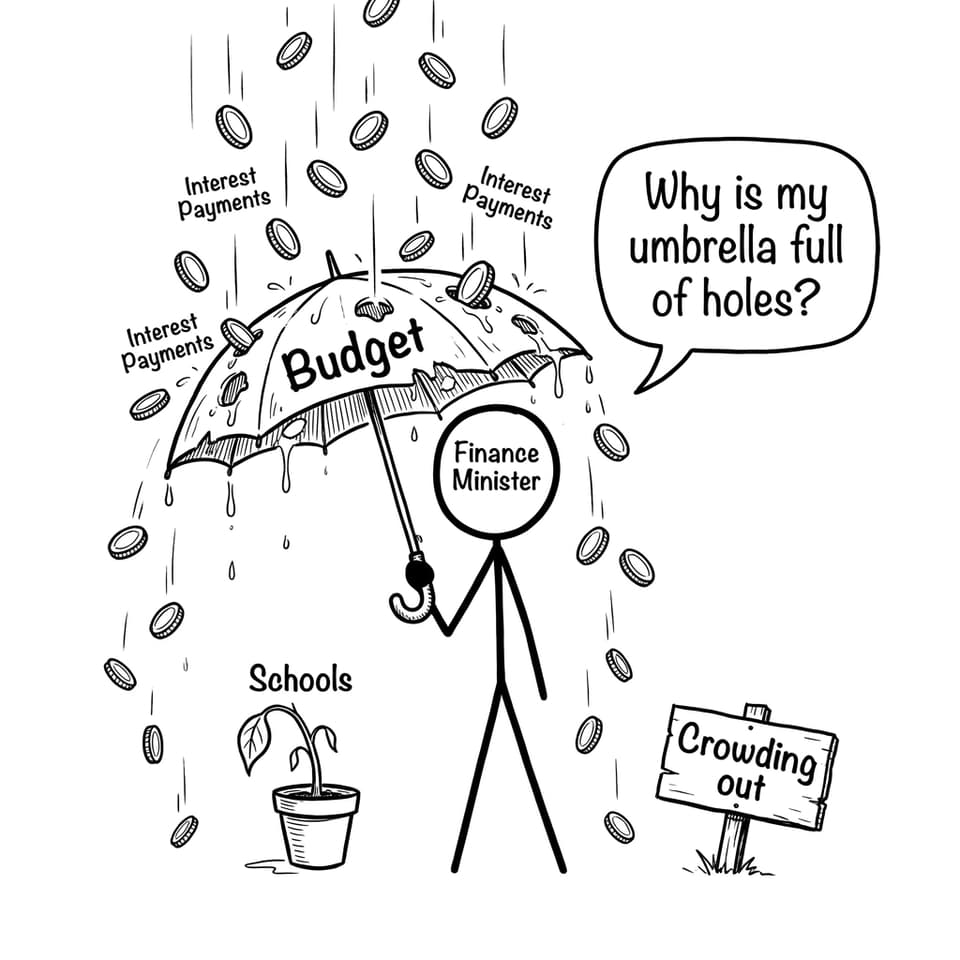
A country can carry debt when GDP rises fast enough to keep the debt burden manageable. But when growth is weak, tax revenue stagnates, and governments struggle to fund both everyday services and repayment schedules. The most dangerous part is compounding: interest payments grow, which pushes budgets into deficit, which forces more borrowing.
In IB Economics, this is your “crowding out” storyline: more of the budget goes to debt service, less goes to investment in health, education, and infrastructure. You can connect it directly to sustainable debt (HL) and macroeconomic objectives. RevisionDojo’s notes on sustainability help you phrase this precisely: see Sustainable level of government (national) debt notes and the explainer Is Government Debt Always a Problem?.
External shocks: when the world changes faster than budgets can
Many debt-trap countries are highly dependent on a narrow export base: commodities, tourism, or a few sectors. When global prices fall or arrivals drop, foreign exchange earnings decline and fiscal revenues weaken. To stabilize demand and protect employment, governments borrow again, hoping the shock is temporary.
This is where you can score evaluation marks in IB Economics: shocks are exogenous, unpredictable, and often repeated. If you need to revise how policy responds when output falls, pair this with Revision Tips: Fiscal Policy Guide for IB Economics and practise with timed prompts from the RevisionDojo Questionbank.
The exchange rate trap: foreign-currency debt that grows overnight
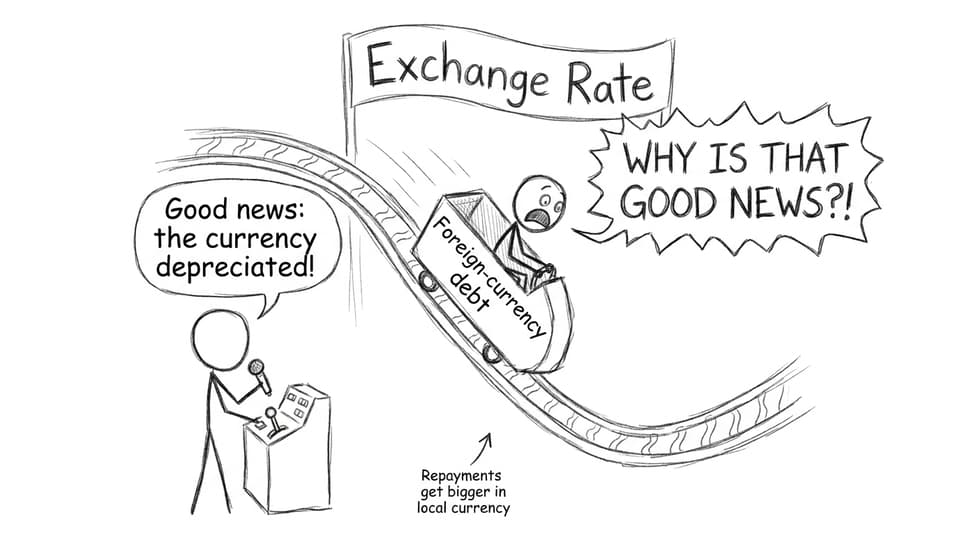
A huge amplifier is currency mismatch. If debt is denominated in USD or EUR while government revenue is collected in local currency, a depreciation makes repayment instantly more expensive in local terms. Nothing “real” changed about the original loan, but the domestic cost of servicing it rises.
For exam answers, state the mechanism simply: depreciation increases the local-currency value of foreign debt service, worsening the budget balance and increasing default risk. Then evaluate: a weaker currency might boost exports, but only if the economy has the capacity and diversification to respond.
Institutions and incentives: when borrowing doesn’t create growth
Debt becomes sustainable when it finances productive investment and improves long-run capacity. But institutional weakness can break that link. Corruption, low-quality procurement, and poor oversight mean borrowed funds may not raise productivity or tax capacity. Then the country is left with the liability, without the growth.
If you want extra context for development-linked policy answers, explore IB Economics 4. The Global Economy and browse more prompts via All IB Economics Posts.
Exam tip: how to turn “debt trap” into a high-mark paragraph
In IB Economics, aim for a tight chain:
-
Define the debt trap (borrow to repay).
-
Explain drivers (weak growth, interest, shocks, exchange rates, institutions).
-
Use one diagram or mechanism (crowding out, AD impact, exchange rate effect).
-
Evaluate with conditions (credibility, diversification, debt structure, time lags).
RevisionDojo makes this workflow easier because you can learn the theory in Study Notes, drill it in the Questionbank, then lock definitions with Flashcards and refine evaluation with AI Chat and Grading tools. If you’re revising macro foundations alongside this topic, review IB Economics 3.3 Macroeconomic Objectives Notes and the Macroeconomics notes hub.
Closing: make debt traps a scoring topic
Debt traps persist because they’re not one problem. They’re a system: weak growth, repeated shocks, currency risks, and institutions that struggle to turn borrowing into productive capacity. If you can explain that system clearly, you’ll be strong in IB Economics essays and data response.
For focused revision, build your plan inside RevisionDojo: learn the framework with Study Notes, test it in the Questionbank, memorise key terms with Flashcards, and sharpen evaluation using AI Chat, Grading tools, Mock Exams, Predicted Papers, and Tutors. Debt traps are complicated in the real world. Your explanation doesn’t have to be.
