

Molecules don’t “choose” to be bent or tetrahedral because they like aesthetics. They do it because electrons hate being crowded.
In IB Chemistry, this is one of those ideas that feels almost too simple at first: negative charges repel, so electron pairs spread out. But that simple push-away instinct becomes a reliable prediction tool on exam day. Once you see molecular shape as an energy-saving decision, VSEPR stops being memorisation and starts being logic.
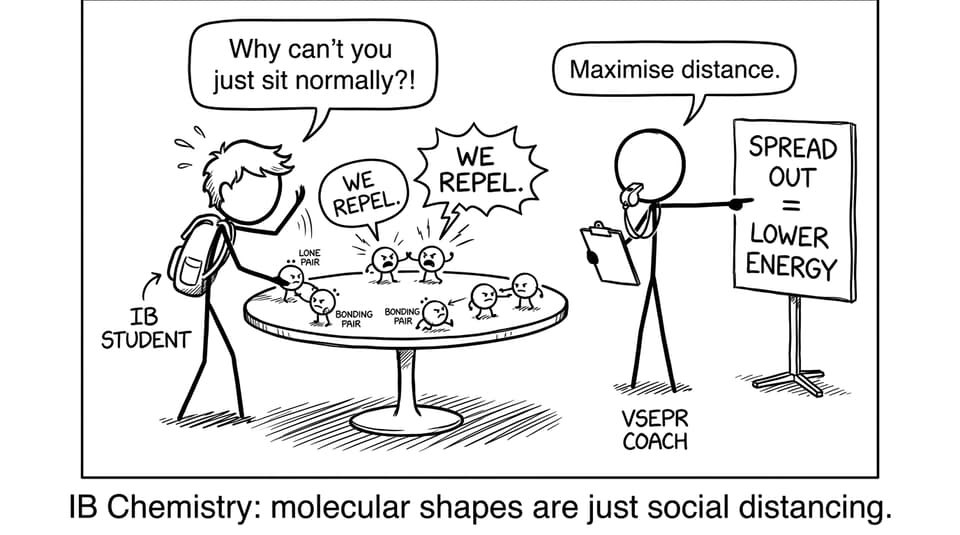
The core idea: electron pairs maximise distance
VSEPR (Valence Shell Electron Pair Repulsion) theory says regions of electron density around a central atom arrange themselves as far apart as possible to minimise repulsion and lower energy. In IB Chemistry, these “regions” are often called electron domains, and they include:
-
Bonding pairs (single, double, or triple bonds)
-
Lone pairs (non-bonding pairs)
If you want the official syllabus-aligned framing, RevisionDojo’s VSEPR hub is the cleanest starting point: S2.2.4 VSEPR theory.
Quick checklist for predicting shape (exam-speed)
-
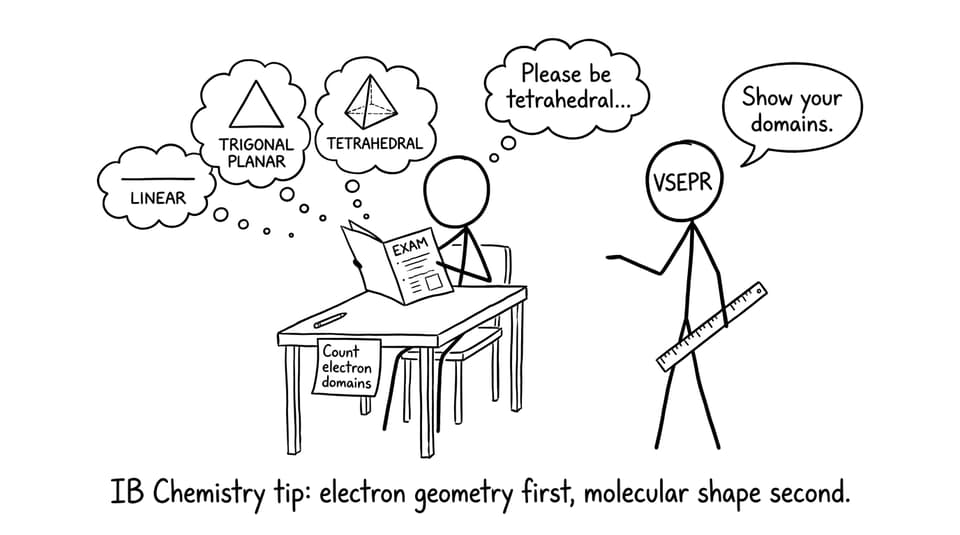
Draw the Lewis structure (correct valence electrons first).
-
Count electron domains around the central atom.
-
Assign the electron-domain geometry (the “ideal” arrangement).
-
Remove lone pairs from the name to get the molecular shape.
-
Adjust bond angles downward if lone pairs are present.
For a definitions refresher in IB Chemistry, this helps: IB Chemistry key definitions glossary.
Why lone pairs distort shapes more than bonding pairs
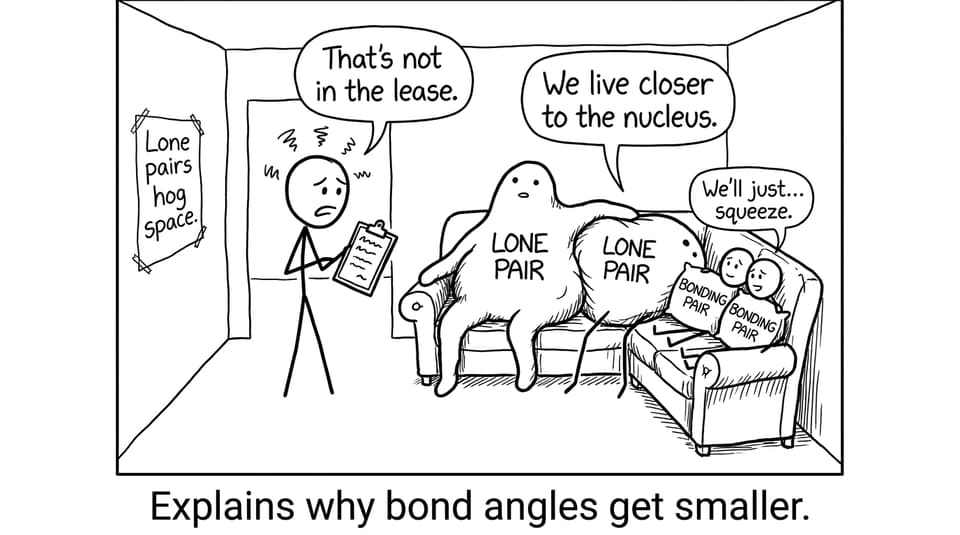
Not all repulsions are equal. Lone pairs tend to repel more strongly than bonding pairs because their electron density is concentrated closer to the central atom (they’re not shared between two nuclei). They occupy “more space” in the valence shell and shove bonding pairs into tighter angles.
That’s why:
-
CH₄ is perfectly tetrahedral (no lone pairs on carbon).
-
NH₃ becomes trigonal pyramidal (one lone pair compresses angles).
-
H₂O becomes bent (two lone pairs compress even more).
If water is your weak point, use this targeted explanation: Why H₂O Is Bent: Molecular Shape Explained.
The five electron-domain geometries you actually use
VSEPR patterns in IB Chemistry are predictable because only a few electron-domain counts appear repeatedly:
-
2 domains: linear
-
3 domains: trigonal planar
-
4 domains: tetrahedral
-
5 domains: trigonal bipyramidal
-
6 domains: octahedral
A key exam nuance: the electron-domain geometry stays the same even when some domains are lone pairs. What changes is the molecular shape you observe (because lone pairs don’t show up as atoms).
For HL students dealing with expanded octets (where 5 and 6 domains appear often), this note page is useful: Expanded Octet of Electrons (HL) notes.
What about double and triple bonds in IB Chemistry?
In VSEPR counting, multiple bonds count as one electron domain. But they can repel a bit more strongly than a single bond because there’s more electron density in that region, so they can slightly distort angles.
RevisionDojo covers this nuance clearly here: Why double and triple bonds affect molecular geometry.
How to practise this efficiently on RevisionDojo
Understanding is step one; exam performance is step two. For IB Chemistry, the fastest way to lock VSEPR is to mix short bursts of practice with immediate feedback:
-
Drill shape questions in the S2.2.4 VSEPR theory Questionbank.
-
Consolidate your model of bonding with the broader topic map: Structure 2: Models of bonding and structure.
-
Use quick recall tools: Structure 2 flashcards.
And if you’re building a full revision system, RevisionDojo brings it together: Questionbank, Study Notes, Flashcards, AI Chat for explanations, Grading tools for structured responses, Predicted Papers, Mock Exams, a Coursework Library, and Tutors when you want a human to check your thinking.
Closing: turn repulsion into marks
Electron pair repulsion is the quiet engine behind molecular geometry: electrons spread out, energy drops, shapes emerge. In IB Chemistry, VSEPR is one of the few topics where a simple principle can reliably carry you through unfamiliar molecules.
If you want that reliability under time pressure, use RevisionDojo to practise VSEPR the way exams demand it: targeted Questionbank sets, crisp Study Notes, Flashcards for fast recall, AI Chat when you’re stuck, and Mock Exams to make the logic automatic. Your future self in the exam hall will thank you.