

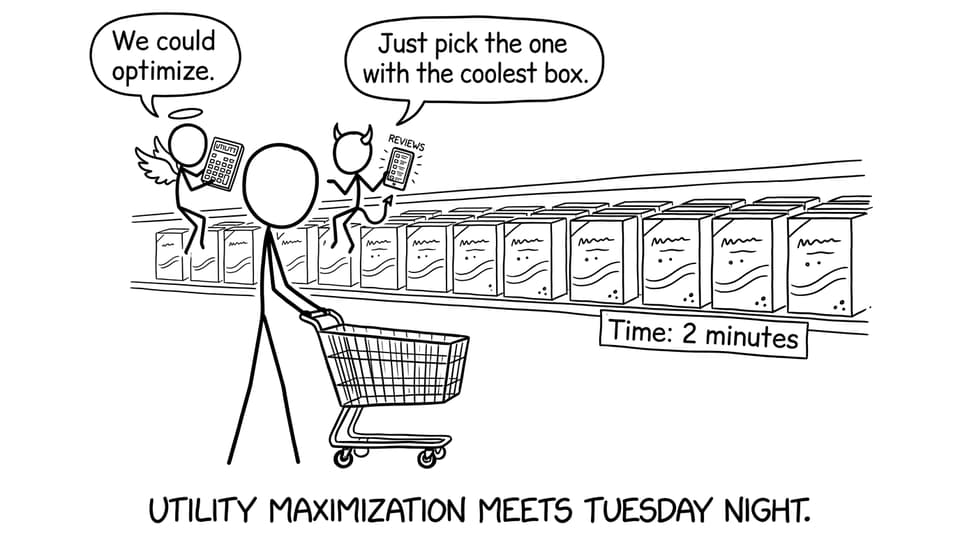
If you have ever spent 20 minutes comparing two nearly identical snacks, then bought a third one at the checkout because it “felt right,” you have already met the central tension in IB Economics: the clean logic of utility maximisation vs the messy reality of being human.
Traditional models assume consumers choose the bundle of goods and services that gives the greatest satisfaction (utility). But outside the textbook, decision-making is shaped by time pressure, imperfect information, psychology, and social context. For exam success in IB Economics, the trick is not just listing factors, but showing how each factor breaks an assumption of rational consumer choice.
Quick checklist: why utility maximisation fails
When you write about this in IB Economics, aim to hit several of these quickly:
-
Limited or asymmetric information
-
Bounded rationality and heuristics
-
Cognitive biases (anchoring, loss aversion, availability)
-
Emotions and impulse decisions
-
Habit and brand loyalty
-
Social pressure and status signalling
-
Real-world constraints (time, budget, access)
For syllabus-aligned definitions, keep IB Economics Key Definitions open while you revise.
Limited information: choosing in the dark
Utility maximisation assumes “perfect information,” but consumers rarely know all prices, qualities, substitutes, or long-run consequences. In real markets, advertising is loud, comparison is costly, and information is uneven.
In IB Economics, you can link this directly to the rational consumer choice assumptions in Rational Consumer Choice (2.4.1) Notes. If consumers can’t accurately rank options (completeness) because they don’t understand them, maximising utility becomes guesswork.
Bounded rationality: the brain has a budget too
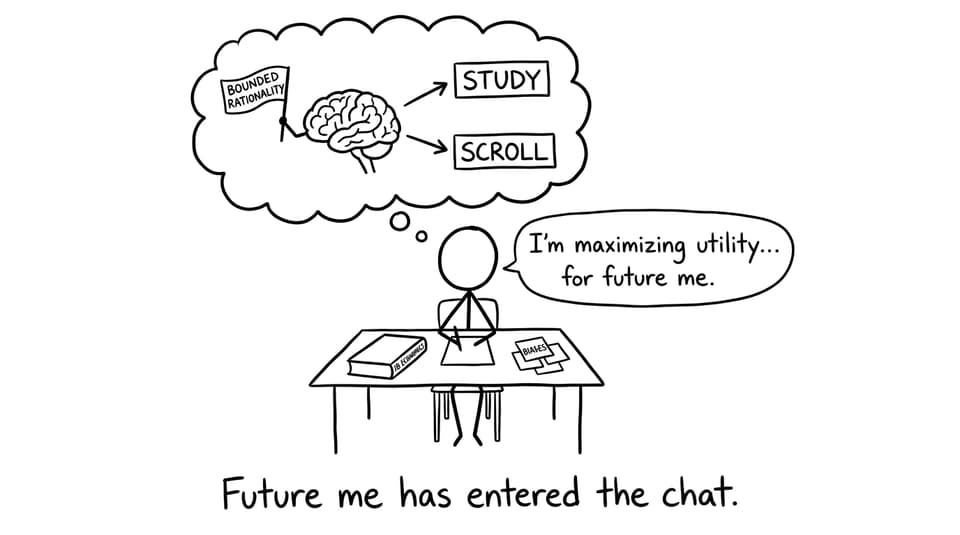
Even with information, humans have limited processing power. We “satisfice” (choose something good enough) because calculating the best choice takes time and mental energy.
That is where behavioural economics enters IB Economics: it explains why real people use shortcuts. For more exam-ready framing, see Behavioural Economics in Action (2.4.2) and the matching 2.4.2 Notes.
Cognitive biases: predictable mistakes
Biases are not random errors. They are systematic.
Anchoring bias: the first number you see sticks, so a “was $19.99, now $12” deal feels amazing even if $12 is still overpriced. Loss aversion: we fear losses more than we value equivalent gains, so we avoid switching products even when it might improve satisfaction.
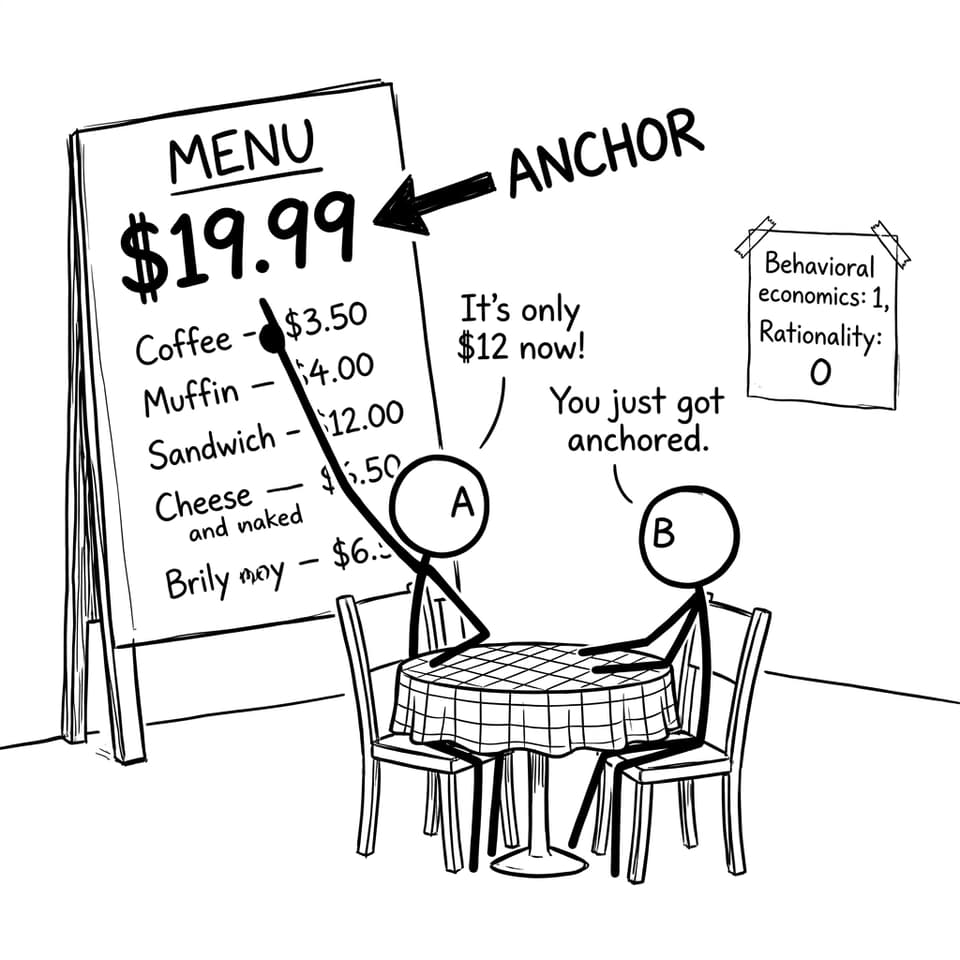
These examples are gold in IB Economics essays because they show exactly how choices drift away from utility maximisation.
Emotions, habits, and social pressure: utility isn’t just “stuff”
Consumers buy when stressed, tired, or excited. They also repeat what they bought last time because habits reduce decision fatigue. And they respond to social cues: trends, peer expectations, and status.
In IB Economics, this is where you can broaden “utility” beyond simple consumption: people derive satisfaction from belonging, identity, and signalling, even if it is financially inefficient.
Constraints: time, money, and access
Finally, even a perfectly rational consumer cannot maximise utility if real constraints bite. Time pressure can force quick decisions; budget constraints can block preferred bundles; limited access (location, stock, subscription lock-in) shrinks choice.
A good micro link for context is IB Economics Topic 2. Microeconomics, where consumer choice sits inside wider market outcomes.
Exam tip: how to turn this into marks
In IB Economics, don’t just list factors. Tie each one to a broken assumption (perfect information, stable preferences, consistent ranking) and add a short example. Then practise writing it under time pressure using the RevisionDojo Questionbank and topic practice like 2.4 Critique of Maximizing Behaviour Questionbank.
Conclusion: make the messiness your advantage
Real consumers do not maximise utility because real life is noisy: limited information, bounded rationality, cognitive biases, emotions, habits, social forces, and constraints all push choices away from the “perfectly rational” benchmark.
If you can explain that clearly, you are doing IB Economics the way examiners want: using theory, then showing its limits. Build that skill with RevisionDojo’s Study Notes, Flashcards, AI Chat, Grading tools, Mock Exams, Predicted Papers, and the Coursework Library, and lock it in with targeted practice in the Questionbank. For more topic pathways, browse IB Economics Resources and the IB Economics blog tag.

