
Metal doesn’t look alive. Yet the moment you connect a wire, something inside it responds instantly: quiet, coordinated, and fast. For IB Chemistry students, that “something” is not magic or mystery: it’s a crowd of electrons that are free to move.
In exams, this topic shows up in short definitions and long explanations alike. If you can explain why metallic bonds allow electrical conductivity with precision, you usually pick up easy marks across bonding, structure, and properties.
IB Chemistry overview: the exam checklist for metallic conductivity
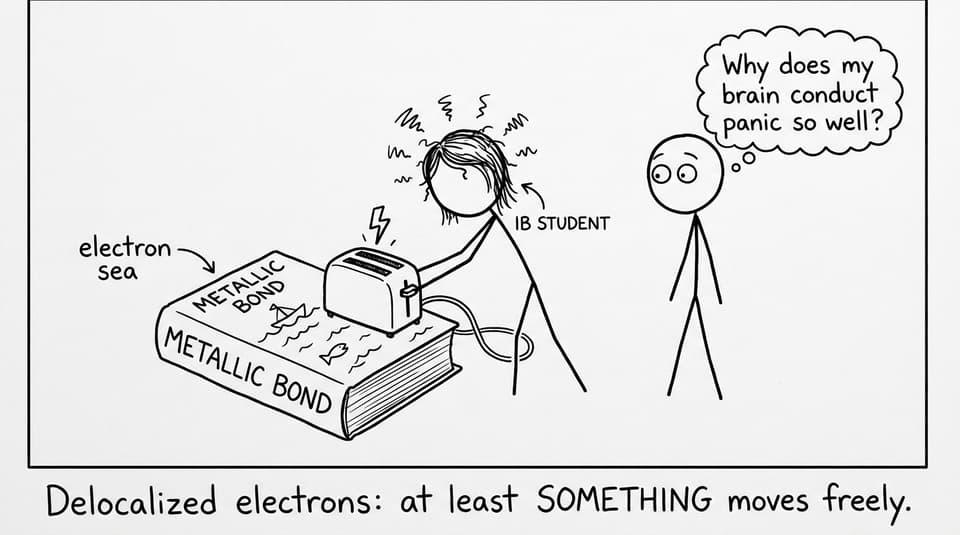
If you remember nothing else, remember this chain (it’s very IB Chemistry-friendly):
-
Metals form a giant lattice of positive metal ions.
-
Outer-shell electrons become delocalized (not tied to one atom).
-
These delocalized electrons can move through the structure.
-
When a potential difference is applied, electrons drift, carrying charge.
-
Current flows because charge carriers are mobile in the solid state.
For a fuller metallic bonding refresher, use Metallic Bonding Explained for IB Chemistry.
Why metallic bonding enables electrical conductivity in IB Chemistry
In IB Chemistry, metallic bonding is defined as the electrostatic attraction between:
-
a lattice of positive ions (cations), and
-
a sea of delocalized electrons.
That “sea” model isn’t just a metaphor. It’s the reason metals conduct electricity.
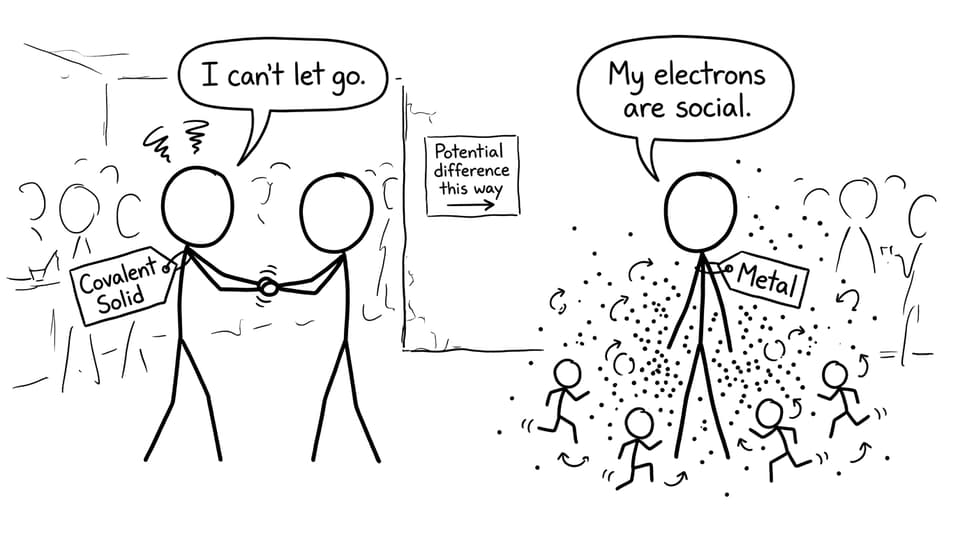
When a metal atom contributes its valence electrons into the shared electron cloud, those electrons are no longer localized in a specific bond (as in covalent substances) or locked into a rigid ion arrangement (as in ionic solids). They’re spread across the entire lattice. So, when an electric field is applied, electrons can respond immediately by moving through the structure, creating an electric current.
If you want syllabus-aligned practice on this exact explanation style, the S2.3 The metallic model hub is the cleanest place to start.
The detail that earns marks: delocalized and non-directional
Two words tend to separate a “good” answer from a top-mark one in IB Chemistry:
Delocalized electrons
Delocalized means electrons are not associated with any single nucleus or bond. They can move throughout the lattice, making them excellent charge carriers.
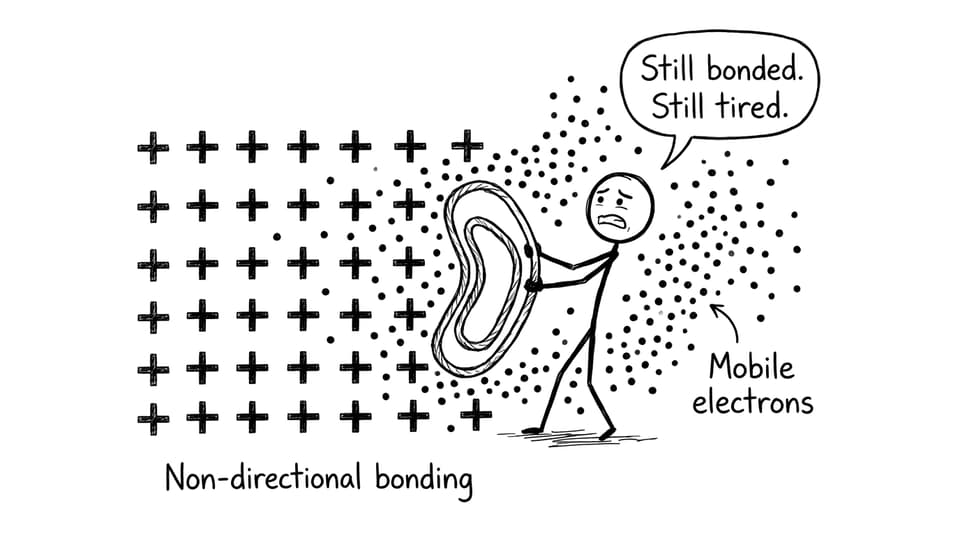
Non-directional bonding
Metallic bonding is non-directional: the attraction isn’t confined between specific pairs of atoms. That matters because the lattice can deform (metals are malleable) without “snapping” a network of fixed bonds. The ions can slide, and the electron sea keeps holding everything together.
RevisionDojo’s 4.5 Metallic bonding Notes lay out this wording in a very exam-ready way.
Quick comparison: why ionic and covalent solids don’t conduct (in the same way)
In IB Chemistry, conductivity questions are often comparative.
-
Ionic solids (solid state): ions are fixed in the crystal lattice, so charge can’t move. They conduct only when ions are free (molten/aqueous).
-
Simple molecular covalent: no mobile ions and no delocalized electrons.
-
Giant covalent: usually no mobile charge carriers (graphite is the famous exception).
If you want a broader “properties from structure” framework, browse Structure 2: Models of bonding and structure.
Conductivity varies by metal (and IB Chemistry loves why)
Not all metals conduct equally well. In IB Chemistry, you can justify differences using:
-
how many delocalized electrons each atom contributes, and
-
how strongly electrons are scattered by the lattice (linked to structure and packing).
That’s why silver and copper are famously strong conductors: their electrons are highly mobile and face relatively low resistance.
For extension understanding, see S2.3.2 Strength of metallic bonds Notes.
Final takeaway (and how RevisionDojo helps)
In IB Chemistry, metallic bonds allow electrical conductivity because metals contain delocalized electrons that can move through a lattice of positive ions. Apply a potential difference, and those electrons drift, so charge moves and current flows.
To lock this in for exam day, use RevisionDojo’s S2.3 The metallic model notes plus the S2.3 the Metallic Model Questionbank. Then tighten your phrasing with Study Notes and Flashcards, check your explanations with AI Chat, and build confidence with Mock Exams, Predicted Papers, and Grading tools. If you want extra support, the Tutors and Coursework Library are there when the topic stops being “a definition” and starts being “a weak spot.”