

Supply responsiveness is the quiet force that decides whether a market feels calm or chaotic. In IB Economics, you can picture it as the economy’s ability to “breathe” with change: when prices shift or demand surges, can producers adjust output smoothly, or do they lag behind and create drama? If you have ever seen a product sell out overnight, then reappear weeks later at a completely different price, you have seen what low responsiveness looks like.
In exam terms, this topic sits right on the bridge between supply theory, elasticity, and market equilibrium. And that’s exactly why it shows up so often.
Quick exam checklist: what “supply responsiveness” really means (IB Economics)
In IB Economics, supply responsiveness describes how quickly and effectively firms change quantity supplied after:
-
a change in price (linked to price elasticity of supply)
-
a shift in market conditions (costs, technology, expectations, number of firms)
-
a demand shock that pushes the market away from equilibrium
If you need a fast refresher on the basic diagrams behind this, start with Define Supply and Demand - IB Economics.
Why supply responsiveness prevents shortages
A shortage happens when quantity demanded exceeds quantity supplied at the current price. In IB Economics, that’s the classic “price below equilibrium” situation. But the deeper story is about time.
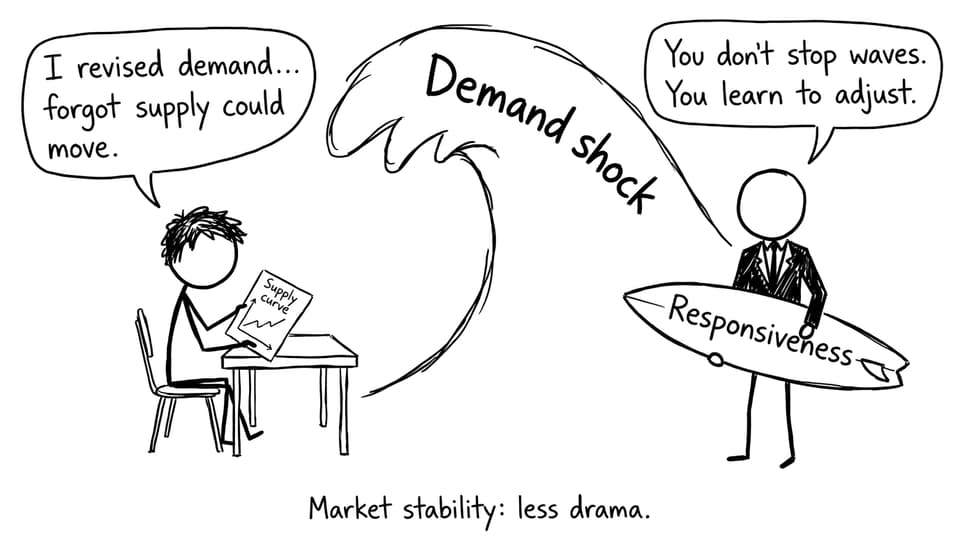
When demand rises suddenly (think concert tickets, seasonal foods, or urgent medical goods), the market needs supply to expand. If firms can scale output quickly, the shortage shrinks, prices settle faster, and consumers don’t get locked out. If firms can’t, the shortage lingers, queues form, and prices jump.
This is where price elasticity of supply becomes more than a definition. RevisionDojo’s Price Elasticity of Supply (PES) Notes help you connect the formula to real producer constraints like capacity, inventories, and time.
Why supply responsiveness prevents surpluses
Surpluses are the mirror image: quantity supplied exceeds quantity demanded. In the textbook diagram, this tends to happen when price is above equilibrium. In real markets, it often happens because firms cannot reduce output fast enough.
If demand falls and supply is unresponsive, producers keep making too much. Stock piles up, resources are wasted, and prices can drop sharply as firms try to clear inventories. A responsive supply side cuts production earlier, limiting waste and cushioning producer revenue.
To link this clearly to equilibrium logic, review Understanding Market Equilibrium in IB Economics.
Why supply responsiveness reduces price volatility (the stability core)
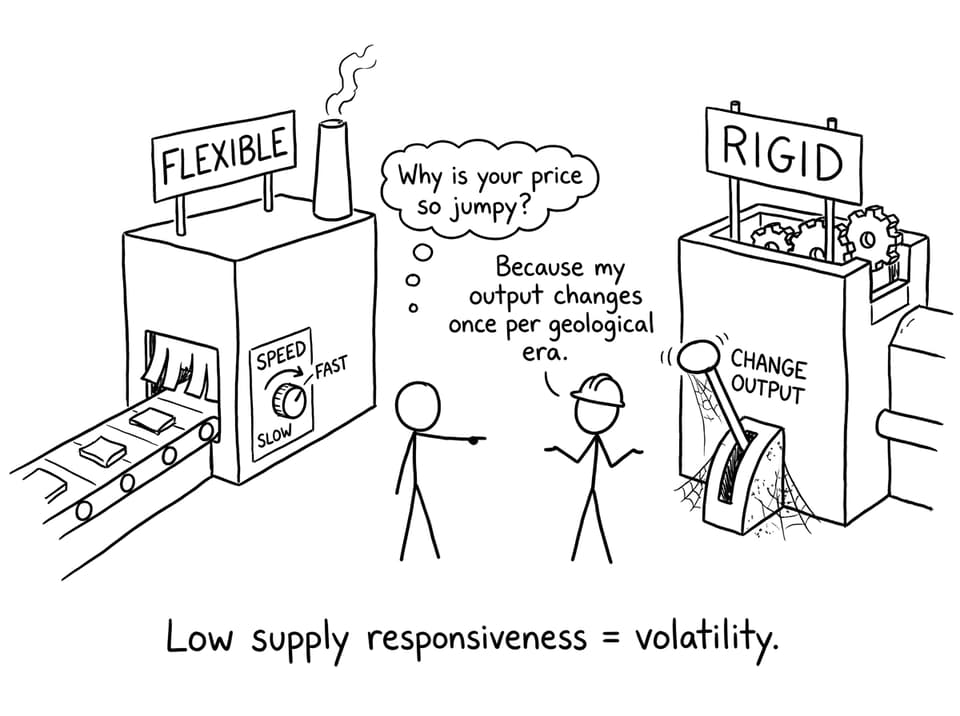
Market stability is mostly about predictability. In IB Economics, volatility spikes when a small shift in demand causes a large swing in price. That usually happens when supply is relatively inelastic in the short run.
Agriculture is a classic example: you cannot grow more wheat next week because the price rose today. Production cycles, weather, and perishability slow down adjustment. By contrast, many manufactured goods can be ramped up with overtime, extra shifts, or faster distribution, keeping prices steadier.
If you want the HL-friendly reasoning behind this contrast, see Why PES for Primary Commodities is Lower (Notes).
How to write it in an exam paragraph (IB Economics)
A strong IB Economics explanation usually links three steps:
-
Shock: demand changes or costs shift.
-
Responsiveness: supply adjusts quickly or slowly (elastic vs inelastic).
-
Outcome: effect on shortages/surpluses, then price stability and allocative efficiency.
To practice this in the exact style examiners reward, use the Competitive Market Equilibrium Questionbank and pair it with 2.3.1 Market Equilibrium Notes.
Conclusion: make your IB Economics answers more stable than the market
Supply responsiveness is crucial for market stability because it limits shortages, prevents surpluses, and reduces price volatility when shocks hit. In IB Economics, it’s one of those concepts that turns a diagram into a story: time matters, flexibility matters, and the speed of adjustment changes everything.
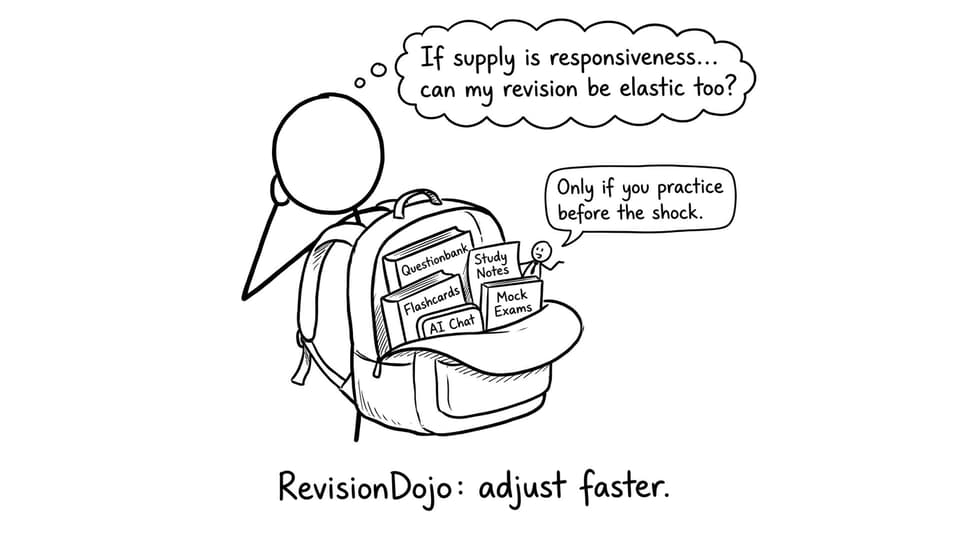
If you want to turn this into marks, build your revision like a responsive supply chain: quick feedback, targeted practice, and constant adjustment. RevisionDojo helps you do that with syllabus-aligned Study Notes, Flashcards, an exam-style Questionbank, AI Chat for explanations, Grading tools, Predicted Papers, Mock Exams, a Coursework Library, and Tutors when you want a human push. Start with the resources above, then practise until your explanations are as stable as the equilibrium you’re describing.

