

A small mystery you’ve felt a hundred times (IB Chemistry)
Touch a bottle pulled from your bag after PE. It’s damp, and it feels colder than it should. Or step out of a pool and shiver even on a warm day. In IB Chemistry, this isn’t a random “weather thing”--it’s a clean story about particles, energy, and averages.
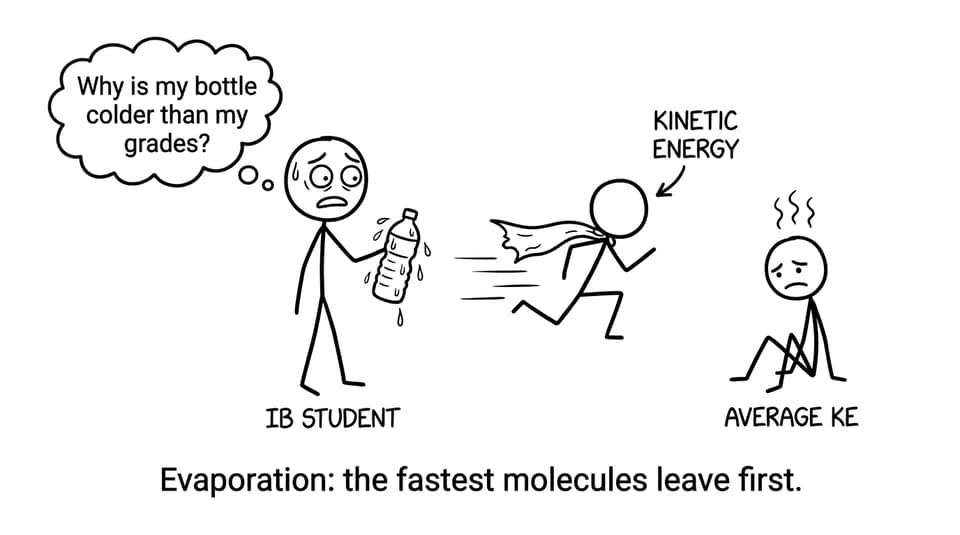
Evaporation causes cooling because the fastest particles leave first. When those high-energy molecules escape, the liquid that remains has a lower average kinetic energy, so its temperature drops. Simple idea. Huge number of exam marks.
Quick exam checklist (IB Chemistry wording)
If a question asks why evaporation cools, hit these points:
-
Particles in a liquid have a range of kinetic energies (not all move equally fast).
-
Only surface particles can evaporate.
-
The highest-energy particles escape by overcoming intermolecular attractions.
-
Average kinetic energy of the remaining liquid decreases.
-
Lower average kinetic energy means lower temperature.
-
Evaporation is endothermic: energy is absorbed from the surroundings (often the liquid itself or skin).
For particle-model foundations, revise S1.1.2 The Kinetic Molecular Theory.
The particle-level reason evaporation causes cooling
A liquid is like a busy hallway between classes: lots of motion, but not everyone walks at the same speed. Some molecules are “slow walkers.” Some are sprinting.
At the surface, a fast molecule can sometimes break free of the attractive forces holding it in the liquid. Those attractions are intermolecular forces, and they matter because stronger attractions make it harder for molecules to escape. If you want a focused refresher, use Intermolecular Forces Explained and the syllabus page for 4.4 Intermolecular forces.
Here’s the key: the molecules that leave are not an “average sample.” They are biased toward higher kinetic energy. When they go, they take that energy with them. What’s left behind has a lower average kinetic energy, so the temperature falls. That is exactly why evaporation causes cooling in IB Chemistry terms.
Why evaporation is endothermic (and why that matters)
Evaporation requires energy to separate particles and overcome attractions. That energy has to come from somewhere, so the system absorbs heat from its surroundings. That’s the definition of endothermic you’re expected to use under exam pressure.
If you need a sharp definition-and-consequences review, see Endothermic Reactions Explained. To connect it to phase changes directly, read Vaporization Explained Simply.
In many markschemes, you’ll also see language like enthalpy of vaporization (ΔHvap) or “latent heat.” The idea is the same: energy is required for liquid particles to become gas particles. If you want thermochemistry structure, anchor it with Enthalpy Change Explained for IB Chemistry.
What speeds up the cooling effect?
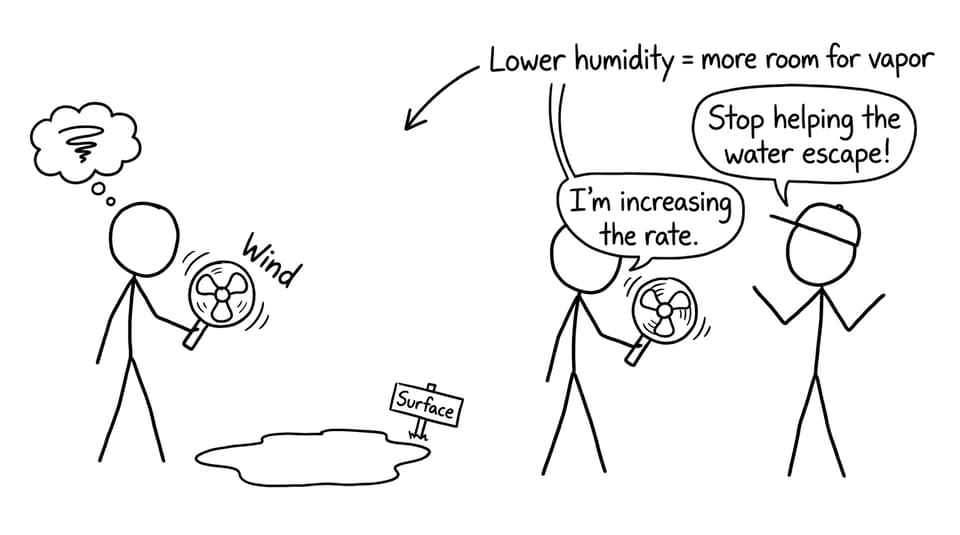
Evaporation causes cooling more strongly when evaporation happens faster. Two common variables:
-
Surface area: more surface means more molecules can escape per second.
-
Wind and low humidity: wind removes water vapor near the surface; low humidity means the air can accept more vapor.
That’s why a thin spill disappears quickly, and why you feel colder stepping out of water on a breezy day.
Bring it back to exam marks (and RevisionDojo)
When an examiner asks why evaporation causes cooling, they’re not asking for poetry. They want particle selection (high-energy molecules escape), averages (average kinetic energy decreases), and energetics (endothermic energy absorption). That’s the IB Chemistry version that scores.
To practise turning this into fast, accurate responses, use the IB Chemistry home page and target the exact skills with RevisionDojo’s Questionbank, Study Notes, Flashcards, AI Chat, Grading tools, Predicted Papers, Mock Exams, Coursework Library, and Tutors. Evaporation causes cooling once you understand it--and then RevisionDojo helps you say it in the exact way the markscheme rewards.