The number every headline loves (and every IB student meets)
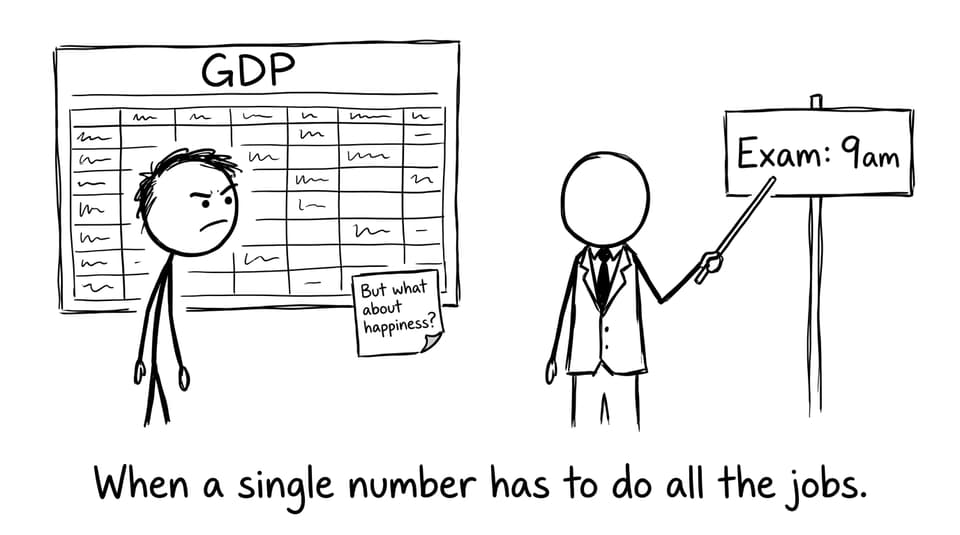
At some point in IB Economics, you notice the world’s obsession with a single statistic. News anchors treat it like a scoreboard. Politicians defend it like a report card. And exam questions quietly assume you can explain it under time pressure: GDP.
Economists use GDP to measure performance because it turns millions of messy, everyday transactions into one standardized signal. It’s not perfect. But it’s consistent, widely collected, and surprisingly useful when you’re trying to answer a simple question: is the economy producing more than it used to?
Quick checklist: what to say in an exam about GDP (IB Economics)
-
Define GDP clearly: total value of final goods and services produced within a country in a time period.
-
Mention real GDP for performance over time (inflation-adjusted).
-
Explain why it’s used: comparability, broad coverage, policy relevance.
-
Add evaluation: living standards, inequality, environment, informal economy.
-
Link to policy and macro objectives (growth, unemployment, inflation).
For syllabus-aligned definitions and examples, use the IB Economics 3.1 Measuring Economic Activities Notes.
Why GDP became the default performance measure
GDP works because it’s a common language. Two countries can argue about almost anything, but when they report GDP using shared methods, you can compare size and growth without needing a story for every industry.
In IB Economics, this matters because growth is typically tracked through changes in real GDP. That’s why exam questions often push you toward interpreting time-series GDP data and then linking it to macroeconomic objectives. If you need a clean refresher on growth and how GDP fits into it, see What Is Economic Growth? (IB Economics Macroeconomics Guide).
The three ways GDP is measured (and why that builds trust)
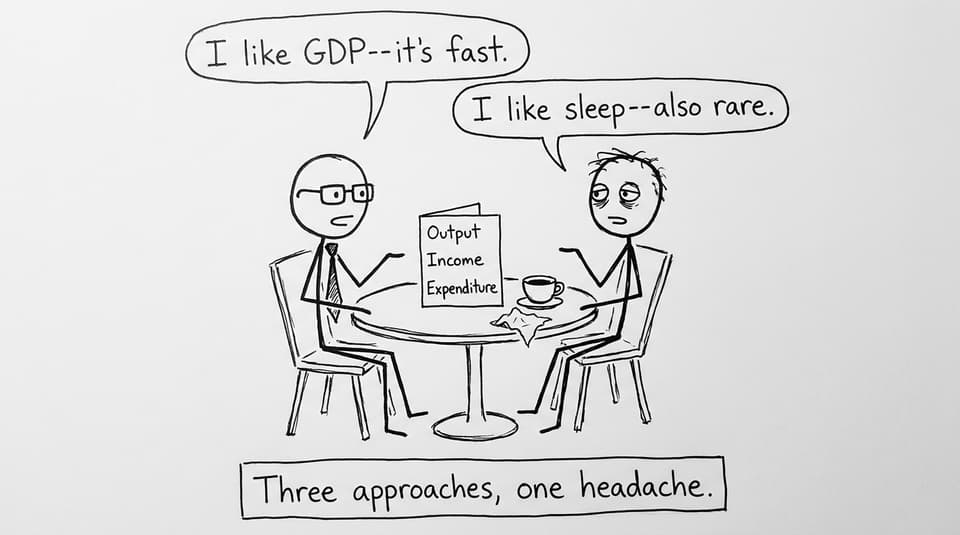
Economists like GDP partly because it can be measured three ways that should, in theory, align:
-
Output approach: value added across industries.
-
Income approach: wages, rent, interest, profits.
-
Expenditure approach: C + I + G + (X - M).
If these different lenses point to the same direction of change, GDP feels more reliable than a single survey or a narrow indicator. In IB Economics, dropping “three approaches” into a paragraph is also an easy credibility boost.
Why policymakers lean on GDP (and why you should mention this)
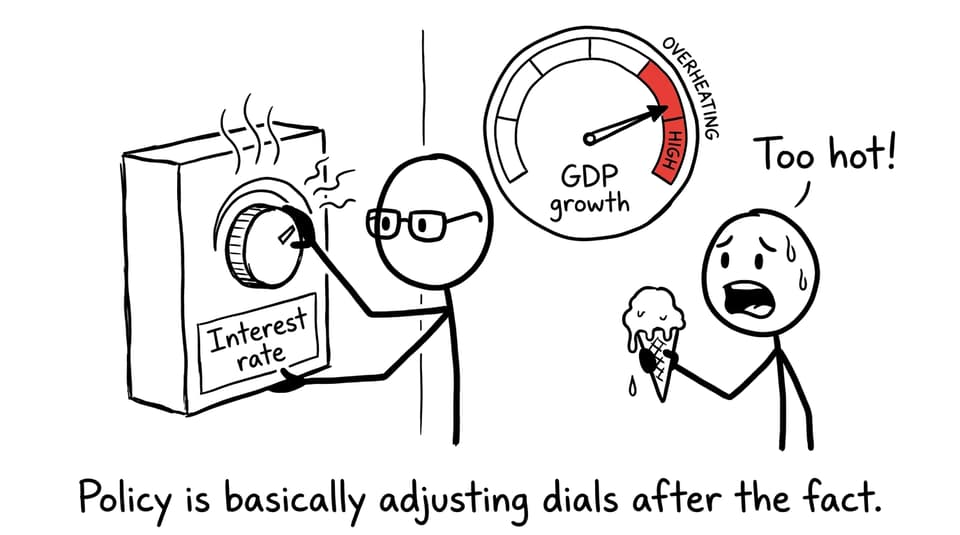
GDP is not just descriptive; it’s actionable. When real GDP growth slows or turns negative, governments consider fiscal responses. Central banks consider monetary responses. And businesses adjust investment plans.
That’s why, in IB Economics, GDP shows up whenever policy is discussed. If you’re revising demand management, pair GDP thinking with a focused policy review like Revision Tips: Fiscal Policy Guide for IB Economics.
The honest limitation: GDP isn’t “well-being”
GDP is widely used, but IB Economics expects you to evaluate it.
GDP can rise while:
-
income distribution worsens,
-
environmental costs increase,
-
unpaid household work stays invisible,
-
informal/underground activity is missed.
That doesn’t make GDP useless. It makes it a strong performance proxy, not a full welfare measure. This is where you can earn evaluation marks by mentioning alternatives or adjustments (like GDP per capita, HDI, or green measures) while still recognizing why GDP remains central.
For a targeted syllabus point on this evaluation skill, explore 3.1.8 Appropriateness of Using GDP or GNI Statistics Videos and the 3.1.5 Real GDP and Real GNI Notes.
How to revise GDP fast with RevisionDojo
The easiest trap in IB Economics is knowing the definition of GDP but freezing when a data response asks for interpretation and evaluation. RevisionDojo is built for that gap:
-
Use the Macroeconomics Questionbank to practise GDP-linked growth questions.
-
Drill definitions with Macroeconomics Flashcards.
-
Rebuild the full topic map with IB Economics 3. Macroeconomics.
-
When your evaluation feels vague, use RevisionDojo’s AI Chat to test your argument structure, and the grading tools to tighten exam-style phrasing.
Closing: use GDP like economists do (and like examiners expect)
Economists use GDP to measure performance because it’s standardized, scalable, and tied to decisions that shape real life. In IB Economics, your job is to explain that usefulness clearly, then evaluate the limitations with calm, precise judgment.
If you want to turn GDP from “a definition I memorised” into “a tool I can use under exam pressure,” practise with RevisionDojo’s Questionbank, lock in terms with Flashcards, refine explanations with AI Chat, and build confidence through Mock Exams, Predicted Papers, Study Notes, and Tutors. GDP may be one number, but your grade is built from how well you use it.

