


IB Chemistry: why counting the invisible matters
In IB Chemistry, you’re asked to be oddly confident about things you cannot possibly see: atoms, ions, molecules, electrons. No one has ever “counted” them in a beaker with their eyes. And yet, in exam questions, you’re expected to treat particle numbers like they’re as ordinary as coins in your pocket.
That’s the quiet genius of the mole. It gives chemists a way to count the uncountable by trading direct counting for something the lab (and your calculator) can actually handle: mass, volume, and concentration. Once you accept that trade, a lot of IB Chemistry calculations stop feeling like magic and start feeling like bookkeeping.
The mole in one clean checklist (exam-ready)
Use this as your 20-second reset whenever IB Chemistry turns quantitative:
-
1 mol = 6.022 × 10²³ particles (Avogadro’s constant, (N_A))
-
Particles can mean atoms, molecules, ions, electrons, or formula units
-
Convert mass to moles: (n = m/M)
-
Convert moles to particles: (N = n \times N_A)
-
Chemical equations compare mole ratios (particle ratios), not grams
If you want the syllabus point laid out step-by-step, start with IB Chemistry S1.4 Counting Particles by Mass: the Mole and the matching S1.4 Notes.
Why the mole works: it ties mass to particle number
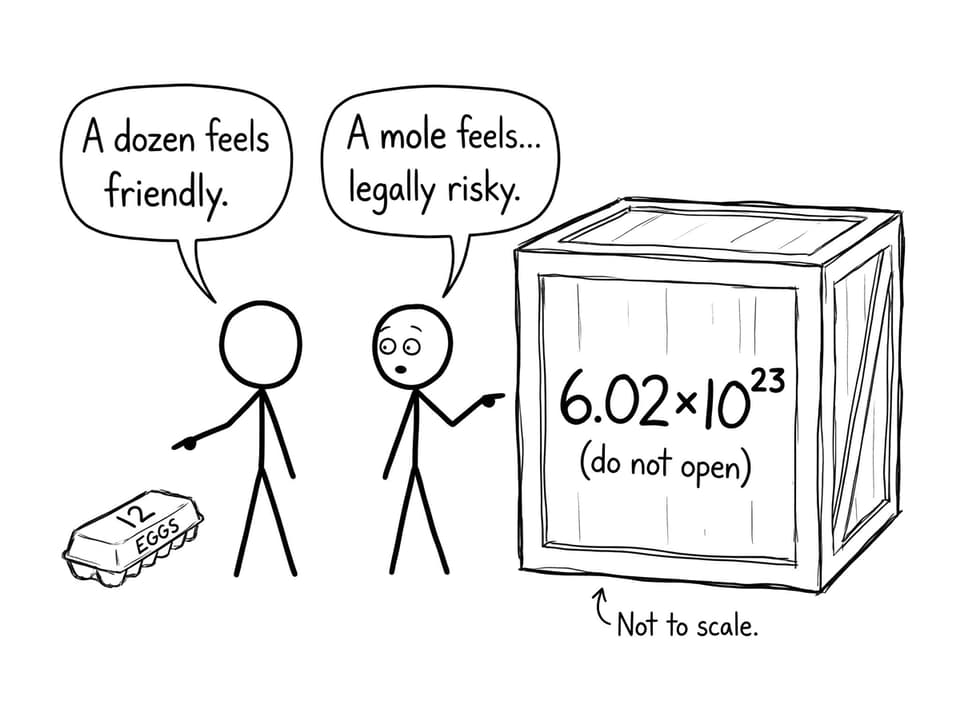
A dozen is helpful because it’s a fixed count. The mole is the same idea, scaled up to match the atomic world.
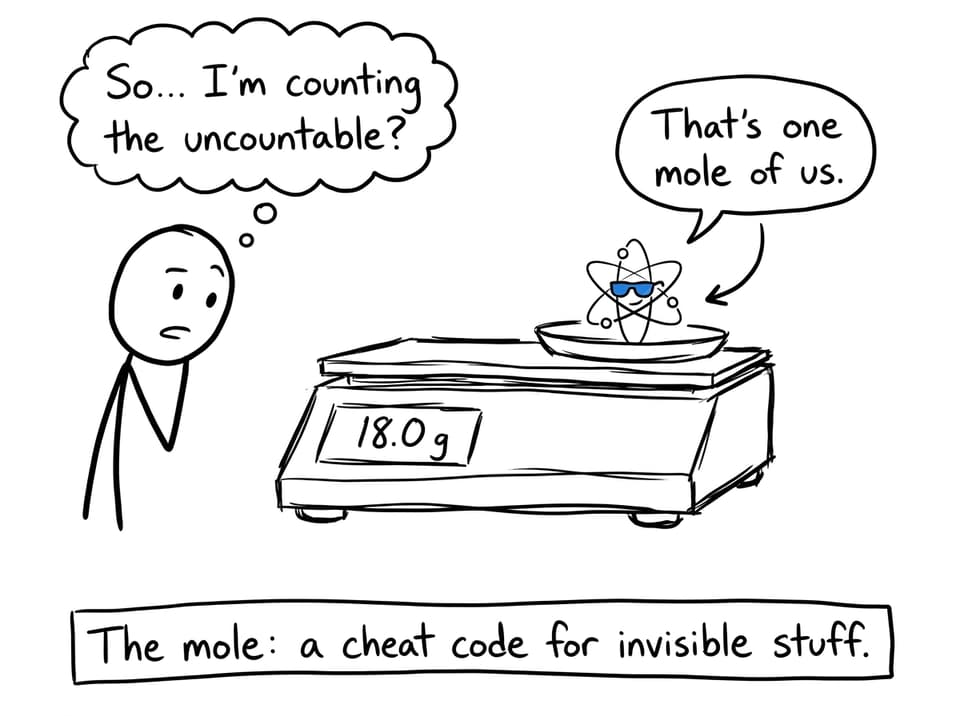
In IB Chemistry, what makes the mole practical is molar mass: the mass of 1 mole of a substance (in g mol⁻¹). You can’t count (6.022 \times 10^{23}) molecules of water, but you can measure 18 g of water and know that it corresponds to 1 mole of (H_2O) molecules.
That bridge between microscopic particles and macroscopic measurements is why the mole exists at all. It’s also why “unit discipline” matters so much in IB Chemistry marking.
For a focused walk-through on calculations, see How to Calculate Moles from Mass and Molar Mass (IB Chemistry).
Why the mole powers stoichiometry (and saves you in Paper questions)
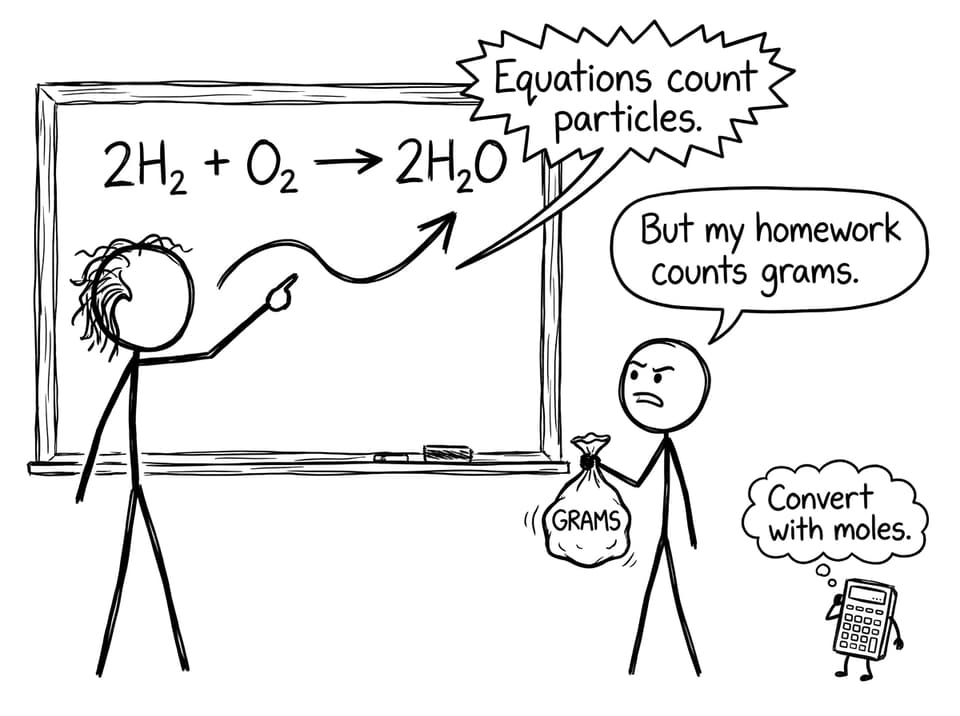
A chemical equation is written in particles: it tells you the ratio in which entities react. When you balance
(2H_2 + O_2 \rightarrow 2H_2O)
you are saying: “2 molecules of hydrogen react with 1 molecule of oxygen,” which scales up to “2 moles react with 1 mole.”
But your balance gives grams, not molecules. So IB Chemistry stoichiometry becomes a repeatable loop:
-
Convert given quantity to moles
-
Use the balanced equation to apply the mole ratio
-
Convert back to what the question asks (mass, volume, concentration, particles)
This is exactly why topics like limiting reagents feel hard until the mole feels normal. If you want that next step, read Limiting Reagent Explained for IB Chemistry and practise within R2.1.1 Chemical Equations and Stoichiometry.
Avogadro’s constant: the universal “particles per mole” label
In IB Chemistry, Avogadro’s constant is the guarantee that keeps everything consistent:
-
(N_A = 6.02214076 \times 10^{23}, mol^{-1}) (exact by definition)
-
It means: “how many particles are in 1 mole”
Because it’s universal, you can use the same relationships for carbon atoms, chloride ions, or electrons. That’s why the mole isn’t a topic you “finish”; it’s a language you keep speaking.
For a crisp explanation (and common traps), use Avogadro’s Constant Explained for IB Chemistry and the syllabus-aligned S1.4.1 The Mole and Avogadro Constant.
Bring it home: turn the mole into easy marks
In IB Chemistry, the mole is less a chapter and more a tool you carry into every calculation. If you can move smoothly between mass, moles, and particles, you’ve essentially learned how to translate between the world you can measure and the world that reactions actually happen in.
To lock it in, use RevisionDojo as your daily practice loop: drill mole questions in the Questionbank, review the definitions with Flashcards, clarify steps with Study Notes and AI Chat, and pressure-test yourself with Mock Exams, Predicted Papers, and Grading tools. When you’re ready to go beyond memorising formulas, RevisionDojo Tutors can help you build the calm, automatic method that wins marks under time.
For a structured starting point, browse the full IB Chemistry hub and keep IB Chemistry quantitative skills sharp all the way to exam day.


