
Why does equilibrium “prefer” the lower-energy side? (IB Chemistry)
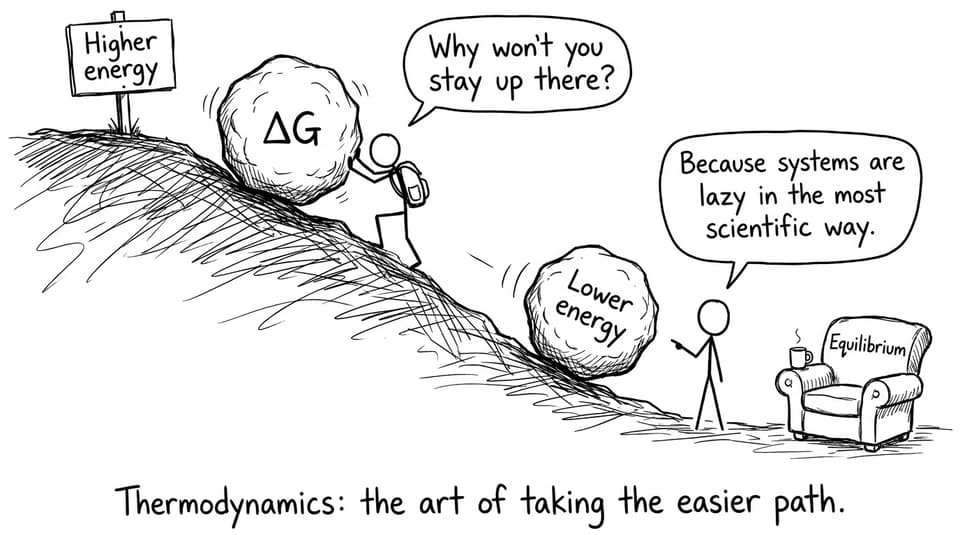
Picture a crowded cafeteria. Students don’t spread out evenly just because it’s fair. They drift toward the tables that feel easiest: closer to friends, nearer the exit, away from the loud group. Chemical systems in IB Chemistry behave with the same quiet logic. They don’t “choose” products or reactants out of preference. They settle where the system is most stable, where the Gibbs free energy is as low as it can be under the conditions.
That’s the meaning behind the phrase: the equilibrium position favors the side with lower energy. In exam terms, you’re being asked to connect equilibrium to ΔG, and then link ΔG to K.
Quick exam checklist (what to say in IB Chemistry)
-
Equilibrium happens when ΔG = 0 (not when reactions “stop”).
-
The favored side is the one with lower Gibbs free energy under the conditions.
-
Use ΔG = ΔH - TΔS to explain why one side is lower in energy.
-
Link to equilibrium constants: ΔG° = -RT ln K.
-
Remember: changing temperature can change what’s favored.
If you want a clean reference for wording and definitions, keep Gibbs Free Energy Explained Simply open while you revise.
Gibbs free energy: the “map” equilibrium follows in IB Chemistry
In IB Chemistry, “lower energy” at equilibrium almost always means lower Gibbs free energy (G), not just lower enthalpy.
The core idea is:
-
If ΔG < 0, the forward reaction is thermodynamically feasible, so the equilibrium position tends to be product-favored.
-
If ΔG > 0, the reverse direction is favored, so the equilibrium position tends to be reactant-favored.
-
At equilibrium, ΔG = 0, meaning the system has reached a minimum in free energy for that set of conditions.
RevisionDojo’s R2.3.7 Gibbs free energy and equilibrium (HL only) notes is the place to practice how the IB wants this stated: precise, short, and linked to K.
Why “lower energy” is really ΔH and ΔS working together
Students often try to answer this using only bond energy stories (ΔH). Sometimes that works. Often, it doesn’t.
Use the full relationship:
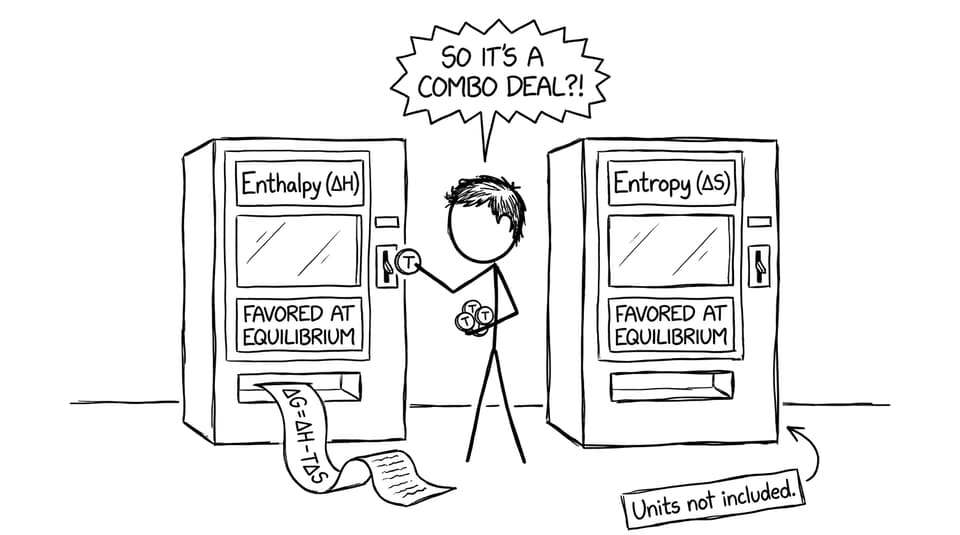
ΔG = ΔH - TΔS
-
ΔH (enthalpy) rewards forming stronger, more stable bonding arrangements (exothermic formation tends to lower G).
-
ΔS (entropy) rewards having more possible arrangements (more disorder, more microstates), especially important for gases and mixing.
-
T scales the entropy term, which is why temperature can flip which side is “lower energy.”
For a tight HL/SL refresher, pair the equilibrium topic hub 7.1 Equilibrium with R1.4.3 Spontaneity and Gibbs free energy (HL only) notes.
The bridge to K: how IB Chemistry connects “favored” to numbers
Once you say “lower Gibbs free energy,” the next IB move is to translate that into the equilibrium constant:
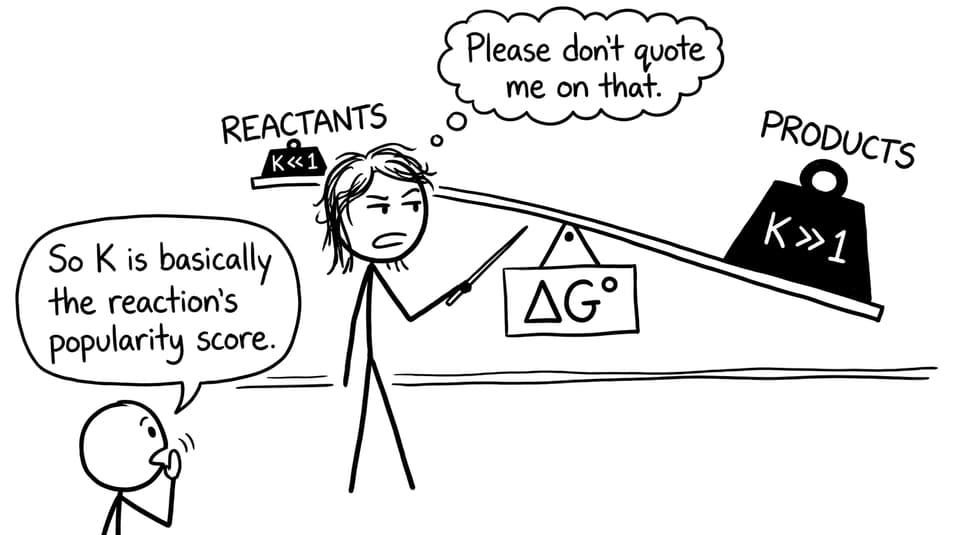
ΔG° = -RT ln K
So:
-
If ΔG° is negative, then ln K must be positive, so K > 1 (products favored).
-
If ΔG° is positive, then K < 1 (reactants favored).
-
If ΔG° = 0, then K = 1 (neither side strongly favored).
To practice this in the exact exam style, use R2.3.7 Gibbs free energy and equilibrium (HL only) Questionbank and the broader Equilibrium Questionbank. RevisionDojo’s Questionbank plus AI Chat and Grading tools is a strong combo here: you can answer, get markscheme-aligned feedback, then ask why your wording lost a mark.
Wrap-up: the calm logic behind “favoring lower energy”
In IB Chemistry, equilibrium favors the lower-energy side because systems settle at the minimum Gibbs free energy available under the conditions. At that point ΔG = 0, the reaction is still dynamic, and the equilibrium constant K tells you which side dominates.
If you want this to feel automatic by exam day, build a short loop: revise the concept with 7.1 Equilibrium, drill it with the Questionbank feature, and use RevisionDojo’s Study Notes, AI Chat, Grading tools, and Tutors to turn “I sort of get it” into full-mark explanations.