

A quick story you already know
You’ve felt it: a metal ruler that seems a hair longer after it’s been in the sun, a balloon that looks slightly more confident near a heater, a cold soda can that “sweats” as the room warms it. IB Chemistry takes those everyday moments and asks one precise question: what changes inside the substance when temperature changes?
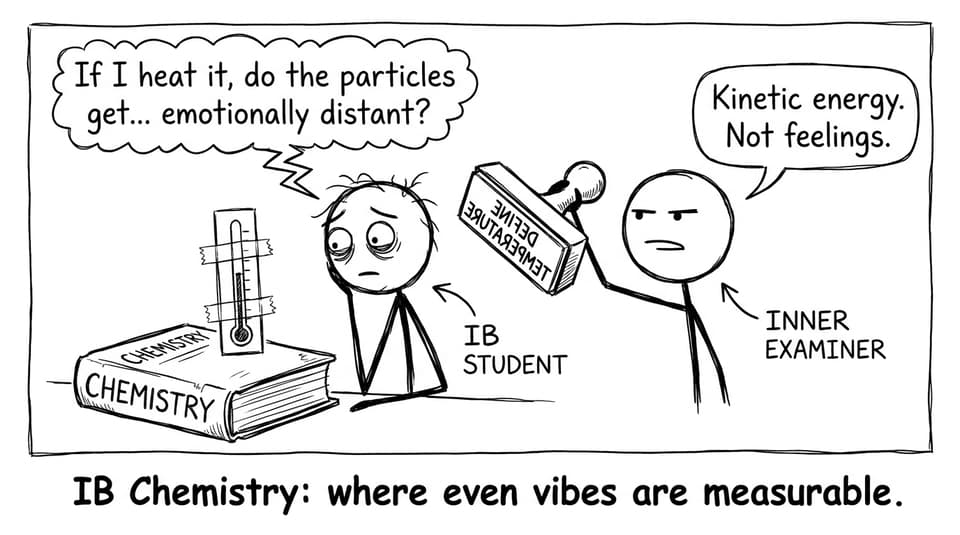
The surprisingly comforting answer is that nothing mystical happens. Temperature is not “heat stored inside matter.” In IB Chemistry, temperature is a measure of average kinetic energy. When kinetic energy rises, particles move more, collide harder, and, depending on the state, end up farther apart on average.
Exam checklist (what to say in IB Chemistry)
Use this as a fast plan when a marker asks about temperature, spacing, and motion in IB Chemistry:
-
Temperature ↑ → average kinetic energy ↑
-
Particles move faster (or vibrate with greater amplitude)
-
Collisions become more frequent/more forceful
-
Particles can overcome intermolecular forces more easily
-
Spacing tends to increase (expansion) and state changes become possible
For syllabus-aligned wording, revise S1.1.3 Temperature and Kinetic Energy and connect it to S1.1.2 The Kinetic Molecular Theory.
Why temperature changes spacing and motion (the core idea)
In IB Chemistry, particles are always moving. Temperature tells you the average kinetic energy of that motion.
-
When temperature increases, particles gain kinetic energy.
-
With more kinetic energy, they move faster and collide more violently.
-
Those collisions push particles slightly farther apart on average, especially when the forces between particles are weak.
That’s the “spacing” part. The “motion” part is even more direct: higher kinetic energy means faster motion.
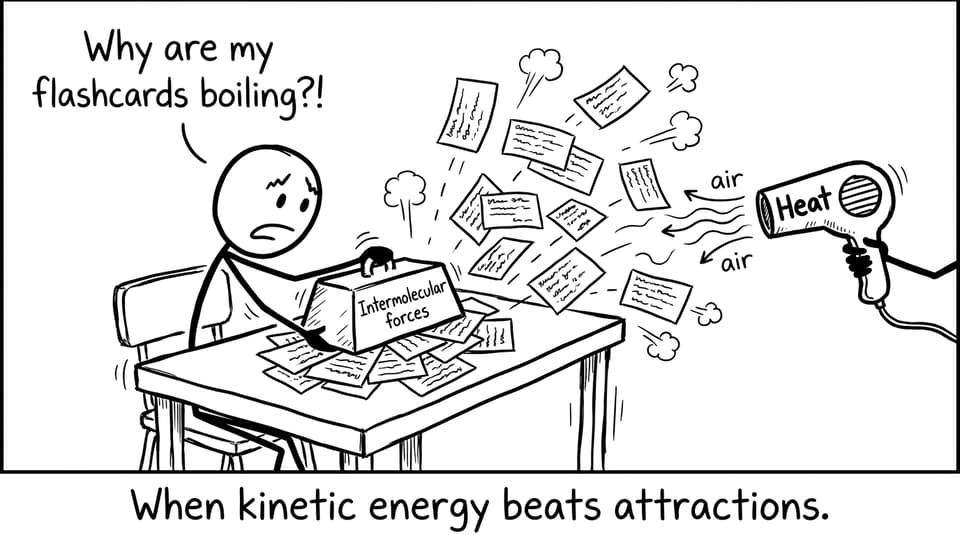
A useful way to frame it (and score marks) is as a competition:
-
Intermolecular forces pull particles together.
-
Kinetic energy (linked to temperature) helps particles resist and escape those attractions.
For a clean extension of this idea, see Why Intermolecular Forces Determine Physical States of Matter.
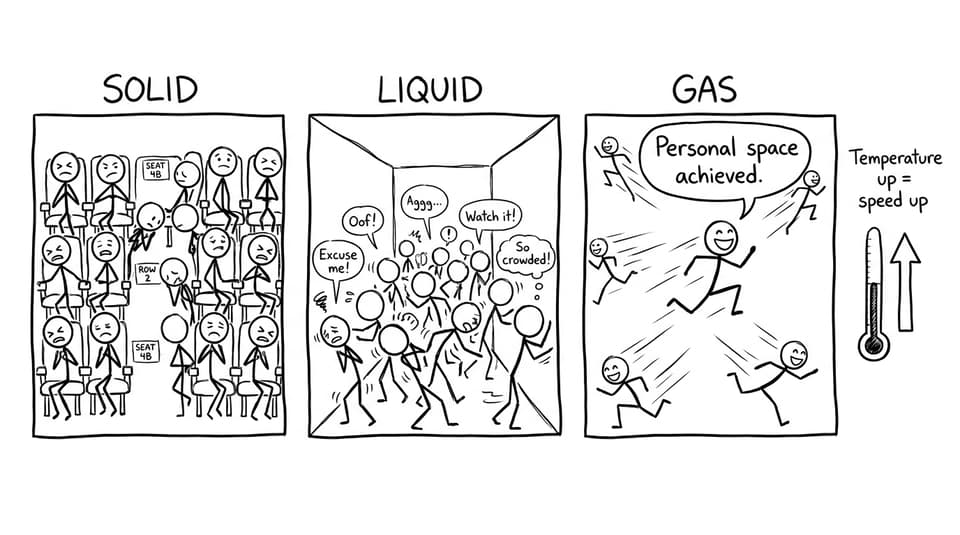
Solids, liquids, gases: what changes when temperature rises?
Solids: vibration gets bigger
In a solid, particles are locked into a structure. Heating doesn’t let them roam freely at first; it increases the amplitude of vibration about fixed positions. In IB Chemistry, that growing vibration explains thermal expansion in solids. If the vibrations become energetic enough to disrupt the structure, the solid can melt.
Liquids: sliding faster, escaping sooner
Liquid particles already move past each other. When temperature rises, they slide faster and collide more forcefully. Eventually, more particles have enough energy to overcome attractions at the surface, leading to evaporation, and at the boiling point, boiling.
A helpful related visual tool is a phase diagram: Phase Diagrams Explained Simply.
Gases: speed dominates, spacing explodes
Gas particles are far apart and attractions are minimal. Heating a gas makes particles move faster, so they hit container walls harder and more often. In IB Chemistry, this links directly to gas laws: at constant pressure, higher temperature leads to larger volume.
If you want the exam connection, read IB Chemistry: How Temperature Changes Gas Volume and then practise with the Structure 1 Questionbank.
How to turn understanding into marks (RevisionDojo workflow)
Concept clarity is step one. Step two is writing it like the markscheme expects.
On RevisionDojo, you can:
-
Drill this idea with the Questionbank and get feedback that pushes your phrasing toward examiner language.
-
Consolidate with Study Notes from the IB Chemistry Revision Notes hub.
-
Use Flashcards for active recall (for example, Structure 3 Flashcards).
-
Build pressure-tested routines with Mock Exams, Predicted Papers, AI Chat, and Grading tools when you need to simulate the real thing.
Closing: make it feel inevitable
Temperature influences spacing and motion because, in IB Chemistry, it’s basically a speedometer for particles. Turn it up, and motion intensifies until attractions can’t hold the same structure. Turn it down, and motion fades until attractions pull particles closer.
If you want this to become automatic under exam pressure, go straight to RevisionDojo IB Chemistry resources: use the Study Notes for clean models, the Flashcards for recall, and the Questionbank (plus AI Chat and Grading tools) to practise saying it the way examiners reward.