

If you have ever stared at an IB Chemistry question and thought, “Why are we obsessed with pH?”, you are not alone. pH feels like a shortcut number that appears out of nowhere. But it is actually one of the cleanest ideas in acids and bases: acidity is defined by how much hydrogen ion is present (in water, as hydronium). pH is just the language chemists invented so we can talk about that hydrogen ion concentration without drowning in negative powers of ten.
The big idea: acidity tracks hydrogen ions
In IB Chemistry, acids and bases are built on proton transfer. When an acid donates a proton to water, the solution ends up with more (\text{H}_3\text{O}^+) (often written as (\text{H}^+) for simplicity). More hydrogen ions (really hydronium) means a more acidic solution.
So when we “measure acidity,” we are really asking: what is the concentration of hydrogen ions in solution? That is why the pH concept targets ().
If you want the syllabus-aligned home for this whole topic, start with the IB Chemistry Acids and Bases hub and then drill it using the Acids and Bases Questionbank.
Why pH uses a log scale (and why examiners love it)
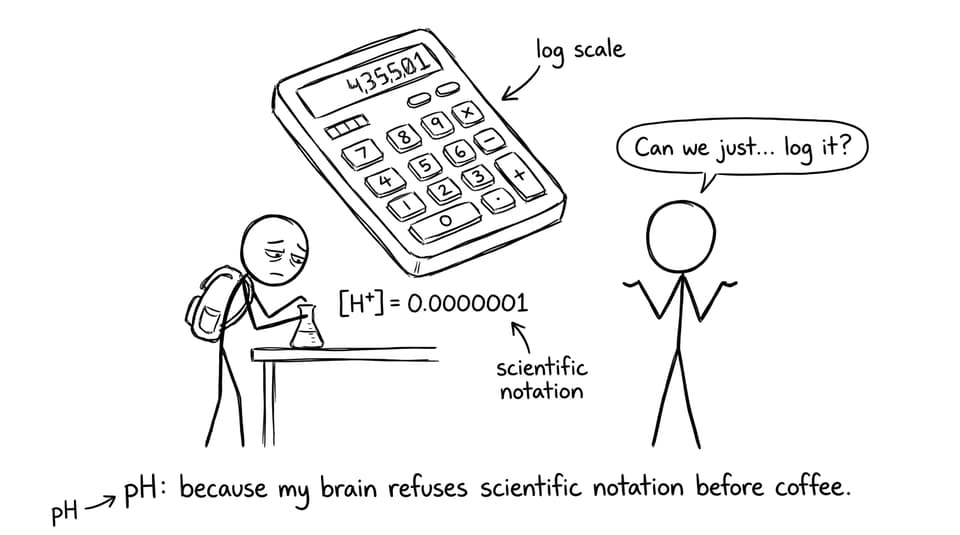
Here is the problem: () values are often tiny.
-
Lemon juice might be around (10^{-2}) mol dm(^{-3})
-
A mildly acidic solution might be around (10^{-5}) mol dm(^{-3})
Writing and comparing those all day is annoying and error-prone. So pH compresses the scale using logarithms:
\\text{pH} = -\\log\[\\text{H}^+$$ \] That minus sign is doing a simple job: it turns “small concentration” into a “normal-sized” positive number. A key **IB Chemistry** exam insight: **a change of 1 pH unit means a factor of 10 change in ($$\\text{H}^+$$)**. So pH 3 is not “a bit” more acidic than pH 4. It is ten times more concentrated in hydrogen ions. 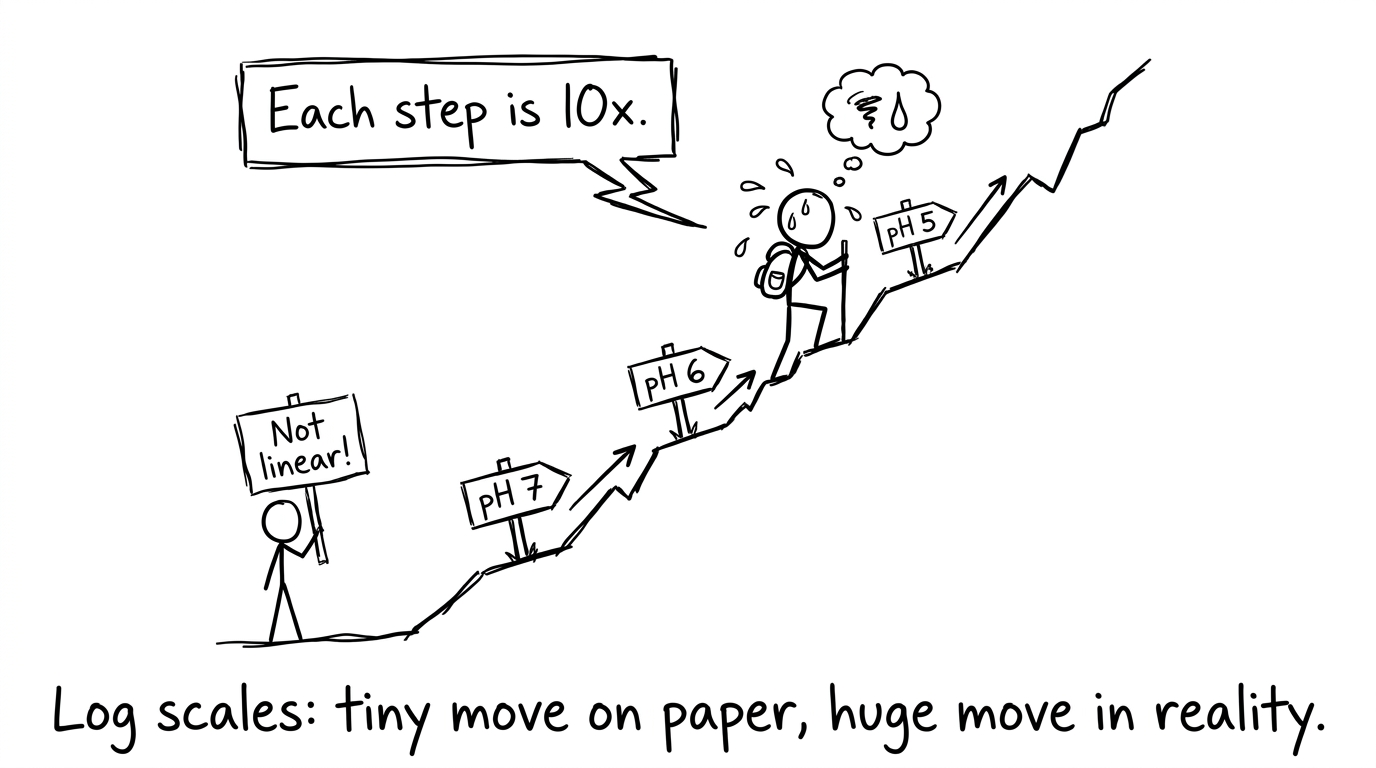 ## The water link: pH also reflects equilibrium pH is not just a random definition. It connects to the equilibrium behavior of water itself. Water autoionizes slightly:2H_2O \rightleftharpoons H_3O^+ + OH^-
This equilibrium is summarized by (K\_w). In many **IB Chemistry** contexts (at 25(^\\circ)C), you will use the relationship:\text{pH} + \text{pOH} = 14
So pH is powerful because it ties together: - hydrogen ions (acidity) - hydroxide ions (basicity) - equilibrium thinking (which appears everywhere in IB) If equilibrium ideas still feel slippery, the [Dynamic Equilibrium Explained for IB Chemistry](https://www.revisiondojo.com/blog/dynamic-equilibrium-explained-for-ib-chemistry) article is a fast reset. 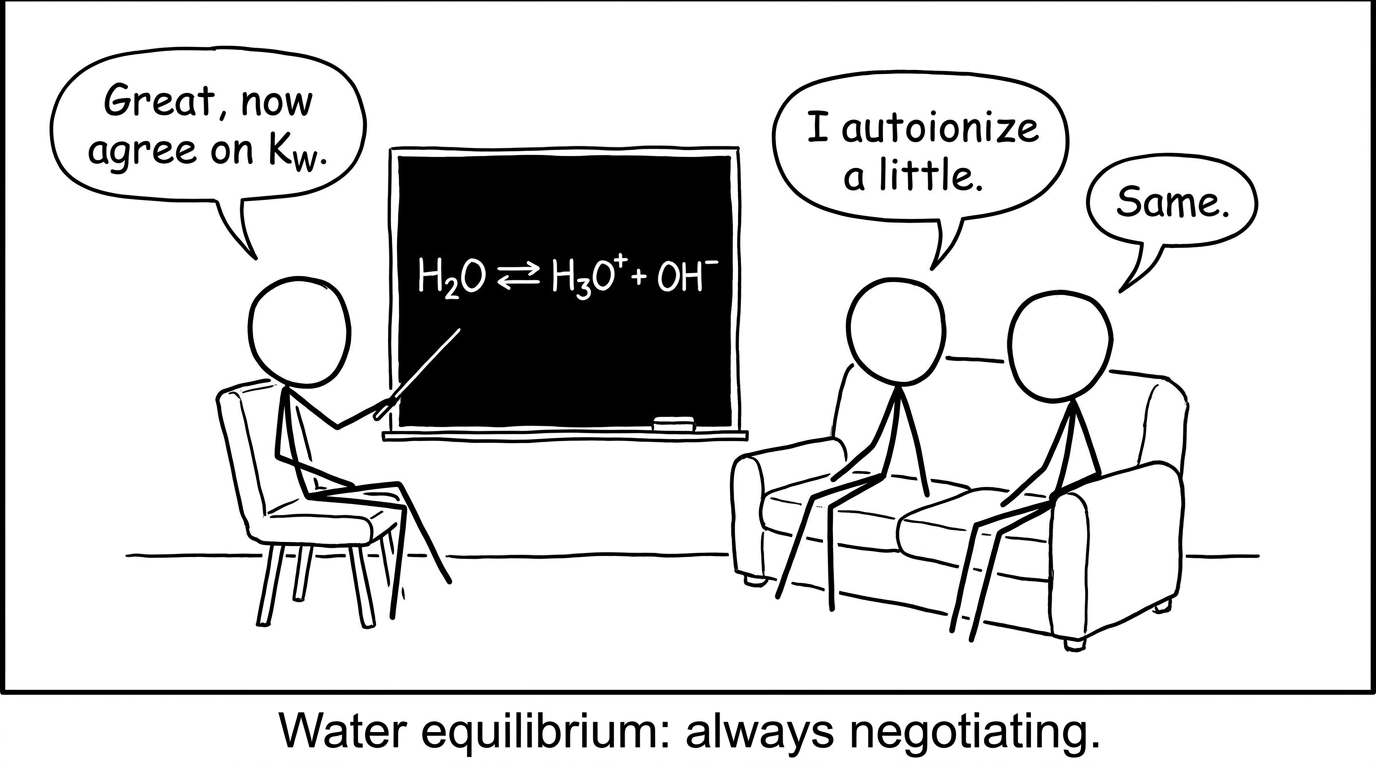 ## Quick exam checklist (what to remember under pressure) - **pH measures ($$\\text{H}^+$$)** because hydrogen ions define acidity in water-based systems. - **It is logarithmic**, so each pH step is a (\\times 10) change in hydrogen ion concentration. - **(K\_w)** links ($$\\text{H}^+$$) and ($$\\text{OH}^-$$), giving **pH + pOH = 14** (at 25(^\\circ)C). - In calculations, (\\text{H}^+) is usually shorthand for **(\\text{H}\_3\\text{O}^+)**. For targeted pH practice, the [8.3 The pH scale Questionbank](https://www.revisiondojo.com/ib/ib-chemistry-new/8-3-the-ph-scale/questionbank) is ideal. ## Bring it home with RevisionDojo The reason pH measures hydrogen ion concentration is simple: **hydrogen ions are what acids create in water**, and pH is the log-based way to report that concentration clearly. In **IB Chemistry**, that single idea connects definitions, calculations, and equilibrium in one line. When you are ready to turn understanding into marks, RevisionDojo helps you practice pH the way exams demand it: build sets in the **Questionbank**, review patterns with **Study Notes**, lock in definitions using **Flashcards**, and check your reasoning with **AI Chat** and **Grading tools**. If you want a structured run-up to test day, combine **Mock Exams** with **Predicted Papers**, and use the **Tutors** feature when you need one calm explanation that finally makes it click. Useful next steps: [Ka and Kb Explained for IB Chemistry](https://www.revisiondojo.com/blog/ka-and-kb-explained-for-ib-chemistry) and [Buffers Explained for IB Chemistry](https://www.revisiondojo.com/blog/buffers-explained-for-ib-chemistry).