


The tiny distance that changes everything (IB Chemistry)
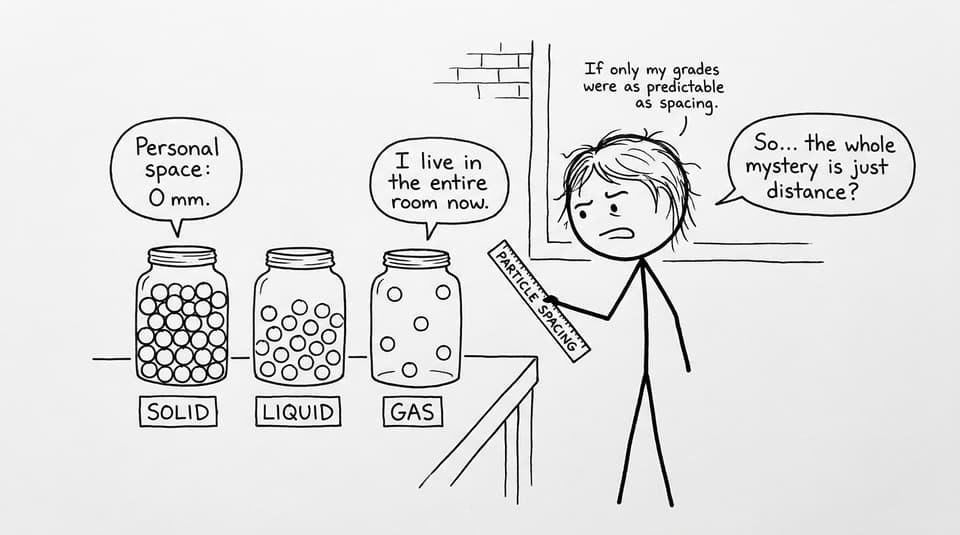
You can tell what state something is in with your eyes: ice holds its shape, water pours, steam vanishes. But in IB Chemistry, the real explanation is quieter and smaller: particle spacing. The distance between particles decides how often they “feel” each other’s pull and how much freedom they have to move. Once you see that, solids, liquids, and gases stop feeling like three separate topics and start feeling like one story told at three different distances.
To revise the broader context quickly, it helps to anchor this idea in the particulate model from S1.1.2 The Kinetic Molecular Theory notes and then practise applying the language with Structure 1 questionbank.
Quick checklist: what examiners want you to say
When a question asks you to explain properties using particles, keep this IB Chemistry checklist in your head:
-
Spacing: close together or far apart?
-
Motion: vibrate, slide, or move freely?
-
Attractions: strong enough to hold structure or too weak to matter?
-
Compressibility: is there “empty space” to squeeze out?
-
Shape and volume: fixed or variable?
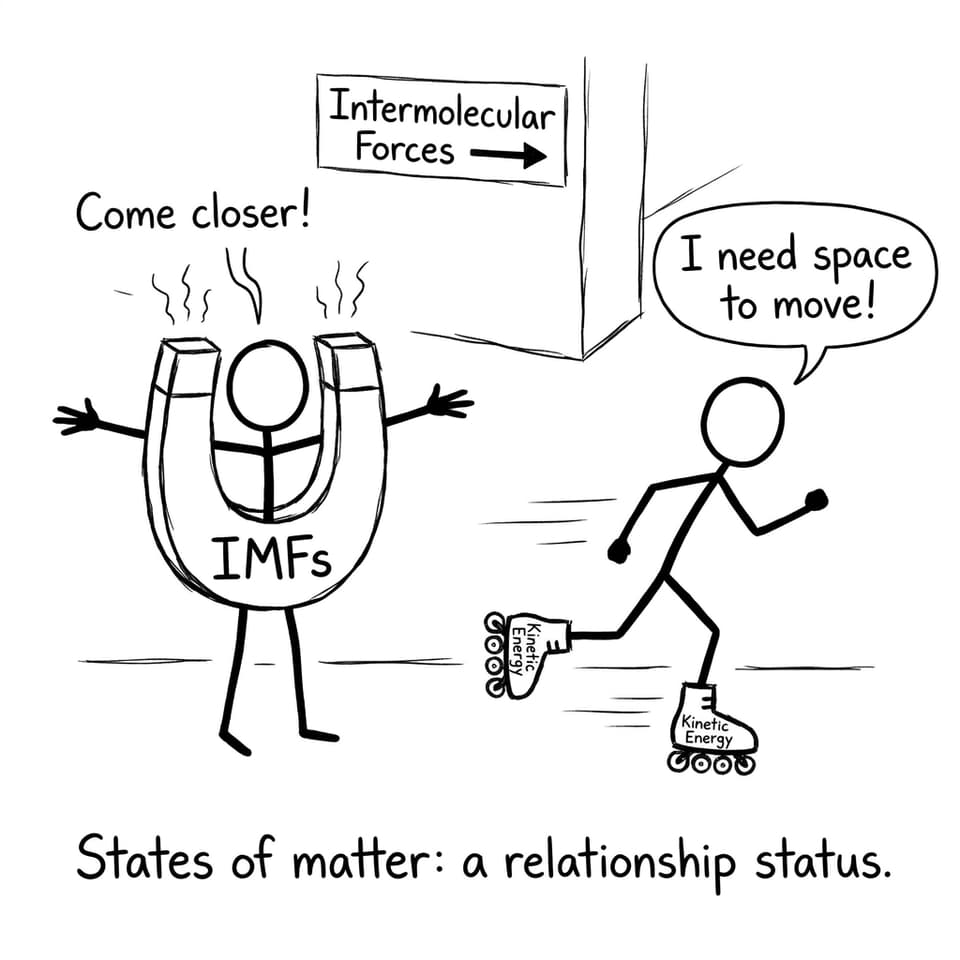
For the attractions piece, revise the vocabulary in Intermolecular Forces Explained and the syllabus-aligned hub 4.4 Intermolecular forces.
Solids: minimal particle spacing, maximum structure
In solids, particle spacing is very small. Particles are packed closely in a fixed arrangement (lattice for many solids). Because the particles are so close, attractive forces have a constant grip. That’s why solids:
-
keep a definite shape
-
keep a definite volume
-
are hard to compress (there isn’t much empty space to reduce)
The key wording for IB Chemistry is that particles vibrate about fixed positions rather than moving past each other. If you can say “close spacing + strong attractions + vibration only,” you’re usually on the mark.
Liquids: slightly increased particle spacing, controlled freedom
Liquids still have small particle spacing, but it’s a bit larger than in solids. That tiny increase matters. Particles remain close enough to feel significant attractions, yet they have enough kinetic energy to move around and slide past one another.
So liquids:
-
have a definite volume (particles are still close)
-
have no fixed shape (particles can rearrange)
-
are nearly incompressible (still not much empty space)
This is where students often lose marks: they describe a liquid as “particles far apart.” In IB Chemistry, “far apart” is reserved for gases. Liquids are close, just not locked.
Gases: huge particle spacing, almost no control
In gases, particle spacing is very large compared with solids and liquids. Particles are separated by lots of empty space, so attractions become negligible most of the time. Motion dominates.
That’s why gases:
-
have no definite shape and no definite volume (they expand to fill the container)
-
are compressible (you can reduce the empty space)
-
have low density (spacing is large)
A clean IB Chemistry phrasing: “Particles are far apart, moving rapidly and randomly; intermolecular attractions are negligible except during collisions.”
Temperature and changes of state: spacing is the result of energy
When temperature increases, average kinetic energy increases, and particles can push further apart. If they gain enough energy to overcome attractions, spacing increases dramatically (melting, then boiling).
If you want to connect spacing to a higher-scoring explanation, use phase boundaries as evidence. Revision is smoother when you pair this topic with Phase Diagrams Explained Simply and extensions like IB Chemistry: Critical Point Explained Simply.
Bring it home: turn spacing into marks with RevisionDojo
Particle spacing explains the differences between solids, liquids, and gases because spacing controls motion, attractions, compressibility, and therefore shape and volume. In IB Chemistry, that one idea shows up everywhere: kinetic molecular theory, intermolecular forces, phase diagrams, and even the language of equilibrium between phases.
If you want this to feel effortless in the exam hall, use RevisionDojo’s Study Notes to lock the concepts, Flashcards to keep the wording sharp, AI Chat to fix misunderstandings fast, and the Grading tools plus Questionbank to practise markscheme-style explanations until they sound like yours.