

A quick story you already know (even if you don’t)
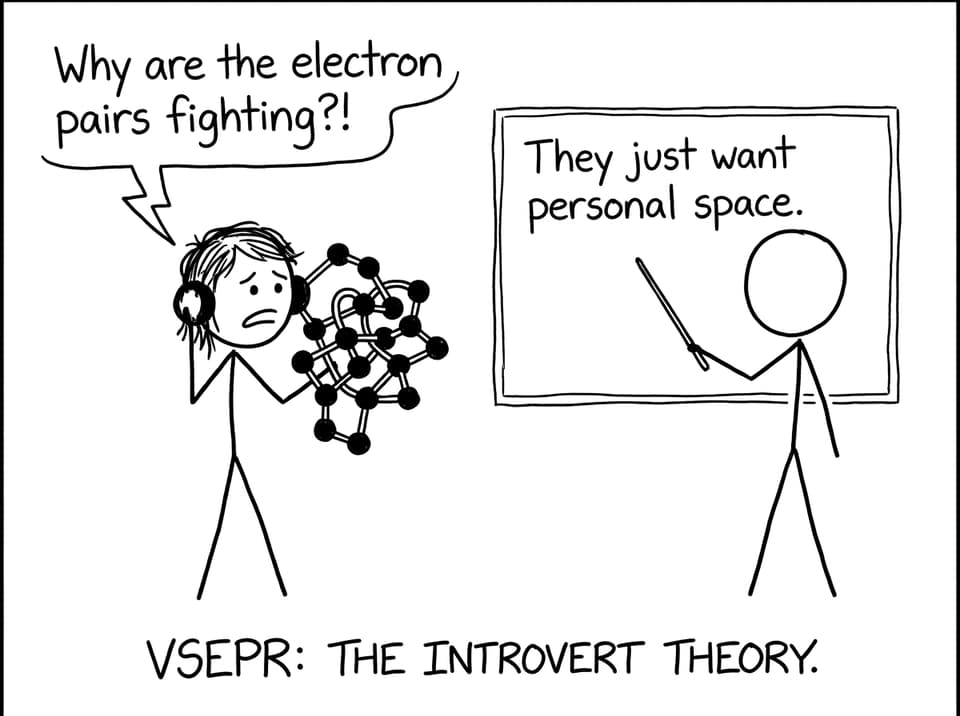
You’ve seen it happen in real life: four people walk into an empty room and, without speaking, drift to the corners. Not because they dislike each other, but because comfort increases when personal space does.
That’s the quiet logic behind molecular geometry in IB Chemistry. Electrons are negatively charged, so regions of electron density repel. A molecule’s 3D shape is the compromise that gives those electron regions the most space, which also means the lowest energy.
The exam checklist (VSEPR in 20 seconds)
For most IB Chemistry questions on shape, run this checklist:
-
Draw a Lewis structure (correct valence electrons first).
-
Count electron domains around the central atom (single, double, triple bonds each count as 1 domain; each lone pair counts as 1).
-
Identify the electron-domain geometry (2 linear, 3 trigonal planar, 4 tetrahedral, 5 trigonal bipyramidal, 6 octahedral).
-
Convert to molecular geometry by ignoring lone pairs in the final “shape name.”
-
State the key repulsion idea: lone pairs repel more strongly than bonding pairs.
If you want the syllabus-aligned version, use S2.2.4 VSEPR Theory and the matching VSEPR Theory Notes.
Why electron pair repulsion controls molecular shape
In IB Chemistry, VSEPR is really a “charge cloud spacing” model. Electron pairs aren’t tiny dots; they’re regions of probability. When those regions get too close, repulsion increases, energy rises, and the arrangement becomes less stable.
So the molecule spreads electron domains out as far as possible. That’s why:
-
2 domains point opposite each other (linear, 180°)
-
3 domains sit in a plane (trigonal planar, 120°)
-
4 domains make a tetrahedron (109.5°)
This is why molecular shape depends on electron pair repulsion: geometry is the visible footprint of invisible electron density.
Why lone pairs “push harder” (and bend bond angles)
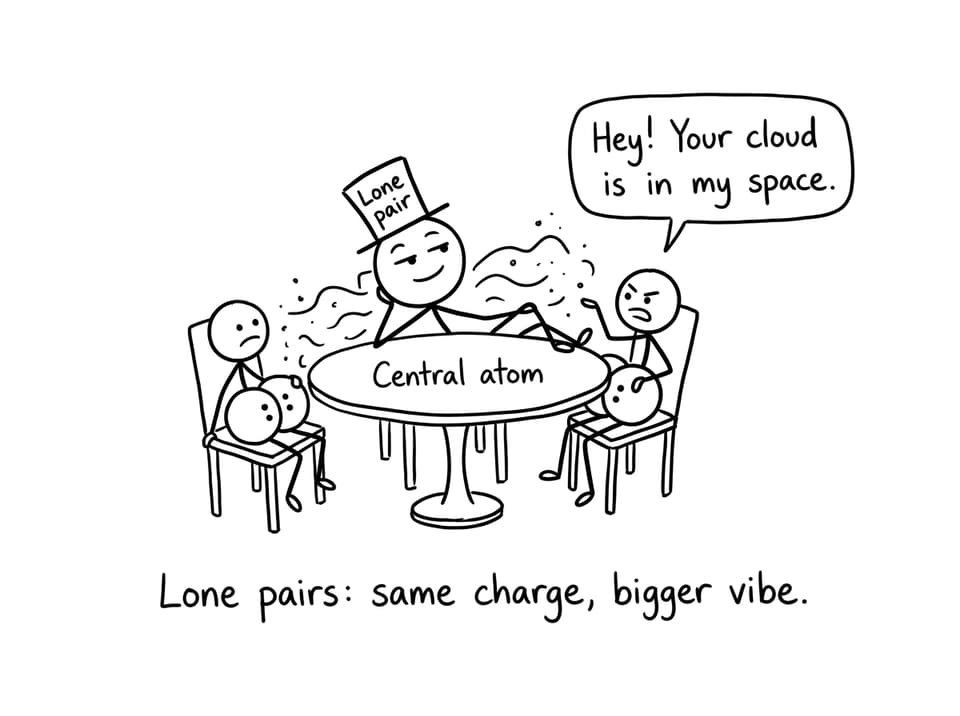
Not all repulsions are equal. Lone pairs usually repel more than bonding pairs because a bonding pair is shared between two nuclei and gets “pulled outward,” while a lone pair is held closer to the central atom and takes up more space.
A useful ranking for IB Chemistry explanations is:
lone pair--lone pair > lone pair--bond pair > bond pair--bond pair
That’s how you justify angle compression:
-
CH₄: tetrahedral, about 109.5°
-
NH₃: trigonal pyramidal (one lone pair), angle slightly less
-
H₂O: bent (two lone pairs), about 104.5°
For a focused example you can quote in Paper 2 explanations, see Why H₂O Is Bent: Molecular Shape Explained.
Same domains, different shapes: the methane vs ammonia lesson
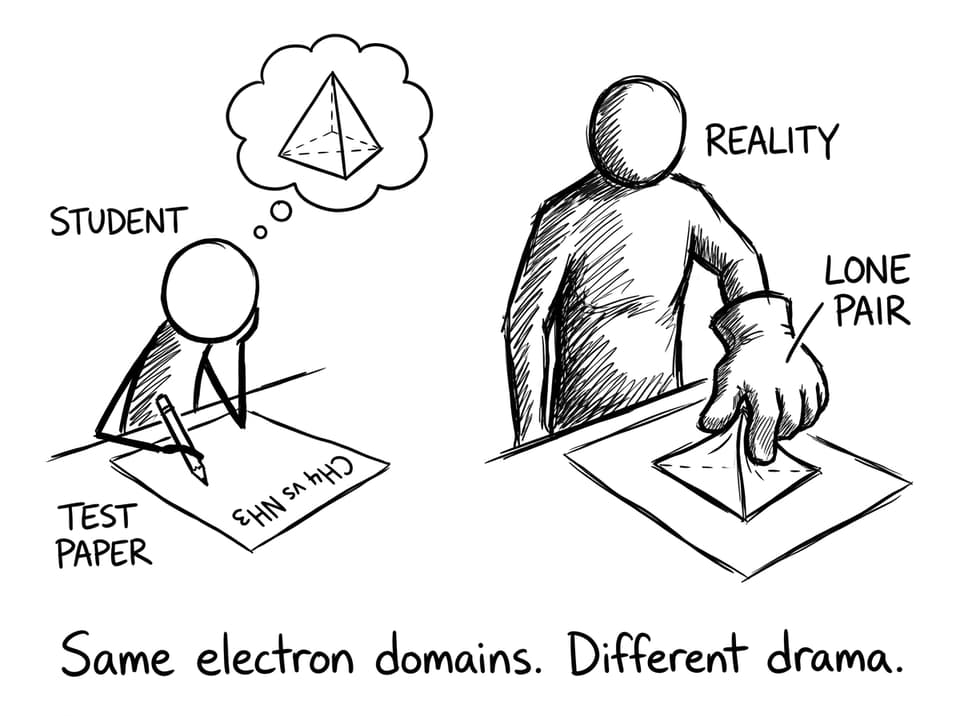
A classic IB Chemistry trap is assuming “four domains means tetrahedral shape.” Four domains means tetrahedral electron-domain geometry. The molecular shape depends on whether any domains are lone pairs.
-
CH₄: 4 bonding pairs, 0 lone pairs --> tetrahedral
-
NH₃: 3 bonding pairs, 1 lone pair --> trigonal pyramidal
That one distinction often separates a 2-mark answer from a full-mark explanation.
If you want to connect shape to real consequences (polarity), the follow-on reading is Is CCl₄ Polar or Nonpolar? IB Chemistry Explained and Electronegativity and Bond Polarity Explained.
Where RevisionDojo fits into your revision loop
When VSEPR feels easy at home but messy under time pressure, it’s rarely the theory. It’s recall, speed, and markscheme language.
RevisionDojo helps you turn IB Chemistry geometry into something automatic:
-
Use the Study Notes for clean definitions and angle patterns: IB Chemistry Revision Notes (SL/HL) and Study Notes feature
-
Drill with the Questionbank for examiner-style prompts: S2.2.4 VSEPR theory Questionbank
-
Lock in terminology with Flashcards: Structure 2 Flashcards
-
Then use AI Chat and Grading tools to practice writing explanations that actually earn marks
-
Finish with Mock Exams and Predicted Papers to simulate timing and decision-making
Conclusion: the simplest reason is the best one
Molecular shape depends on electron pair repulsion for the same reason people spread out in an empty room: pushing apart lowers tension. In IB Chemistry, that “tension” is electron-electron repulsion, and the stable geometry is the one that maximizes separation between electron domains.
If you want this to feel effortless under exam timing, pair the VSEPR Theory Notes with targeted practice in the Questionbank on RevisionDojo--and let the marks come from clarity, not guesswork.