


If you have ever looked at a periodic table and thought, “Why does it feel like atoms get stingier with their electrons as you move right?” you are already thinking like an IB Chemistry student.
In class, ionization energy can sound like a definition to memorize. In real revision, it’s more like a story about attention: as the nucleus gains “pull,” the outer electrons find it harder to leave. That simple cause-and-effect is why ionization energy generally increases across a period, and it’s one of the fastest explanations to score marks in IB Chemistry.
The exam-ready checklist (what to say in 20 seconds)
Use this quick chain in IB Chemistry short answers:
-
Across a period, nuclear charge increases (more protons).
-
Electrons are added to the same principal energy level, so shielding is almost constant.
-
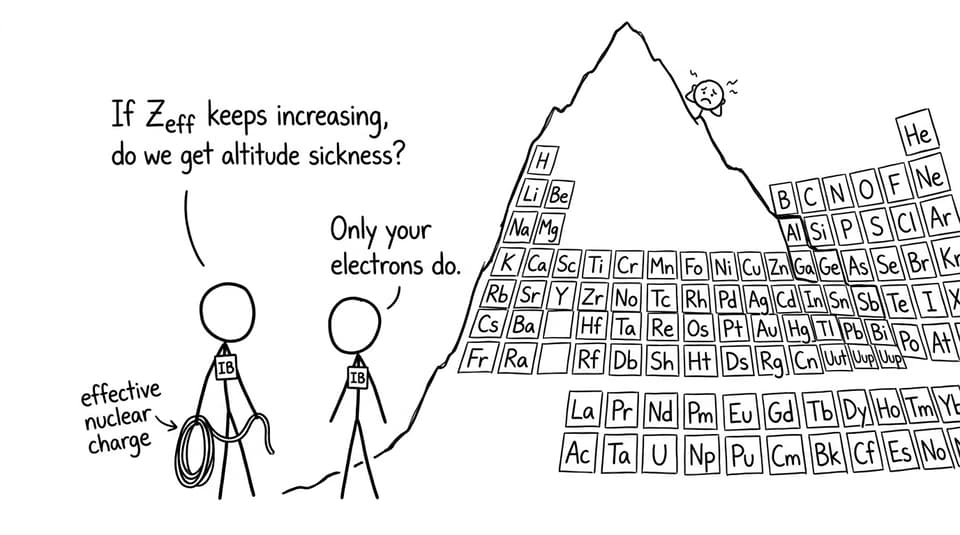
Effective nuclear charge increases.
-
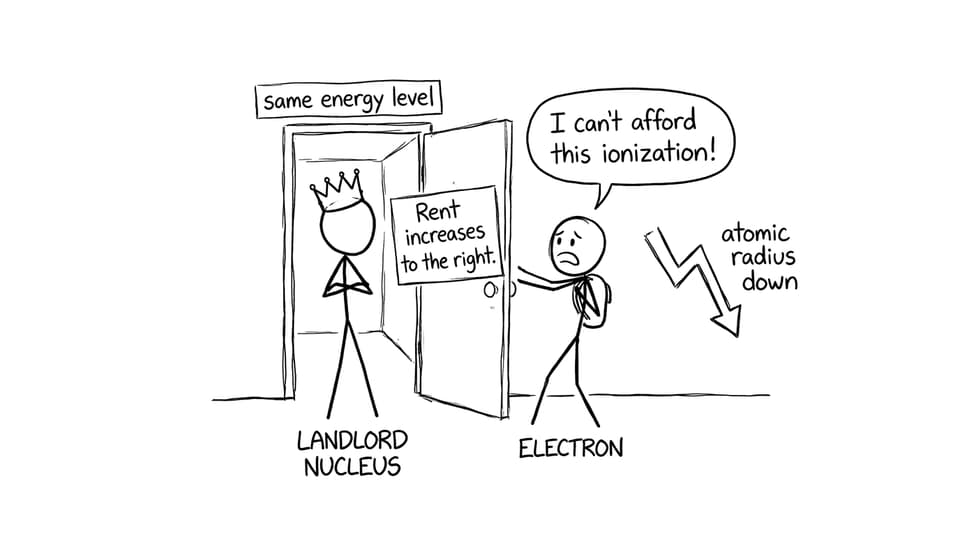
Atomic radius decreases.
-
Outer electrons are held more strongly, so ionization energy increases.
If you want a clean definition to anchor your explanation, revise it alongside Ionization Energy Explained Simply.
The real driver: effective nuclear charge in IB Chemistry
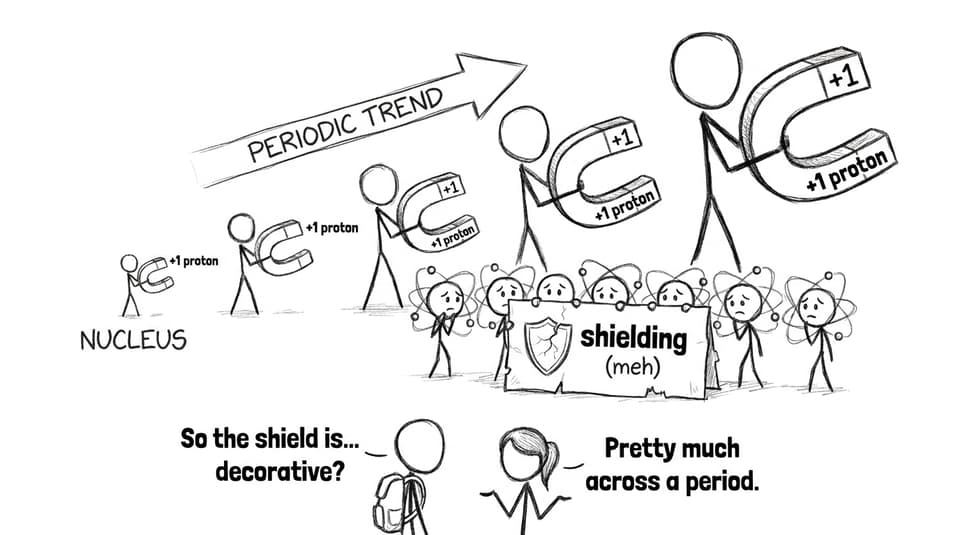
Across a period, each step to the right adds one proton. That’s the quiet change that does most of the work. Meanwhile, the extra electrons you add go into the same shell, so they don’t create a brand-new inner layer of shielding.
So the nucleus becomes more positive, but shielding barely improves. The result is a higher effective nuclear charge (Zeff) felt by the valence electrons. In IB Chemistry, that phrase is gold because it links structure to trend.
To deepen that idea (and get the wording exam-smooth), pair this with Effective Nuclear Charge Explained and IB Chemistry: Nuclear Charge and Electron Arrangement.
Why shielding stays nearly constant across a period
A common trap: “More electrons means more shielding.” That’s only strongly true when you add new shells.
Across a period, electrons are added to the same principal energy level. Inner-shell electrons (the main source of shielding) do not suddenly multiply. So the shielding effect changes only slightly, and it cannot keep up with the steady increase in proton number.
This is also why the periodic trend for size matters. If Zeff rises, the electron cloud is pulled in, and radius falls. See What Is the Periodic Trend for Atomic Radius? to connect the dots the way examiners like.
Smaller radius, tighter grip, higher ionization energy
Once the atomic radius decreases, the outer electron is, on average, closer to the nucleus. Electrostatic attraction increases as distance decreases. That makes the electron harder to remove, so the first ionization energy increases.
In IB Chemistry, you can phrase it as: “Stronger attraction between the nucleus and valence electrons means more energy is required to remove an electron from a gaseous atom.” That sentence, written clearly, is often the whole mark scheme.
The small dips: exceptions you still have to explain
Even though the general pattern rises, there are classic small drops:
-
Between Groups 2 and 13: the removed electron is now from a higher-energy p subshell, so it is easier to remove.
-
Between Groups 15 and 16: pairing electrons in a p orbital introduces extra repulsion, making removal slightly easier.
RevisionDojo breaks these discontinuities into clear patterns in Discontinuities in ionization energy trends.
Practice it the RevisionDojo way
Trends become “obvious” only after you have answered them under time pressure. For IB Chemistry, the fastest route is targeted practice and feedback:
-
Drill questions in the Periodicity Questionbank.
-
Focus on the syllabus point with S1.3.6 Ionization Energy plus the S1.3.6 Questionbank.
-
When you want a one-page explanation to revisit before mocks, use the S1.3.6 Notes.
RevisionDojo also supports the rest of your workflow: Study Notes for clarity, Flashcards for retention, AI Chat for “why” questions, Grading tools to fix wording, Predicted Papers and Mock Exams for timing, plus Tutors when you want a human to pressure-test your explanations.
Closing: turn the trend into free marks
Ionization energy increases across a period because the nucleus gains protons faster than shielding can soften their pull. Effective nuclear charge rises, atomic radius falls, and electrons become harder to remove. That is the whole story, and in IB Chemistry it’s one of the most reliable “explain the trend” questions you can bank on.
When you are ready to make it automatic, practice it on RevisionDojo using the Questionbank, lock in the wording with Study Notes and Flashcards, and use AI Chat to fix the one sentence you keep stumbling over. Your future self, halfway through a timed paper, will thank you.


