


If you have ever watched a reaction crawl along in a dilute solution, it can feel almost personal. You did everything “right”, samesame chemicals, same setup, same time pressure, andand still nothing seems to happen. Then you increase concentration, and suddenly the beaker looks like it remembered the deadline.
That frustration is basically IB Chemistry kinetics in disguise. In IB Chemistry, the link between concentration and rate is one of those ideas that seems obvious after you see it clearly: reactions don’t speed up because particles “try harder.” They speed up because they meet more often.
The exam-ready idea (IB Chemistry)
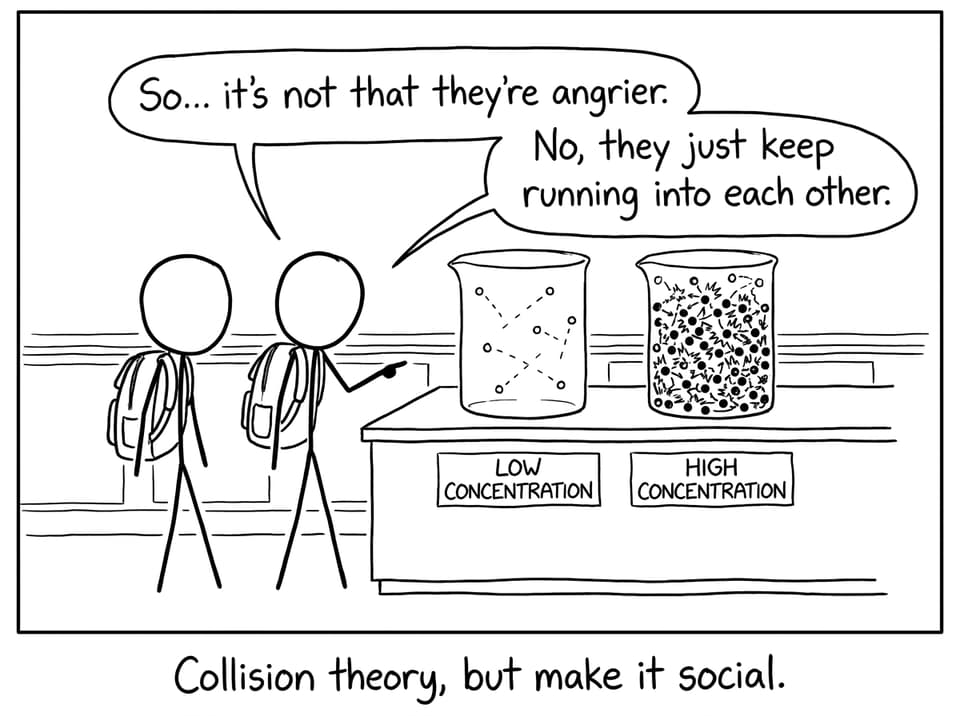
In IB Chemistry, increasing concentration increases the rate of reaction because there are more reactant particles per unit volume, so particles collide more frequently. More collisions per second means more chances for successful (effective) collisions, so the reaction goes faster.
If you want a full refresher on how rate is defined and measured, see Rate of Reaction Explained Simply.
Quick checklist you can write in 15 seconds
When an IB Chemistry question says “use collision theory to explain why higher concentration increases rate,” hit these points:
-
Higher concentration = more particles in the same volume
-
Particles are closer together
-
Collision frequency increases (more collisions per unit time)
-
More collisions means more effective collisions per unit time
-
Therefore, rate increases
For syllabus-aligned practice, pair this with 6.1 Collision theory and rates of reaction and the matching 6.1 notes.
Why concentration increases rate: collision theory, calmly explained
Collision theory is the backbone of this explanation in IB Chemistry. It says a reaction happens only when particles collide and the collision is successful.
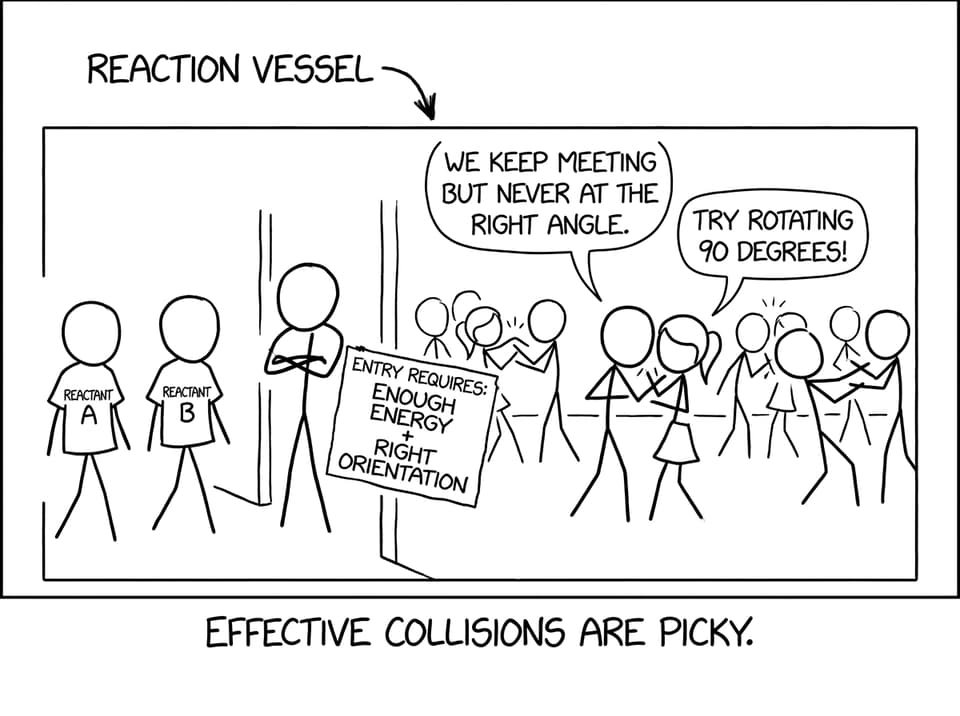
A collision is “successful” when:
-
Particles actually collide
-
The collision has enough energy to overcome activation energy (Ea)
-
The particles collide with a suitable orientation
Increasing concentration mainly changes the first part: how often collisions happen. In a dilute solution, particles are spread out, so even if they have enough kinetic energy, they simply don’t meet often. Increase concentration and the average distance between particles decreases. Now the same random motion produces many more encounters per second, and a fixed fraction of those encounters will meet the energy and orientation requirements. So the number of successful collisions per second rises, and the rate increases.
If you want a deeper, IB-focused breakdown, read IB Chemistry: Collision Theory Explained Simply.
A common trap: concentration does NOT change activation energy
A key IB Chemistry detail: increasing concentration does not lower activation energy. Activation energy belongs to the reaction pathway (mechanism). Concentration changes the collision frequency, not the energy barrier itself.
Want to connect this with other rate factors? Temperature is the one that strongly changes the fraction of particles with energy ≥ Ea. See How Does Increasing Temperature Affect the Rate of a Reaction?.
When the effect is dramatic (rate laws and higher orders)
Sometimes doubling concentration doubles the rate. Sometimes it quadruples it. In IB Chemistry, that difference comes from the rate-determining step and the reaction order.
If the slow step involves two particles colliding (bimolecular), increasing concentration makes those meetups much more common. For steps requiring multiple particles, the probability can rise sharply. You don’t need to overcomplicate this in short answers: just tie “more particles per volume” to “more frequent collisions” and then to “more successful collisions.”
For more practice on kinetics-style questions, use the Chemical kinetics (HL) hub and the Chemical kinetics flashcards.
Bring it home with RevisionDojo
If IB Chemistry kinetics feels like a collection of rules, treat it like a skill instead: explain every trend using collision theory, then prove it with questions. RevisionDojo makes that loop easy with a targeted Questionbank, clear Study Notes, quick Flashcards, and AI Chat for “why did I lose marks?” moments. When you are ready to test under pressure, build realistic practice with Mock Exams, Predicted Papers, and Grading tools that train you to write the exact collision-theory phrasing examiners want. For extra support, the Tutors and Coursework Library help you turn understanding into consistent points.
For your next session, start with Factors affecting the rate of reaction notes, then reinforce with R2.2 How Fast? Questionbank practice.


