

The moment molecular shapes stop feeling random
In IB Chemistry, molecular geometry can feel like a list you’re supposed to memorize: tetrahedral, trigonal planar, linear. Then an exam question asks why methane is 109.5° or why water is bent, and the memorized list suddenly feels fragile.
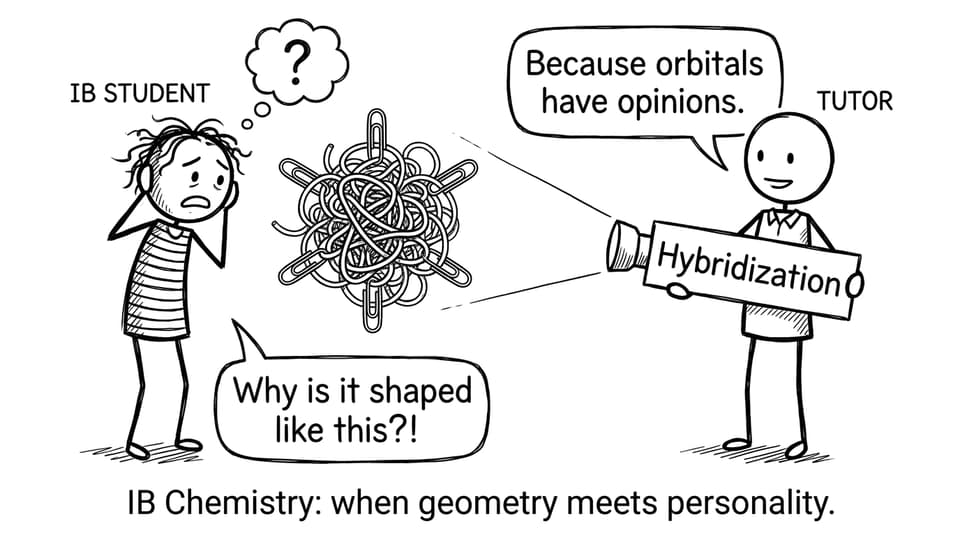
Hybridization is the “why.” It turns shapes from trivia into a logic chain. In IB Chemistry, hybridization explains molecular geometry because it connects electron-domain arrangements (VSEPR) to the actual orbitals that form sigma bonds, pointing in specific directions for maximum overlap and minimum repulsion.
If you want a quick refresher on the syllabus-aligned content, pair this with Hybridization Explained for IB Chemistry and the deeper HL notes at S2.2.16 Hybridization and Bonding Notes.
Quick exam checklist: how to use hybridization to justify shape
Use this sequence whenever IB Chemistry asks you to connect hybridization and molecular geometry:
-
Draw (or imagine) the Lewis structure and count electron domains (bonding regions + lone pairs).
-
Use VSEPR to get electron-domain geometry.
-
Match the domain count to a hybridization model:
-
2 domains → sp → linear (180°)
-
3 domains → sp2 → trigonal planar (120°)
-
4 domains → sp3 → tetrahedral (109.5°)
-
-
Adjust the molecular shape for lone pairs (they repel more strongly than bonding pairs).
For VSEPR structure practice, see 14.1 Covalent Bonding and Electron Domain and Molecular Geometries and the focused topic hub S2.2.4 VSEPR theory.
Why hybridization explains molecular geometry in IB Chemistry
In IB Chemistry, VSEPR tells you what electron pairs want to do: spread out to minimize repulsion. But hybridization explains how the atom makes that possible.
An isolated carbon has one 2s and three 2p orbitals. If carbon used those “as is,” you’d predict bonds with mismatched energies and directions. Yet in methane, CH₄, all four C to H bonds are identical and arranged symmetrically.
Hybridization solves the mismatch by mixing orbitals into new, equivalent hybrids that aim toward the corners of the geometry predicted by electron-domain repulsion. The model is simple, but it’s powerful: atoms “remix” orbitals to maximize overlap (strong sigma bonds) while matching the spatial arrangement that reduces repulsion.
If definitions are a weak point, bookmark the IB Chemistry Glossary so “electron domain,” “molecular geometry,” and “hybrid orbital” stay exam-clean.
The three hybridizations you actually use (and what they explain)
sp3 in IB Chemistry: tetrahedral logic (and why angles shrink)
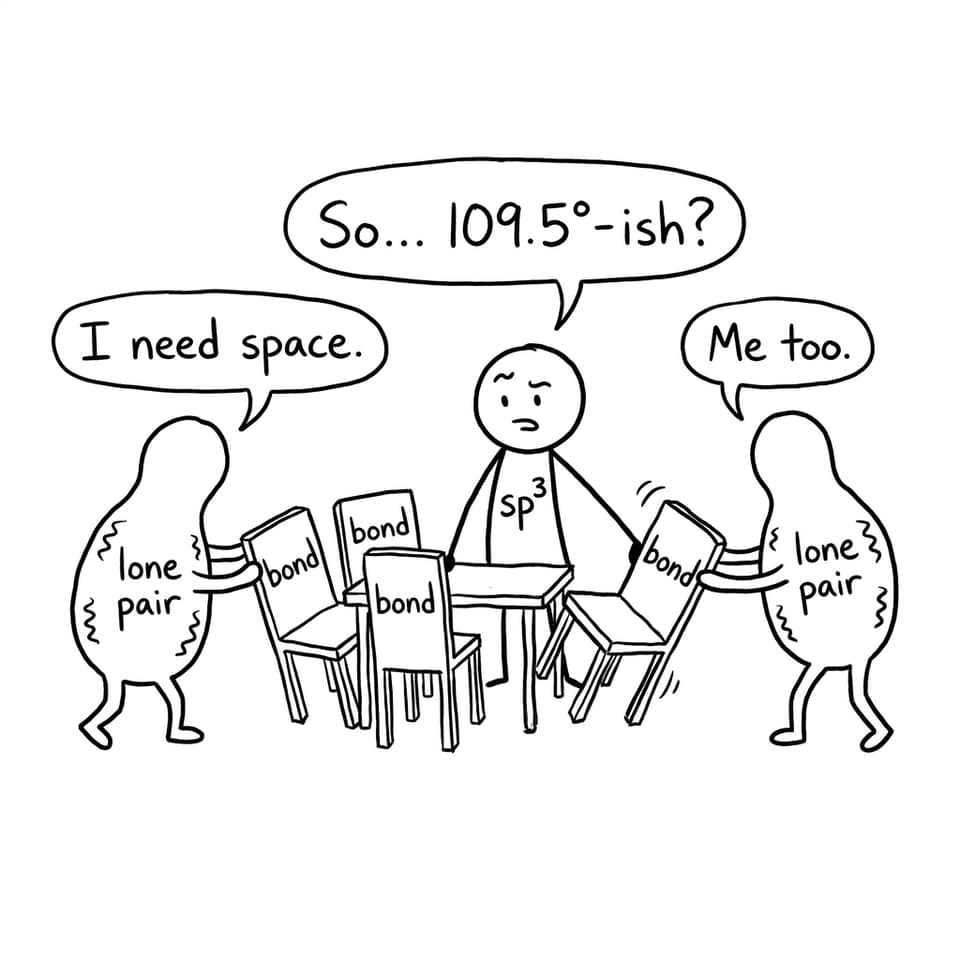
In IB Chemistry, sp3 hybridization is your go-to for four electron domains. Carbon in CH₄ mixes one s + three p to form four identical sp3 orbitals, directed tetrahedrally (about 109.5°). That directionality is the geometry.
Now the exam twist: lone pairs. Nitrogen in NH₃ is still sp3 (four domains), but one hybrid orbital holds a lone pair. Lone pairs repel more strongly, pushing bonding pairs closer, so the H to N to H angle is slightly less than 109.5°. Oxygen in H₂O has two lone pairs, compressing even more.
For a clean example you can quote, use Why H₂O Is Bent: Molecular Shape Explained.
sp2 in IB Chemistry: planar shapes and the “extra” p orbital
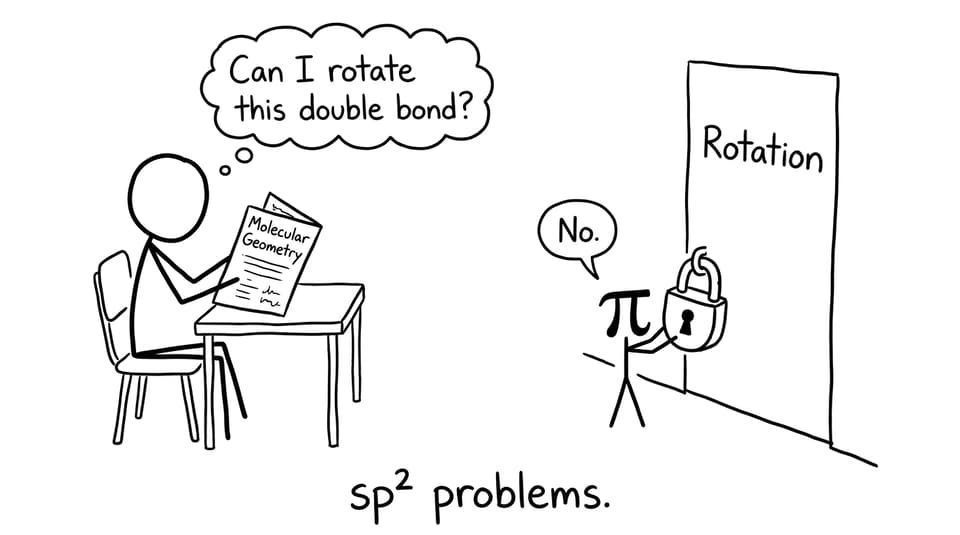
With three electron domains, sp2 hybridization gives a trigonal planar arrangement (around 120°). One p orbital remains unhybridized, perpendicular to the plane.
That leftover p orbital matters because it forms a π bond in double bonds. So hybridization doesn’t just explain the planar geometry of ethene (C₂H₄); it explains why rotation is restricted: the π bond relies on sideways overlap that breaks if you twist.
sp in IB Chemistry: linear geometry without drama
Two electron domains give sp hybridization and a linear arrangement at 180°. CO₂ is the classic: the central carbon uses sp hybrids for two sigma bonds in opposite directions, while two unhybridized p orbitals support two π bonds.
If you want the bigger bonding unit context (covalent vs other models), review Chemical Bonding and Structure HL Notes.
How to turn this into marks on RevisionDojo
Knowing the story is good. Training it into exam language is better.
RevisionDojo is built for IB Chemistry students who want that conversion:
-
Use the Questionbank (start with S2.2 The Covalent Model Questionbank) to practice “explain why” prompts.
-
Drill key facts with Structure 2 Flashcards.
-
Patch weak areas fast using Study Notes, AI Chat, and Grading tools for written explanations.
-
When you’re close to exams, build pressure-proof routines with Mock Exams and Predicted Papers.
-
If hybridization still feels slippery, the Tutors can diagnose exactly where your reasoning chain breaks.
For a full overview of everything available, see IB Chemistry Resources.
Closing: the calm way to remember it
In IB Chemistry, hybridization explains molecular geometry because it turns “electron pairs spread out” into a concrete orbital picture: hybrid orbitals point in the directions that make bonds strongest and repulsions smallest. That’s why CH₄ looks tetrahedral, why C₂H₄ stays planar and stiff, and why lone pairs quietly bend the rules.
If you want to make those explanations automatic, practice them where the feedback is immediate: RevisionDojo’s Questionbank, Study Notes, Flashcards, AI Chat, Mock Exams, Predicted Papers, and Tutors are designed to turn orbital theory into reliable exam marks in IB Chemistry.