

The moment atoms “relax” (and your IB Chemistry diagram finally makes sense)
In IB Chemistry, few ideas feel as backwards at first as this: forming a chemical bond releases energy. If two atoms are “doing something,” shouldn’t that cost energy? But bond formation is less like building a house and more like exhaling after holding your breath. The system finds a more stable arrangement, and that stability shows up as energy flowing out.
Think of it as the quiet logic underneath every exothermic energy profile you have ever drawn: atoms don’t release energy because they are generous. They release energy because they are moving to a lower potential energy state.
Quick exam checklist (IB Chemistry bond energetics)
-
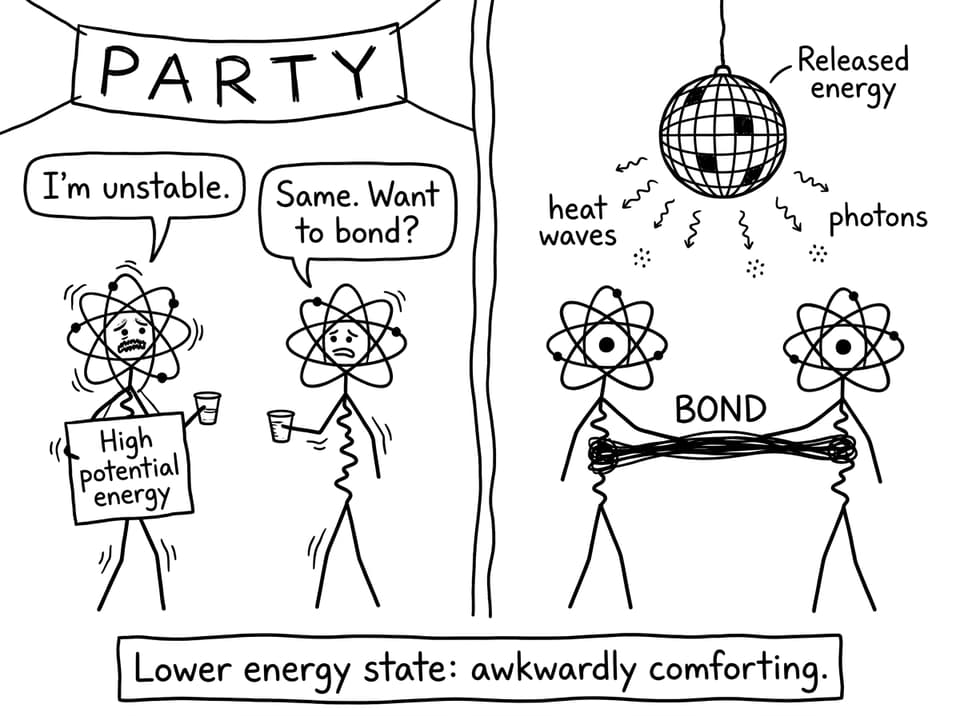
Bond formation releases energy because the bonded state has lower potential energy.
-
Attraction (nuclei-electron) eventually outweighs repulsion at the right distance.
-
The “lost” potential energy leaves as heat/light (energy to the surroundings).
-
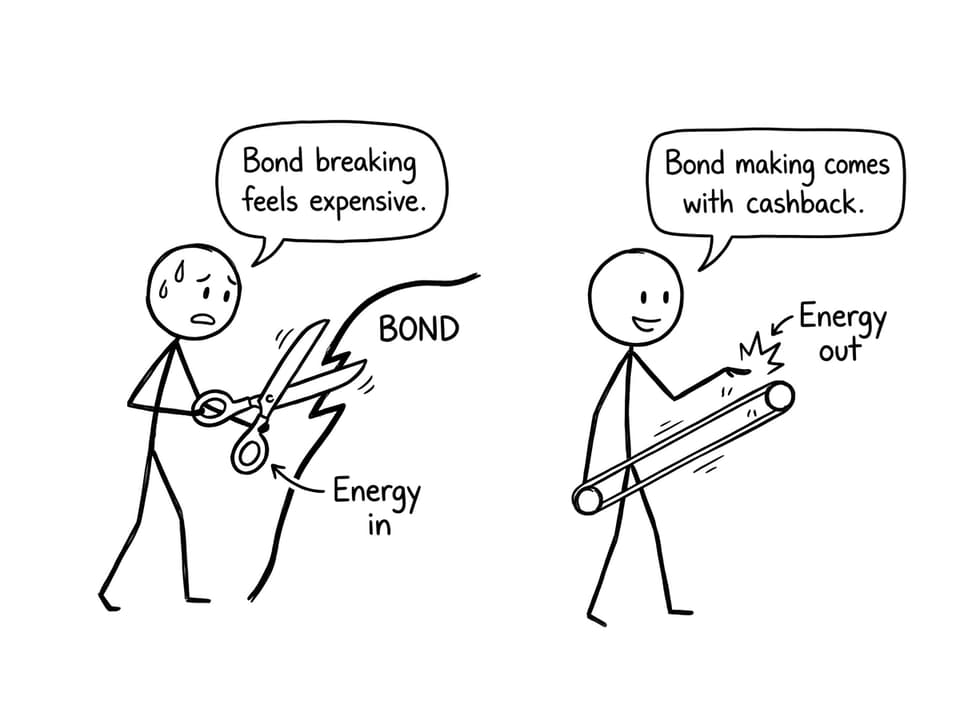
Bond breaking is the reverse: energy in to pull atoms apart.
-
Overall reaction enthalpy depends on the balance of bonds broken vs bonds formed.
For syllabus-aligned practice on energy ideas, the Energetics and Thermochemistry Questionbank is a good place to pressure-test your understanding.
Why forming a bond releases energy in IB Chemistry terms
When atoms are far apart, their interaction is basically “nothing happens.” As they approach, two types of forces compete:
-
Attractions between positive nuclei and negative electrons
-
Repulsions between nucleus-nucleus and electron-electron
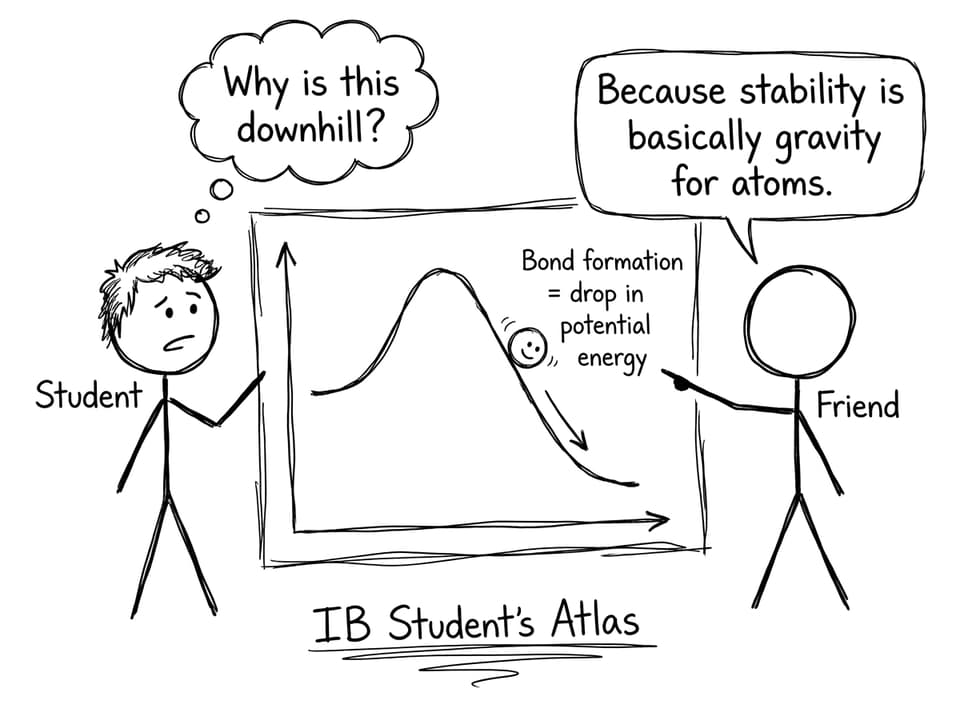
At a particular separation distance, attractions dominate just enough to pull the atoms into a stable position. That stable position is a minimum on a potential energy curve (often described as an “energy well”). In IB Chemistry, the key idea is that moving into that minimum means the system’s potential energy decreases. Energy conservation still applies, so that decrease must go somewhere: it is released to the surroundings, often as heat.
If you want the clean definition that connects straight to calculations, review R1.2.1 Bond enthalpy Notes alongside a few worked questions.
The “ball rolling downhill” model (and why it’s actually useful)
A good IB Chemistry analogy is a ball rolling downhill. You don’t pay energy for the ball to roll down; it rolls down because that’s the direction of lower potential energy. Bond formation is similar: atoms “fall” into a lower-energy arrangement. The surroundings receive the difference.
This is why strong bonds matter. A stronger bond corresponds to a bigger drop into that energy well, so more energy is released when it forms. That links directly to bond enthalpy thinking, especially in questions where you estimate reaction enthalpy using average bond enthalpies. RevisionDojo’s explainer Bond Enthalpy Explained for IB Chemistry frames this as an energy budget, which is exactly how exam questions behave.
Bond breaking vs bond making (don’t mix the sign)
Students often lose easy marks in IB Chemistry by saying “bonds store energy, so breaking them releases energy.” The exam wants the opposite: breaking a bond requires energy input because you must overcome the electrostatic attraction holding atoms at their optimal distance.
A helpful pairing is to read:
Once those are clear, energy profiles and ΔH signs stop feeling like memorisation.
How to write this explanation in an exam (a high-scoring template)
In IB Chemistry, aim for one tight chain of logic:
-
Forming a bond creates a more stable, lower potential energy arrangement.
-
As atoms reach the optimal bonding distance, attractions outweigh repulsions.
-
The system’s potential energy decreases, so energy is released to the surroundings.
If the question asks you to connect to reaction energetics: mention that overall ΔH depends on energy absorbed to break reactant bonds and energy released when product bonds form. For energy diagram confidence, What Is Activation Energy? IB Chemistry Explained is a fast clarifier.
Bring it home with RevisionDojo
If you can explain why bond formation releases energy, you can usually explain energy profiles, ΔH signs, and half of thermochemistry without panic, which is why this idea sits at the heart of IB Chemistry.
To turn this concept into marks, use RevisionDojo’s Study Notes for quick clarity, then lock it in with the Questionbank, Flashcards, and AI Chat when you get stuck mid-problem. When exam pressure rises, the Grading tools, Predicted Papers, and Mock Exams help you rehearse the exact explanations examiners reward. And if you want a human check on your reasoning, RevisionDojo Tutors can spot the tiny sign errors that cost big points.
For your next step, review Enthalpy Change Explained for IB Chemistry and then test yourself on energetics questions until “lower potential energy” becomes your default explanation in IB Chemistry.