

Electronegativity questions in IB Chemistry can feel unfair because they look like pure memorisation. Then, in the exam, the command term is explain -- and suddenly you need a cause-and-effect story, not a trend.
Here’s the calm truth: the trend is predictable once you picture what the nucleus is “trying” to do. It’s always pulling on bonding electrons. The periodic table just changes how far away those electrons are, and how much shielding gets in the way.
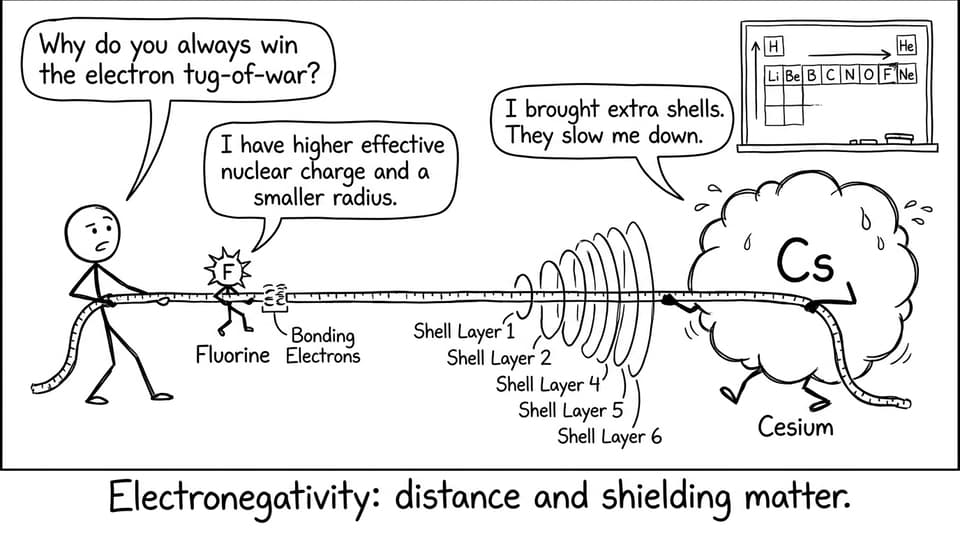
IB Chemistry definition you should anchor to
In IB Chemistry, electronegativity means: how strongly an atom attracts the shared pair of electrons in a covalent bond. If you want the examiner-friendly wording, keep the IB Chemistry Key Definitions close during revision.
Once you commit that definition, the trend explanation becomes mechanical.
Quick checklist (exam-ready)
Use this mini-script when you see a “why does electronegativity…” question in IB Chemistry:
-
Across a period: nuclear charge increases, shielding roughly constant, atomic radius decreases -> electronegativity increases.
-
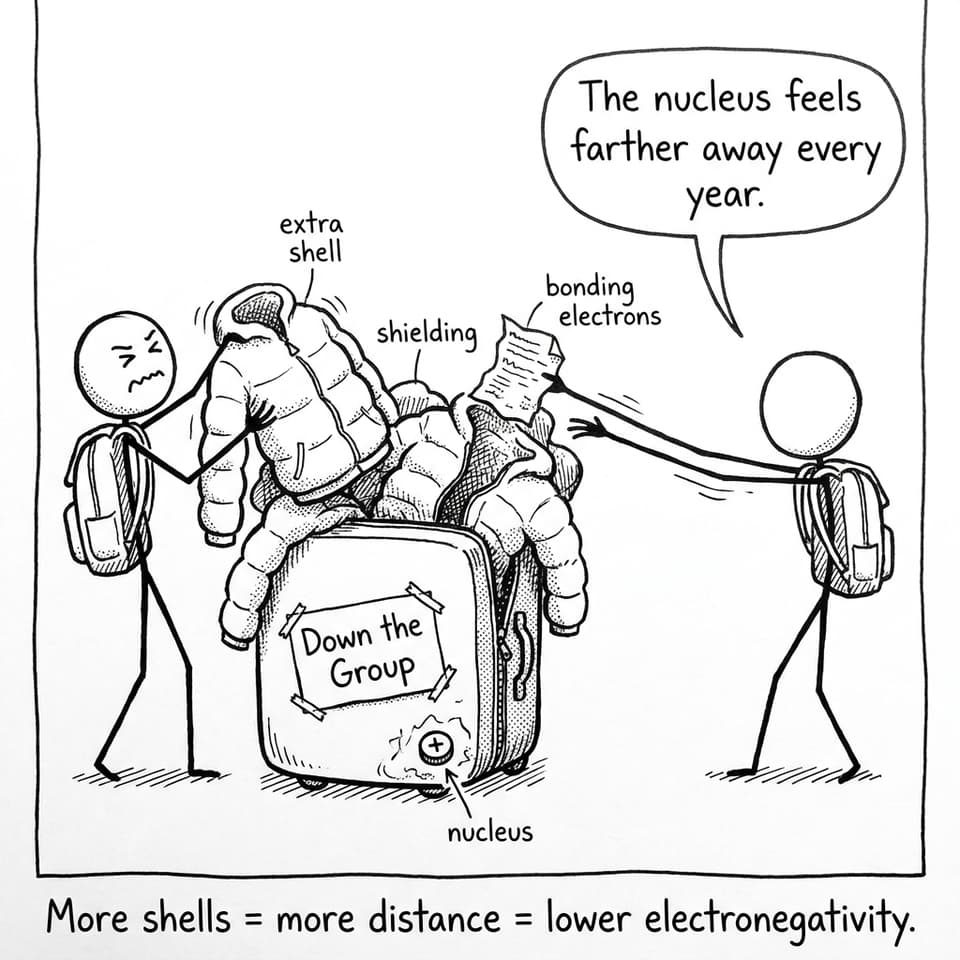
Down a group: more electron shells, more shielding, larger atomic radius -> electronegativity decreases.
For the bigger picture, revise Periodicity Explained Simply alongside this.
Why electronegativity increases across a period
Across a period (left to right), atoms gain protons. But crucially, they do not gain a whole new electron shell.
That creates two exam-friendly drivers:
Effective nuclear charge rises
More protons means a stronger positive pull. Because added electrons go into the same main energy level, shielding does not rise much. So the bonding electrons feel a stronger net pull (higher effective nuclear charge). If you want to sharpen this explanation, the story is laid out clearly in Effective Nuclear Charge Explained.
Atomic radius falls
As the nucleus pulls more strongly, the outer electrons are held closer. A smaller radius means bonding electrons are closer to the nucleus, so attraction increases again.
Put together: higher effective nuclear charge + smaller radius = stronger attraction for shared electrons. That is why electronegativity increases across a period in IB Chemistry.
If you want a dedicated trend recap, use Electronegativity Trend Across a Period: IB Chemistry Guide.
Why electronegativity decreases down a group
Down a group, atoms add new shells. This is where many students lose marks, because they only say “bigger atom” and stop.
You need the two-part mechanism:
Distance increases
Valence electrons are further from the nucleus. Electrostatic attraction falls with distance, so the nucleus has a weaker grip on bonding electrons.
Shielding increases
Inner-shell electrons repel outer electrons and reduce the net nuclear pull. Even though nuclear charge increases down the group (more protons), the combined effects of greater shielding and greater radius dominate.
So electronegativity decreases down a group -- not because the nucleus gets “weaker”, but because the bonding electrons are protected and far away.
Why this matters for bonding (fast exam link)
Electronegativity trends show up immediately in bond polarity and bond type questions.
-
Small electronegativity difference -> electrons shared more equally (nonpolar-ish covalent).
-
Larger difference -> unequal sharing (polar covalent).
-
Very large difference -> electron transfer becomes favourable (ionic character).
You can practise the language with Electronegativity and Bond Polarity Explained and the syllabus-aligned IB Chemistry S2.2.5 Bond Polarity Notes. For tricky MCQs and structured responses, use the IB Chemistry 3.2 Periodic Trends Questionbank.
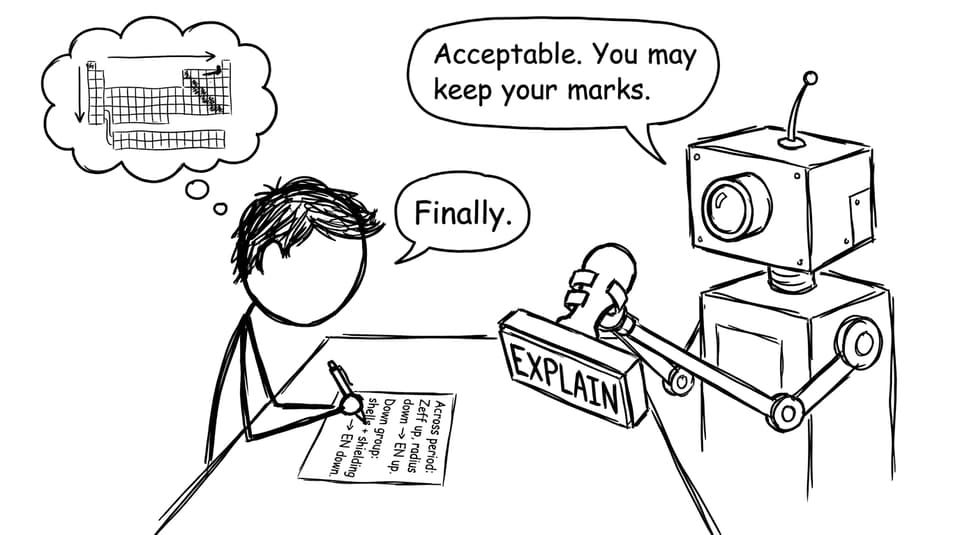
Wrap-up: the story you should remember for IB Chemistry
Across a period, effective nuclear charge increases and atomic radius decreases, so electronegativity rises. Down a group, extra shells increase distance and shielding, so electronegativity falls. That’s the whole logic chain for IB Chemistry.
When you’re ready to turn understanding into marks, use RevisionDojo as your home base: the Questionbank for targeted practice, Study Notes for clean explanations, Flashcards for retention, AI Chat to fix misconceptions, Grading tools for exam-style feedback, Predicted Papers and Mock Exams for timing, plus the Coursework Library and Tutors when you want personalised support. Start with the IB Chemistry 3.2 Periodic Trends hub and build from there.