
In IB Chemistry, few ideas feel as quietly powerful as electronegativity. You look at two symbols with a line between them, and suddenly you’re expected to predict solubility, boiling point, and even whether a molecule “behaves” like it has a positive and negative end. The trick is that the bond isn’t just a connection -- it’s a decision about where electrons spend most of their time.
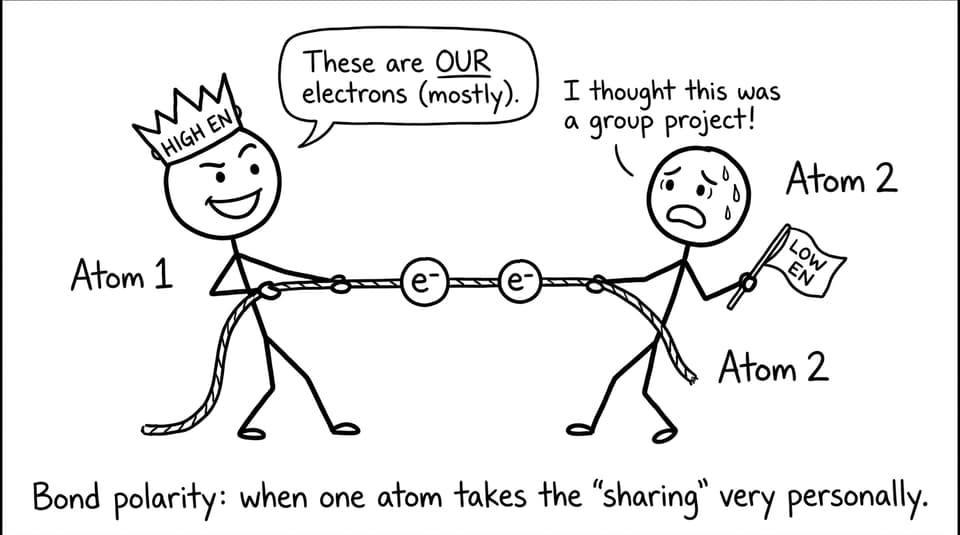
The IB Chemistry core idea: electrons aren’t shared equally
Electronegativity is an atom’s ability to attract the bonding pair of electrons. So in IB Chemistry, electronegativity difference (ΔEN) is essentially a measure of how uneven that “sharing” will be.
When ΔEN is:
-
Very small: electron density stays fairly centered --> nonpolar covalent
-
Moderate: electron density shifts toward one atom --> polar covalent with partial charges (δ+ and δ−)
-
Large (often taught as ~> 1.7): electron density is so shifted it resembles transfer --> mostly ionic character
If you want a clean refresher on the definitions and exam phrasing, pair this with Electronegativity and Bond Polarity Explained.
Why electronegativity difference determines bond polarity (the “electron density” explanation)
Bond polarity exists because electrons are negatively charged and they create an uneven charge distribution when they spend more time near one atom.
In IB Chemistry wording, you can say:
-
A bond dipole forms when the electron density is drawn toward the more electronegative atom.
-
The more electronegative atom becomes δ− (partial negative).
-
The less electronegative atom becomes δ+ (partial positive).
That’s why ΔEN determines polarity: it predicts the size of the electron density shift, and therefore the size of the dipole.
For more background on the “why” behind the trend itself, see Electronegativity Explained Simply for IB Chemistry.
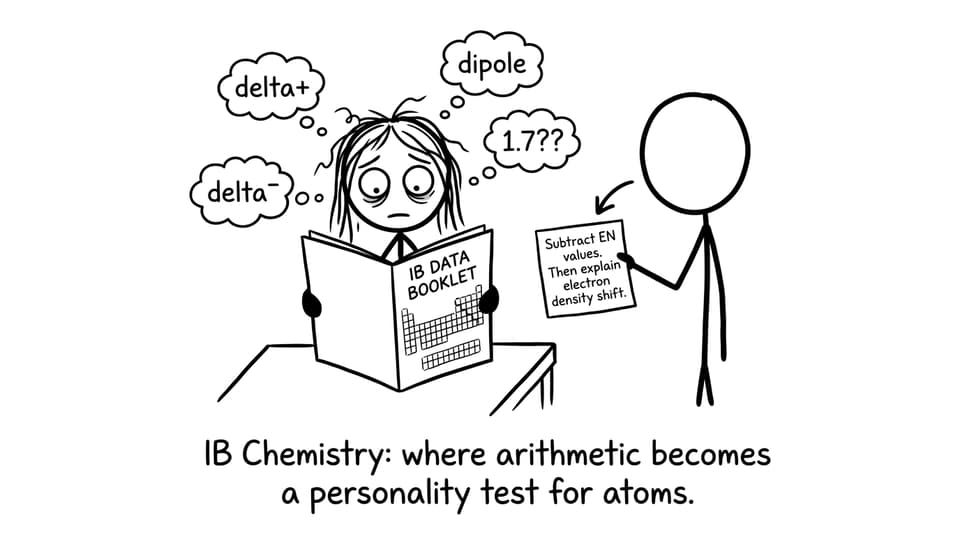
Examples you can reuse in IB Chemistry answers
You don’t need dozens of examples. You need a few you can deploy under time pressure.
Nonpolar covalent (ΔEN ~ 0)
- H₂ or Cl₂: identical atoms, identical pull --> no dipole.
Polar covalent (moderate ΔEN)
-
H--Cl: chlorine is more electronegative, so Cl becomes δ− and H becomes δ+.
-
O--H in water: oxygen pulls electron density strongly --> strong bond dipoles.
Ionic character (large ΔEN)
- NaCl: electron density is overwhelmingly localized around Cl, often modeled as electron transfer.
To reinforce the “covalent model” language IB likes, review Covalent Bonds Explained Clearly for IB Chemistry.
From bond polarity to molecule polarity (where students lose marks)
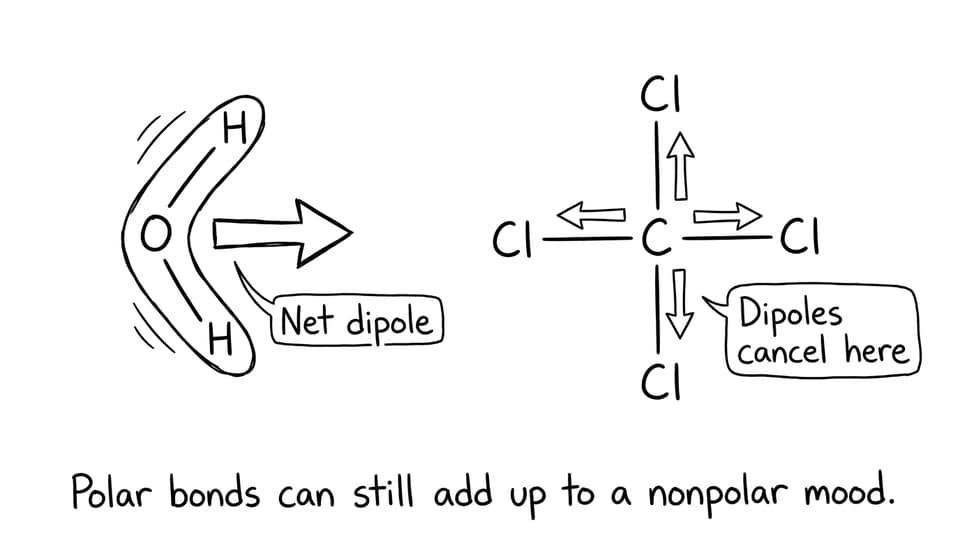
A bond can be polar while the molecule ends up nonpolar. In IB Chemistry, the missing step is geometry: dipoles are vectors, so they can cancel.
-
H₂O: bent shape --> dipoles don’t cancel --> polar molecule.
-
CCl₄: tetrahedral and symmetric --> dipoles cancel --> nonpolar molecule.
This is exactly why questions about polarity often sit next to structure and VSEPR ideas in bonding topics like IB Chemistry Structure 2: Models of Bonding and Structure.
Why IB Chemistry cares: properties follow polarity
Once you see bond polarity as “electron density geography,” the properties stop feeling random.
Polarity affects:
-
Intermolecular forces (dipole--dipole, hydrogen bonding)
-
Solubility (“like dissolves like”)
-
Boiling point and melting point (stronger attractions need more energy)
To connect polarity directly to the forces you’ll compare in exam questions, use Intermolecular Forces Explained and the syllabus-aligned S2.2.8 Intermolecular forces notes.
Quick exam checklist (30 seconds before you write)
-
Identify which atom is more electronegative.
-
State: electron density shifts toward the more electronegative atom.
-
Label δ− on that atom and δ+ on the other.
-
Say “a dipole forms” (or “bond is polar covalent”).
-
If asked about molecule polarity: check shape and whether dipoles cancel.
If you want targeted practice that mirrors mark schemes, drill the idea in RevisionDojo’s Questionbank and the dedicated S2.2.5 Bond Polarity Notes.
Closing: make ΔEN your shortcut in IB Chemistry
Electronegativity difference determines bond polarity because it predicts where electron density will sit in a bond -- and chemistry is, in many ways, the story of where electrons prefer to be. In IB Chemistry, that one idea feeds directly into dipoles, intermolecular forces, and the property explanations that separate average answers from top-mark ones.
When you’re ready to turn this into marks, RevisionDojo is built for that moment: use the Study Notes to lock in definitions, Flashcards for quick recall, the Questionbank and Mock Exams to build speed, Predicted Papers to focus revision, and AI Chat plus Grading tools to pressure-test your explanations. If bonding still feels abstract, the Tutors and Coursework Library give you a calmer path through it. Keep IB Chemistry simple: follow the electrons, and let ΔEN tell you where to look.


