
A piece of sodium lands in water and suddenly the lab feels louder. A noble gas sits beside it on the periodic table and does basically nothing for an entire lifetime. In IB Chemistry, that difference isn’t “personality”; it’s electron configuration. Once you see reactivity as an atom’s fastest route to a lower-energy, more stable arrangement of electrons, the periodic table stops being a chart to memorize and becomes a map of predictable behavior.
The IB Chemistry idea in one sentence
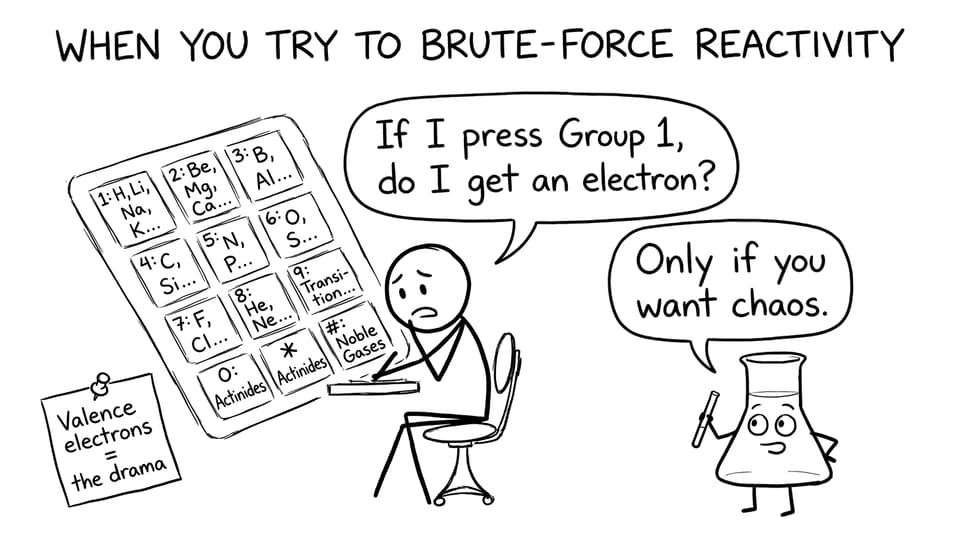
Electron configuration determines an element’s reactivity because reactions happen when atoms lose, gain, or share valence electrons, and the outer-shell arrangement tells you how “close” an atom is to a stable configuration.
Quick exam checklist (keep it simple)
-
Identify the valence shell (highest energy level).
-
Count valence electrons.
-
Ask: is it easier to lose, gain, or share electrons to reach stability?
-
Link to trends: ionization energy, electronegativity, and shielding.
If you want a clean refresher on writing configurations, use S1.3 Electron Configurations and the matching S1.3 notes.
Valence electrons: where reactions actually happen
In IB Chemistry, “reactivity” is mostly about the electrons you can realistically move around. Core electrons are held tightly and usually don’t participate. Valence electrons are exposed to the outside world, so they set the rules for bonding.
That’s why elements in the same group behave similarly: their outer electron configuration matches. When you study S3.1.2 Electron configuration and group trends, you’re basically learning the logic behind “same group, similar reactions.”
Nearly empty vs nearly full shells: why extremes react hardest
Here’s the pattern that shows up everywhere in IB Chemistry:
Group 1 metals: reactive because losing is easy
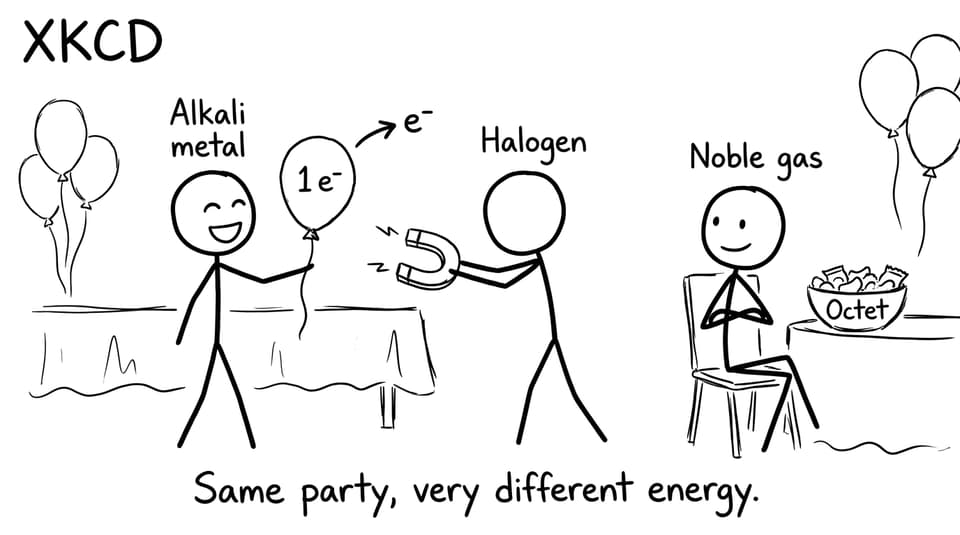
Alkali metals have an outer configuration ending in ns¹. That single electron is relatively easy to remove (low first ionization energy), so they readily form +1 cations to reach a noble gas configuration.
Group 17 non-metals: reactive because gaining is tempting
Halogens end in ns² np⁵. They are “one electron short” of a full outer shell, so they strongly attract electrons in bonding (high electronegativity) and often form -1 anions.
Want the trend language examiners love? Pair your explanation with the cause-and-effect chain from Periodicity Explained Simply and use electronegativity vocabulary from Electronegativity Trend Across a Period: IB Chemistry Guide.
Noble gases: stable configurations, low motivation
Noble gases have full valence shells. In energy terms, they’re already in a low-energy arrangement, so there’s little “payoff” to gaining, losing, or sharing electrons. In IB Chemistry, that’s the key phrase: no significant drive toward a more stable configuration.
This is also why the noble-gas shorthand is so useful when writing configurations: it highlights that “stable core” immediately. For extra practice, go straight to the S1.3 Electron Configurations Questionbank.
Transition metals: variable reactivity and multiple oxidation states
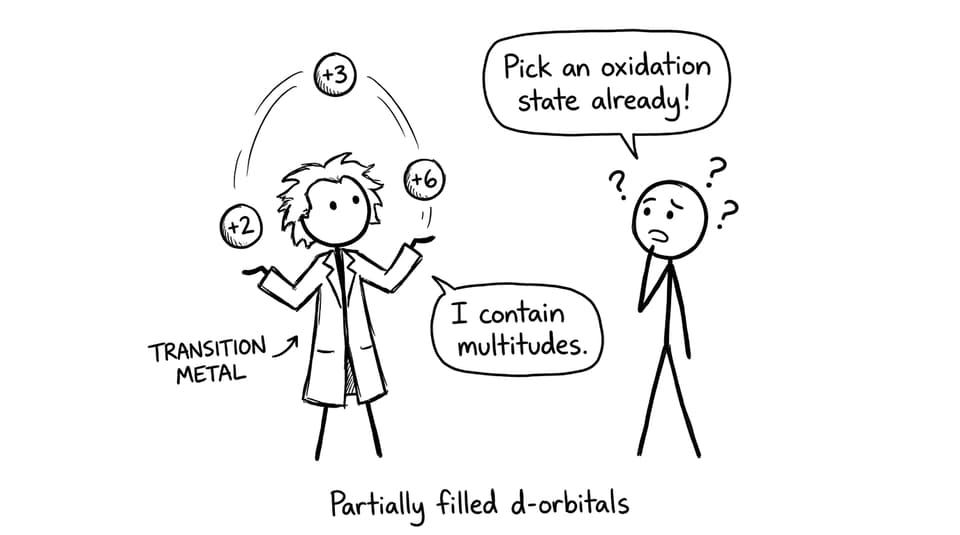
Transition metals complicate the story in a good way. With partially filled d subshells, they can access multiple stable electron arrangements, which is why they show variable oxidation states and often act as catalysts.
This isn’t random. It’s electron configuration giving them flexibility: losing different numbers of electrons can lead to reasonably stable outcomes.
How to turn this into marks (the IB Chemistry phrasing)
When you explain reactivity, connect configuration to measurable trends:
-
Ionization energy: how hard it is to remove an electron. See Successive ionization energies (HL).
-
Electronegativity: how strongly an atom attracts bonding electrons.
-
Effective nuclear charge and shielding: why attraction changes across periods and down groups. Use Effective Nuclear Charge Explained.
Conclusion: make electron configuration your shortcut
If you’re revising IB Chemistry, electron configuration is one of those topics that pays you back across the whole syllabus. It explains group trends, bonding behavior, oxidation states, and the big reactivity patterns that show up in exam questions.
To turn understanding into marks, build a routine on RevisionDojo: use the Study Notes for clarity, drill the Questionbank for pattern recognition, lock in definitions with Flashcards, and ask AI Chat to fix the one line in your explanation that keeps losing marks. When you’re ready to simulate pressure, use Predicted Papers and Mock Exams to practice making these explanations fast and exam-ready. Start here: IB Chemistry Resources and IB Chemistry Predicted Papers.