


A quiet beaker can still be busy
In IB Chemistry, dynamic equilibrium is one of those ideas that feels wrong the first time you meet it. You look at a reaction mixture and nothing seems to change: the colour holds steady, the pressure stops drifting, the concentration graph flattens. It looks like the reaction has “finished.”
But zoom in and it’s a different story. Molecules are still colliding. Bonds are still breaking and reforming. The reason dynamic equilibrium involves forward and reverse reactions occurring simultaneously is simple and surprisingly human: nothing tells particles to stop moving. The only thing that changes is the balance of chances.
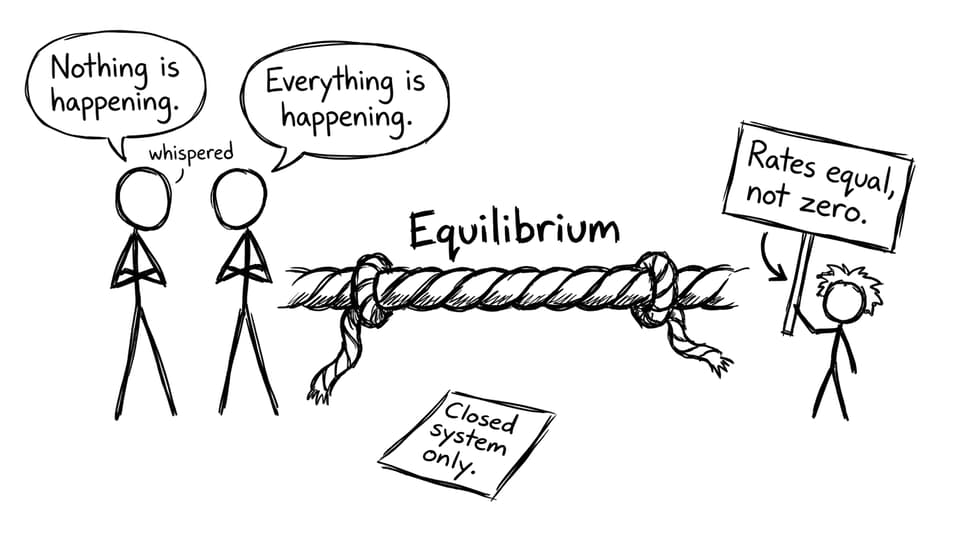
Dynamic equilibrium (IB Chemistry) quick checklist
Use this as a fast recall list when an IB Chemistry markscheme asks you to “explain” equilibrium:
-
The reaction is reversible (written with ⇌).
-
The system is closed (no substances enter or leave).
-
Forward and reverse reactions both continue.
-
At equilibrium: rate forward = rate reverse.
-
So concentrations stay constant (not necessarily equal).
If you want a syllabus-aligned version of this, see Dynamic Equilibrium Explained for IB Chemistry.
Why do forward and reverse reactions happen at the same time?
At the particle level, a reversible reaction is really two processes:
-
Reactants collide in the right orientation and with enough energy to form products (forward reaction).
-
Products also collide in ways that can re-form reactants (reverse reaction).
In IB Chemistry, the “dynamic” part means the microscopic activity never switches off. As long as particles have kinetic energy (so, basically any temperature above absolute zero), collisions keep happening. Some collisions succeed forward, some succeed in reverse.
A helpful way to picture it: at the start there are mostly reactant particles, so forward-successful collisions are common. As products build up, reverse-successful collisions become more common. Eventually the system reaches a point where the number of successful forward events per second matches the number of successful reverse events per second.
That’s equilibrium: not silence, but equal traffic in both directions.
For targeted practice in the exact wording examiners reward, use the R2.3.1 Dynamic equilibrium Questionbank.
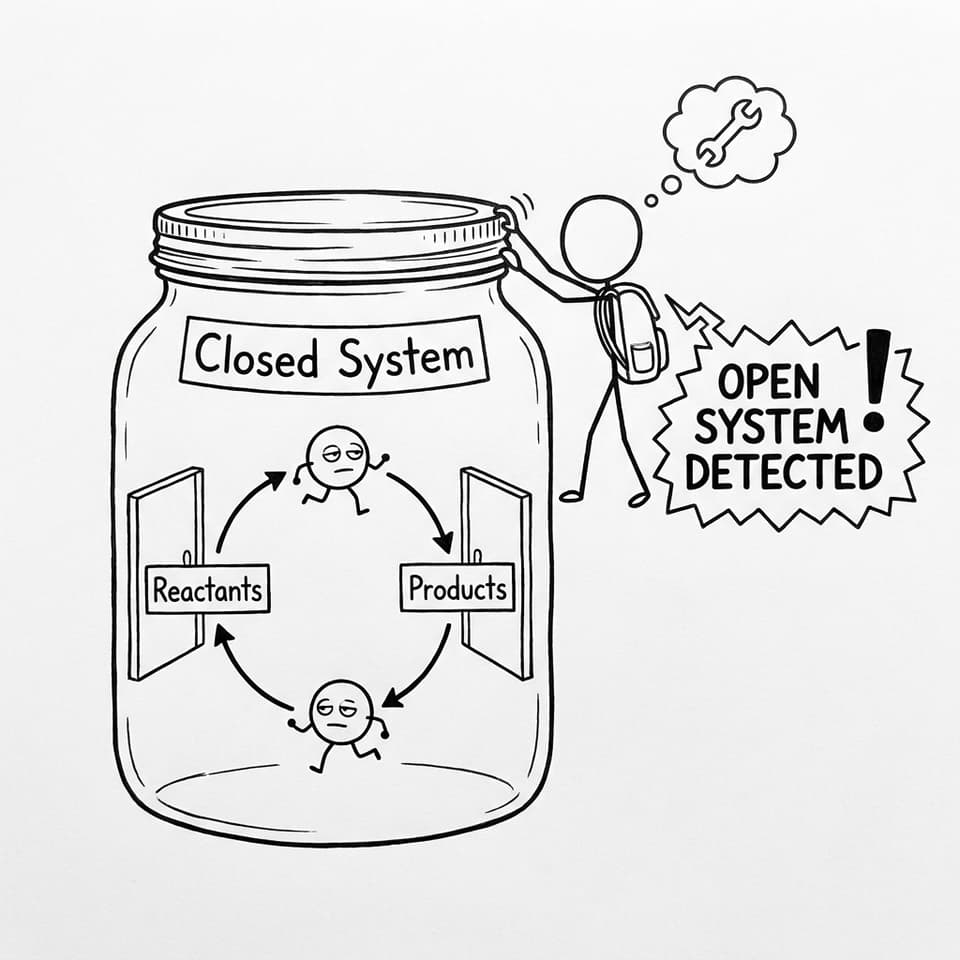
What stays constant (and what doesn’t) in IB Chemistry equilibrium questions?
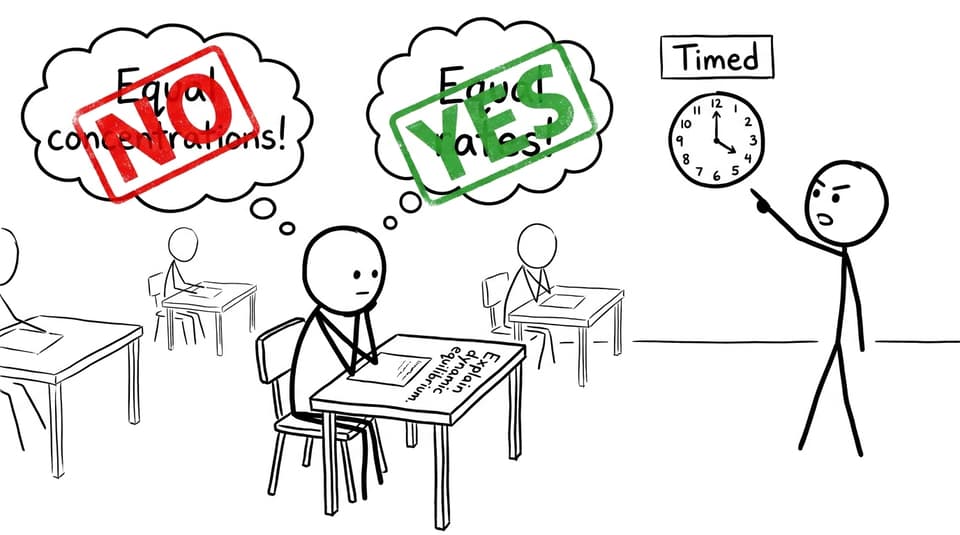
This is where many IB Chemistry answers lose marks: students describe the wrong “equal.”
At dynamic equilibrium:
-
Rates are equal (forward rate equals reverse rate).
-
Concentrations are constant over time.
-
Concentrations are not generally equal to each other.
A reaction can be strongly product-favoured and still be at equilibrium: it just means the reverse reaction is happening in a smaller concentration of products, but at the same overall rate as the forward process in the remaining reactants.
To tighten your language, the IB Chemistry Key Definitions page is a quick way to memorise examiner-friendly phrasing.
The deeper reason: equilibrium is about probability, not “stopping”
A calm equilibrium mixture is like a crowded hallway with two doors. People keep moving, but the flow through each door becomes equal. No one announces, “We’re done.” It’s just that the system has reached a stable pattern.
In IB Chemistry, that stable pattern links to energetic favourability too. At equilibrium, there is no net driving force pushing the system further forward overall. In HL, this idea connects neatly to Gibbs free energy: at equilibrium,
- (\Delta G = 0)
If you’re curious how this connects to equilibrium constants, see R2.3.7 Gibbs free energy and equilibrium (HL) Notes and R2.3.2 The equilibrium law and constant Notes.
Bring it home: how to turn this into marks
If you can say one sentence clearly, you can answer most equilibrium definition questions in IB Chemistry: dynamic equilibrium is when forward and reverse reactions occur simultaneously in a closed system at equal rates, so concentrations remain constant.
To practise the exact exam phrasing and build speed, combine RevisionDojo’s R2.3.1 Dynamic equilibrium Notes with the Questionbank, then use Flashcards for quick recall: R2.3.1 Dynamic equilibrium Flashcards.
When you’re ready to pressure-test the idea under timed conditions, RevisionDojo’s predicted papers and mock-style practice, AI Chat, grading tools, Study Notes, Questionbank, Flashcards, and Tutors turn IB Chemistry equilibrium from a definition you memorise into a concept you can use.