
If you have ever changed one number in an equilibrium question and watched the whole system “decide” to move, you have felt the core intuition of IB Chemistry: equilibrium is not a statue, it’s a living balance.
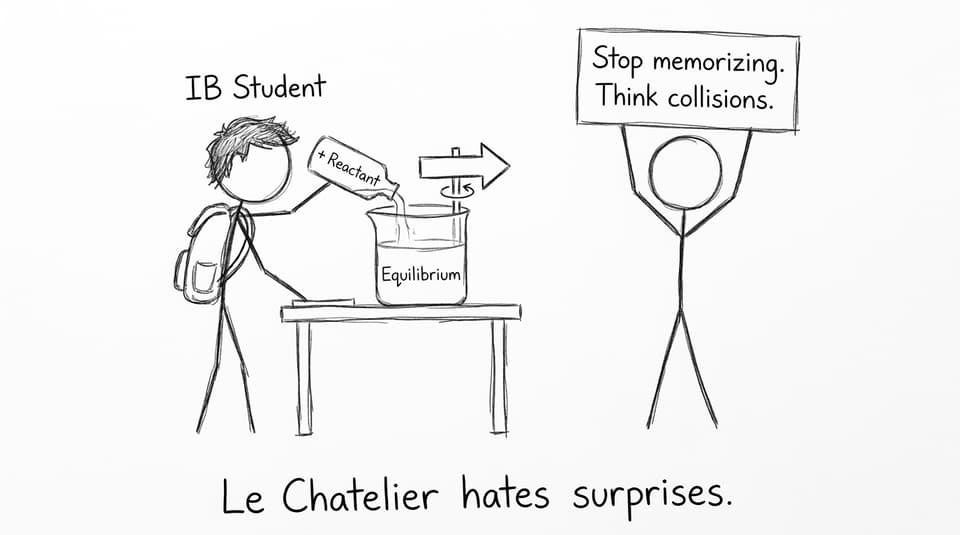
At equilibrium, nothing looks like it’s happening. But at particle level, everything is happening. Molecules collide, bonds break, products reform reactants, reactants rebuild products. The only reason the graph looks flat is that two opposing rates match. Change concentration, and you briefly change the odds of those collisions. The system responds until balance returns.
The IB Chemistry checklist for concentration changes
-
Equilibrium means forward rate = reverse rate (see Dynamic Equilibrium Explained for IB Chemistry).
-
Concentration changes affect collision frequency immediately.
-
The system shifts to make Q move back toward K.
-
K does not change unless temperature changes (use the IB Chemistry glossary to keep definitions crisp).
Why changing concentration shifts the equilibrium position
In IB Chemistry, “shift” is shorthand for: the composition changes until the reaction reaches a new equilibrium.
Imagine a reversible reaction:
At equilibrium, the forward and reverse reactions continue, but their rates are equal. Now suppose you increase (). Instantly, there are more A particles per unit volume, so collisions that lead to products become more frequent. That makes the forward rate temporarily greater than the reverse rate. The mixture responds by consuming some of the added A and forming more products, until the forward and reverse rates match again.
That is the heart of Le Chatelier’s principle (reinforce it with Le Chatelier's Principle, Simply Explained). The system shifts in the direction that reduces the disturbance.
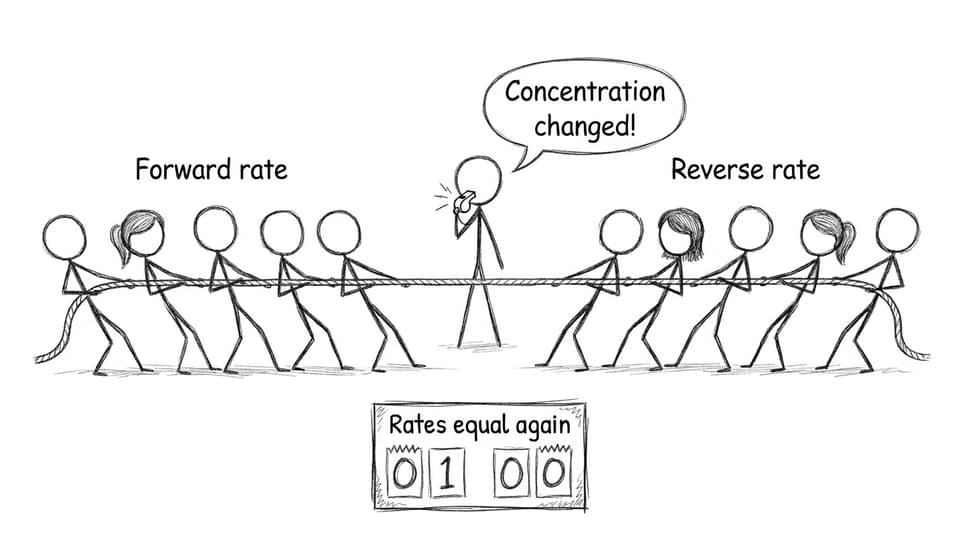
If you add reactant: shift right
Adding reactant increases the chance of reactant-side collisions that produce products. The forward reaction speeds up first, so the equilibrium position moves toward products.
If you add product: shift left
Adding product increases the frequency of product collisions that regenerate reactants. The reverse reaction speeds up first, so the equilibrium position moves toward reactants.
If you remove something: the system “replaces” it
Removing reactant makes the forward rate drop, so the system tends to form more reactants (shift left). Removing product makes the reverse rate drop, so the system tends to form more products (shift right).
These patterns are exactly what IB Chemistry markschemes reward: direction, reason (rates/collisions), and the link to Q and K.
The Q vs K reason (what examiners really want)
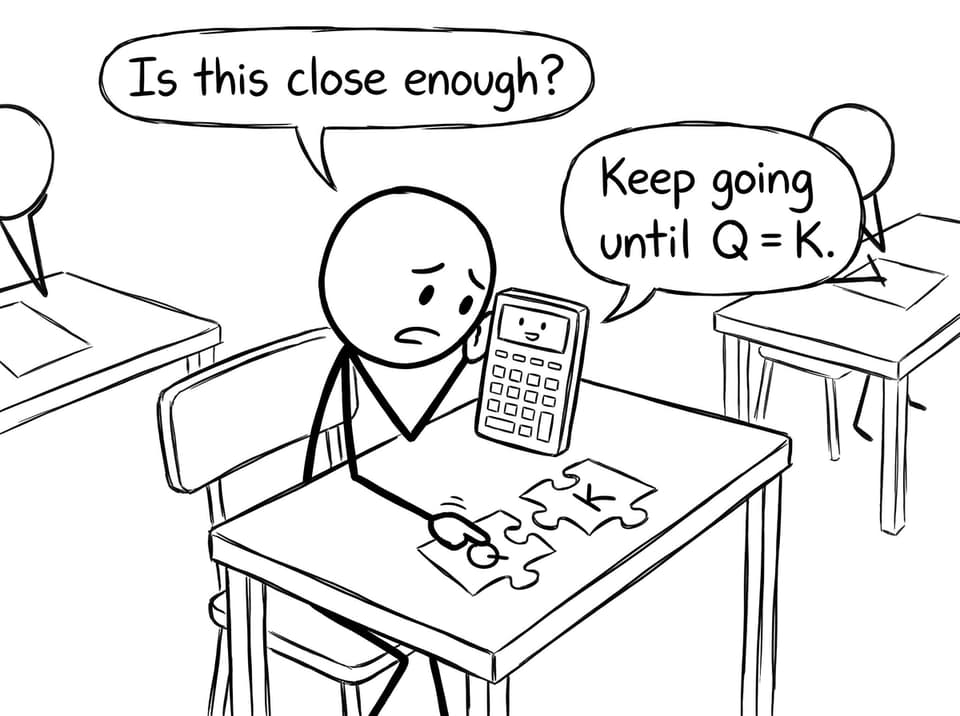
A clean way to explain concentration shifts is through reaction quotient (Q). (Q) has the same form as (K), but uses current (not necessarily equilibrium) concentrations.
-
If (Q < K), there are “too many reactants” relative to equilibrium, so the reaction goes forward.
-
If (Q > K), there are “too many products,” so the reaction goes backward.
For a syllabus-aligned explanation, use R2.3.5 Reaction quotient (Q) Notes and lock in the K-expression skills with R2.3.2 Equilibrium law and constant Notes.
How RevisionDojo helps you master this in IB Chemistry
Understanding is step one. Speed and accuracy are step two.
On RevisionDojo, students typically learn equilibrium faster by mixing:
-
Study Notes and Lessons (see R2.3 How far? Lessons)
-
Flashcards for Le Chatelier language (try R2.3.4 Le Châtelier’s principle Flashcards)
-
The Questionbank for equilibrium drill (use IB Chemistry Topic Equilibrium Questionbank or 7.1 Equilibrium Questionbank)
-
AI Chat for “why did my Q end up greater than K?” moments
-
Grading tools, Mock Exams, and Predicted Papers to practice writing the explanation under time pressure
-
The Tutors option when you want your reasoning tightened, not just your final answer
Conclusion: the equilibrium position shifts because rates stop matching
Changing concentration shifts the equilibrium position because it breaks the balance of rates that defines equilibrium. In IB Chemistry, the exam-ready story is simple: concentration change alters collision frequency, which changes rates, which changes (Q), and the system shifts until (Q=K) again.
If you want this to feel automatic, build a short routine on RevisionDojo: read the equilibrium notes, drill flashcards for Le Chatelier phrasing, then use the equilibrium Questionbank and AI Chat until your explanations sound like markscheme language.