

Bond polarity is one of those IB Chemistry ideas that feels obvious right after you understand it, and strangely slippery when you’re under timed exam pressure. You look at HCl, you know it’s polar, but the “why” can vanish the moment a markscheme demands precision.
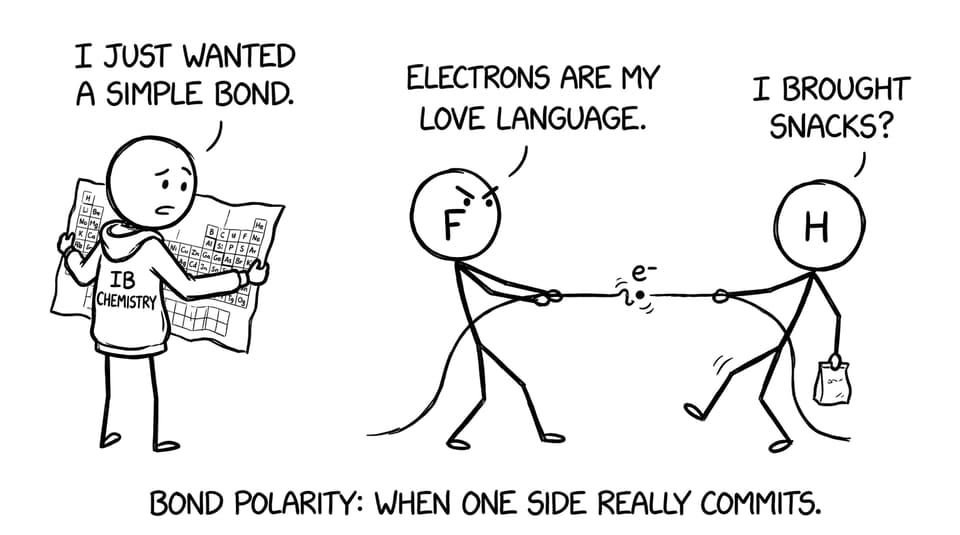
At its core, bond polarity is just a story about who gets closer to the shared electrons. Not in a dramatic, Hollywood way. More like two people sharing a bench: one person keeps inching toward the middle until the other is left balancing on the edge.
Quick checklist for explaining bond polarity in IB Chemistry
Use this quick script whenever a question asks why a bond is polar:
-
Define electronegativity: ability of an atom to attract a shared pair of electrons.
-
State the consequence: higher electronegativity pulls bonding electrons closer.
-
Link to charges: uneven electron density creates δ− and δ+.
-
Name the result: a dipole and therefore a polar covalent bond.
If you want a syllabus-aligned definition to copy into your own phrasing, keep the IB Chemistry Key Definitions open while you practise.
Why electronegativity differences create bond polarity
In IB Chemistry, electronegativity is treated as an atom’s “pull” on shared electrons. When two atoms form a covalent bond, the electrons belong to both atoms, but they don’t have to sit exactly in the middle.
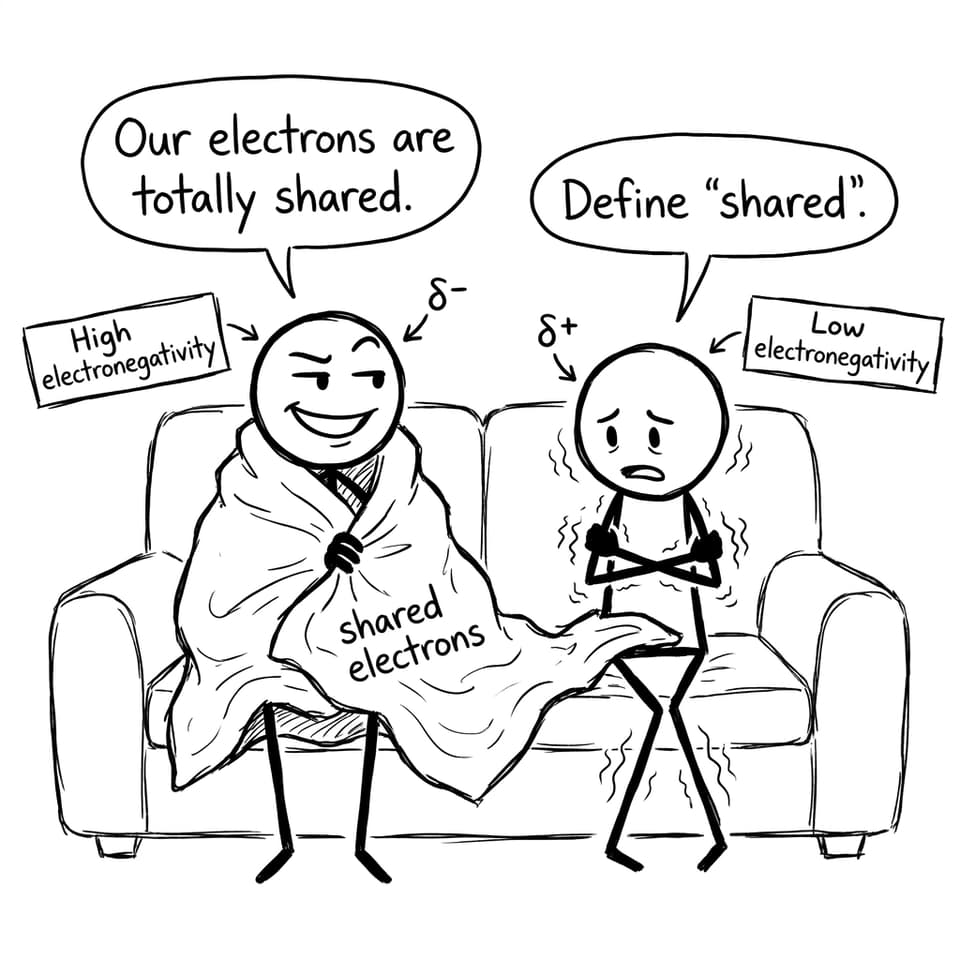
If one atom is more electronegative, it attracts the shared electron pair more strongly. Electron density shifts toward that atom. That shift is what creates bond polarity:
-
The more electronegative atom becomes partially negative (δ−).
-
The less electronegative atom becomes partially positive (δ+).
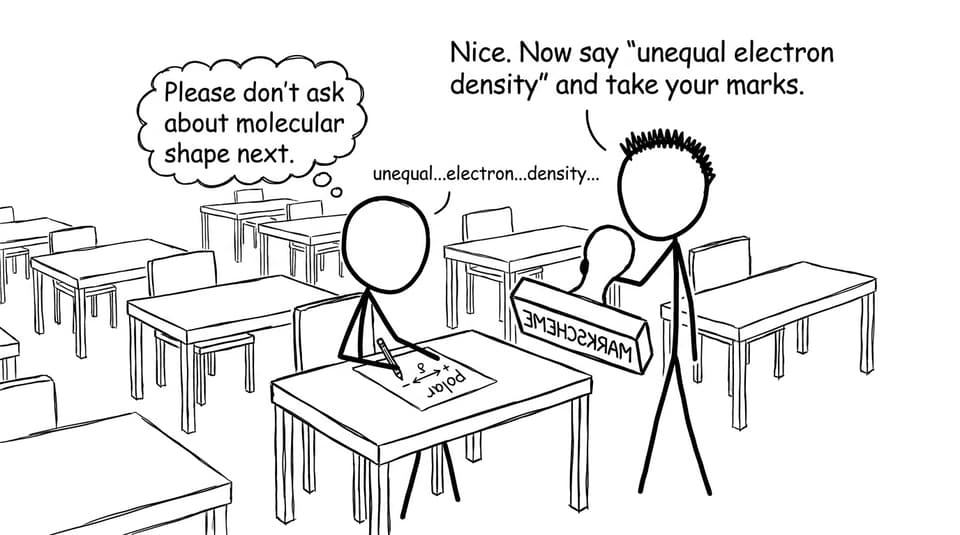
This is why markschemes love the phrase “unequal sharing of electrons” or “uneven electron density”. It signals that you understand polarity is about distribution, not full electron transfer.
For a clean set of examples and exam wording, revise with IB Chemistry S2.2.5 Bond Polarity Notes and then test yourself using the RevisionDojo Questionbank.
Bond polarity sits on a spectrum (not a switch)
A common trap in IB Chemistry is thinking bonds are either “covalent” or “ionic” like a light switch. In reality, bonding sits on a continuum.
A useful guideline is electronegativity difference (ΔEN):
-
Very small or zero ΔEN (e.g., O_2, N_2): electrons are shared nearly equally, so the bond is nonpolar covalent.
-
Moderate ΔEN (e.g., HCl, O-H): unequal sharing creates a polar covalent bond.
-
Large ΔEN (often metal + nonmetal): electron density is so uneven that the bonding is described as ionic in IB-level questions.
To get comfortable with the language and typical cutoffs used in exam-style explanations, see What Is Electronegativity Difference? and IB Chemistry: Using Atomic Trends to Predict Bond Types.
Why polarity matters after you’ve labelled δ+ and δ−
Examiners don’t ask about bond polarity just to make you draw little arrows. In IB Chemistry, polarity connects to properties:
-
Polar bonds can lead to stronger intermolecular forces (dipole-dipole, and sometimes hydrogen bonding).
-
Those forces can raise boiling points compared with similar-sized nonpolar molecules.
-
Polarity influences solubility (the “like dissolves like” idea you’ll use repeatedly).
And one more high-yield link: bond polarity is not automatically molecular polarity. Shape can cancel dipoles. For extra clarity, pair your bond polarity revision with Electronegativity and Bond Polarity Explained.
Final takeaway (and how to revise it fast)
Bond polarity arises because electronegativity differences pull shared electrons unevenly, creating δ+ and δ− and a dipole, the cleanest kind of cause-and-effect story in IB Chemistry.
To lock it in, build a short loop: read the key idea in the Covalent Bonds Explained Clearly for IB Chemistry, drill definitions with the Structure 2 Flashcards, then practise timed explanations with Questionbank, AI Chat, and the Grading tools. Add Predicted Papers and Mock Exams when you want the pressure to feel familiar, and use Tutors if you want feedback that’s faster than waiting for confidence to appear on its own.