
In IB Chemistry, phase changes look innocent until you meet the kettle. One minute your water sits quietly. The next, it turns into a noisy, bubbling protest that fogs up your glasses and your confidence.
That drama is the clue. Boiling and evaporation both produce gas, but they do it in fundamentally different ways. And in IB Chemistry, that difference explains why boiling requires breaking stronger (and more widespread) intermolecular attractions than evaporation.
The quick IB Chemistry checklist (memorize this)
-
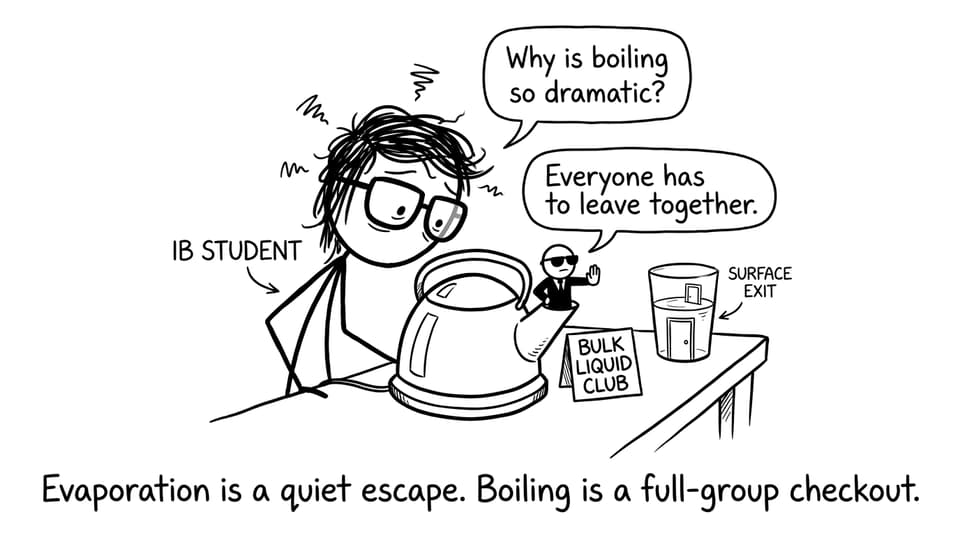
Evaporation happens at the surface only and can occur at any temperature.
-
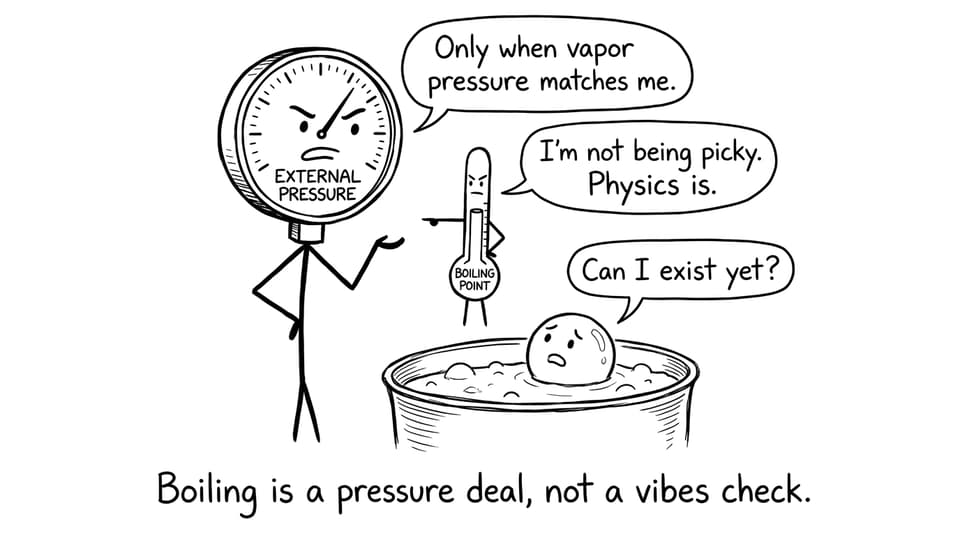
Boiling happens throughout the entire bulk liquid and occurs when vapor pressure = external pressure.
-
Boiling needs enough energy not just for escape, but for bubble formation inside the liquid.
-
Both processes involve overcoming intermolecular forces (IMFs), not covalent bonds.
If you want a fast refresher on IMFs first, use Intermolecular Forces Explained.
Evaporation: the quiet surface escape (IB Chemistry view)
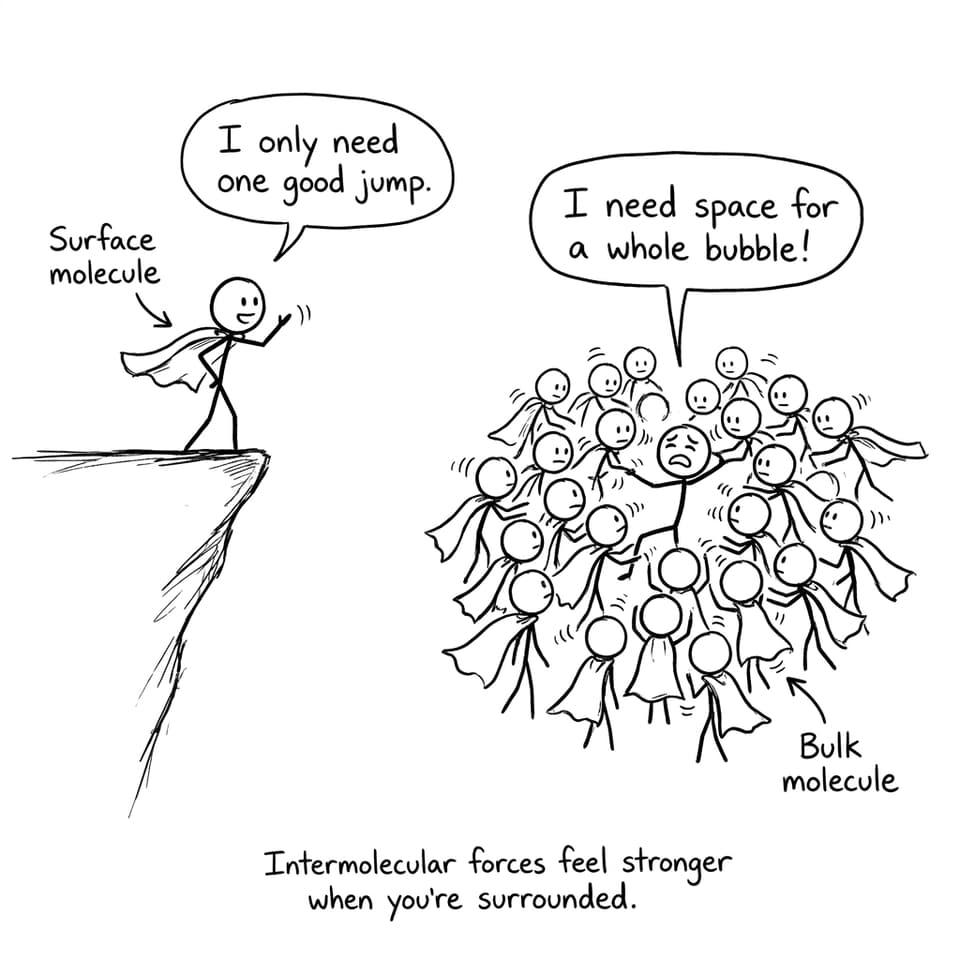
In IB Chemistry, evaporation is basically selective. Only molecules at the surface even have a chance to leave. And even among those, only the ones with higher-than-average kinetic energy escape into the gas phase.
Why does that matter for intermolecular forces? Surface molecules are less “surrounded.” They experience fewer attractive neighbors pulling them back, so the effective cohesive pull is lower than it is inside the liquid. That means fewer IMFs must be overcome at once.
This is also why evaporation is slow and why it causes cooling: the highest-energy molecules leave, lowering the average kinetic energy of what remains. If you want the clean definition contrast, see Vaporization Explained Simply.
Boiling: bulk liquid, bubble physics, bigger energy bill
Boiling in IB Chemistry is not “faster evaporation.” It’s a different condition entirely.
Boiling starts when the liquid’s vapor pressure equals external pressure. At that point, vapor bubbles can form inside the liquid and survive rather than being crushed shut.
Here’s the key IMF insight: a molecule in the bulk is surrounded on all sides. To create a bubble, many molecules must separate enough to create a pocket of gas. That collective separation means overcoming intermolecular attractions throughout the liquid structure, not just at a surface edge.
So boiling demands more energy because it is asking for a whole interior rearrangement, not just a few lucky escapes.
To lock this in, review Vapor Pressure Explained for IB Chemistry and connect it to boiling point questions.
Where ΔHvap fits (and how exam questions phrase it)
In IB Chemistry, the energy required to turn liquid into gas at constant temperature is the enthalpy (latent heat) of vaporization, ΔHvap. It’s typically large because vaporization requires molecules to move far apart and overcome most intermolecular attractions.
Exam-style questions often connect:
- stronger IMFs ⟶ higher boiling point ⟶ larger ΔHvap
To practice that exact relationship, use the 4.4 Intermolecular forces Questionbank and keep the IB Chemistry Key Definitions open while you work.
Conclusion: make boiling vs evaporation a scoring topic
In IB Chemistry, boiling requires breaking stronger and more widespread intermolecular forces than evaporation because boiling is a bulk phenomenon that depends on vapor pressure matching external pressure and forming bubbles inside the liquid. Evaporation is a surface phenomenon where only a few high-energy molecules escape.
If you want this to feel automatic under exam pressure, RevisionDojo is built for it: revise the concepts with Study Notes, drill the patterns in the Questionbank, lock definitions with Flashcards, and use AI Chat plus Grading tools to fix the exact mistakes you keep repeating. Add Predicted Papers and Mock Exams when you’re close to test day, and lean on the Coursework Library and Tutors when you need targeted support.
Keep it simple: in IB Chemistry, evaporation is a quiet surface exit; boiling is the whole liquid reorganizing at once.