


Atomic radius trends can feel like one of those facts you’re supposed to “just know” for IB Chemistry. But in an exam, memorised facts crack under pressure. Understanding holds.
Picture a student at their desk, trying to force the periodic table to behave like a neat spreadsheet. It doesn’t. It behaves like physics. And once you see the physics, the trend becomes inevitable: atomic radius increases down a group.
The exam-ready checklist (what to say in IB Chemistry)
When asked “Why does atomic radius increase down a group?” hit these points:
-
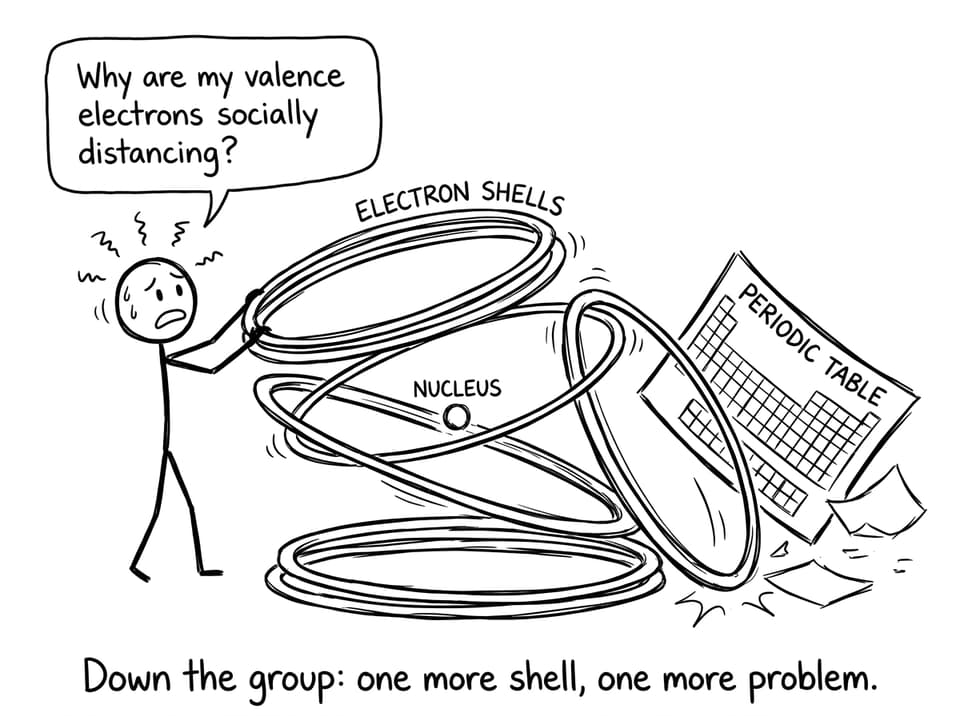
Additional electron shell is added each step down
-
Outer electrons are farther from the nucleus (higher principal energy level, n)
-
Electron shielding increases from inner shells
-
Effective nuclear charge decreases for the valence electrons (or increases much less than shielding)
-
Result: weaker attraction between nucleus and outer electrons, so the atom is larger
If you want the broader map of periodicity, keep the Periodicity topic hub open while revising IB Chemistry.
More shells = a bigger “address” for electrons
Down a group, each element has one more occupied main energy level than the one above it. That matters because electrons in higher n levels occupy orbitals that extend further from the nucleus.
So the first reason atomic radius increases down a group is simple geometry: the outer electron cloud is built on a larger shell.
RevisionDojo’s periodic trends notes are useful here because they connect “shell number” to what you actually observe in data.
Shielding grows faster than nuclear pull
Here’s the part that earns marks in IB Chemistry: the nucleus does gain protons as you go down a group, so nuclear charge increases. If that were the only change, electrons would be pulled in tighter and radius would shrink.
But it’s not the only change.
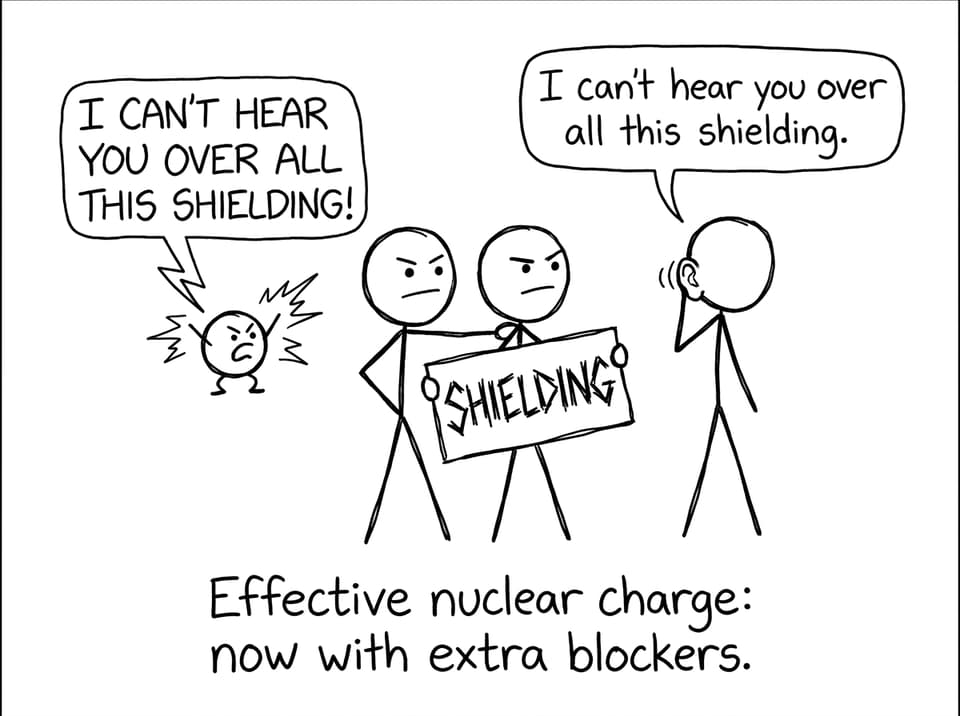
Each added shell brings inner electrons that sit between the nucleus and the valence electrons. Those inner electrons repel the outer electrons and also block some of the nucleus’ attraction. This is electron shielding, and it reduces the effective nuclear charge (Zeff) felt by the valence shell.
The practical outcome: the nucleus can’t “reach” the outer electrons as effectively, so the outer shell sits further out, and atomic radius increases down a group.
For a deeper explanation you can borrow directly into your long-answer style, see IB Chemistry: Electron Shielding and Chemical Behavior.
Why this trend matters for reactivity and bonding
Atomic size isn’t a trivia point. In IB Chemistry, it’s a shortcut to predicting behaviour:
-
Group 1 metals become more reactive down the group because the outer electron is farther away and more shielded (easier to lose).
-
Halogens become less reactive down the group because gaining an electron becomes harder as the atom gets larger.
-
Bond lengths generally increase down a group because larger atoms have orbitals that overlap at longer distances.
If you want the trend framed more broadly, read What Is the Periodic Trend for Atomic Radius? and pair it with Trends in Atomic Radius Explained.
Quick practice: the 10-second markscheme sentence
In IB Chemistry, a safe, compact sentence looks like this:
“Down a group, atoms have more occupied electron shells, so valence electrons are further from the nucleus and more shielded; effective nuclear charge felt by valence electrons is lower, so attraction decreases and atomic radius increases.”
Then practise writing it under time pressure with the IB Chemistry Periodicity Questionbank.
Conclusion: turn a memorised trend into a predictable one
Atomic radius increases down a group because atoms add electron shells, and those extra shells create distance and shielding that weaken the nucleus’ pull on the valence electrons. In IB Chemistry, that single idea lets you explain not only size, but also reactivity, bond length, and several other periodic trends.
To make this feel automatic before exams, use RevisionDojo as your full toolkit: learn the logic in Study Notes, drill it in the Questionbank, lock it in with Flashcards, and test your phrasing with AI Chat and Grading tools. When you’re ready to simulate the real thing, RevisionDojo’s Predicted Papers, Mock Exams, Coursework Library, and Tutors help you practise like it counts, because it does.


