



The decimal place that started an argument
In IB Chemistry, there’s a familiar moment in the lab: you and a friend stare at the same scale, the same meniscus, the same number… and still write down slightly different values. It feels like someone must be wrong.
But that tiny disagreement is the point. Uncertainties accompany all experimental measurements because measurement is never a perfect snapshot of reality; it’s a translation. Instruments translate mass, volume, and temperature into numbers, and every translation comes with a margin.
A quick checklist: what examiners want you to show
Use this mini-checklist whenever uncertainty appears in IB Chemistry questions or your IA:
-
State the measured value with units and a sensible ± uncertainty.
-
Match your decimal places to the instrument’s resolution.
-
Distinguish random vs systematic effects.
-
Explain whether a difference is significant compared with uncertainties.
-
Remember uncertainty affects any calculated value through propagation.
For exam-focused practice on this exact skill set, the IB Chemistry Topic 11.1 Questionbank is the fastest way to see how the IB frames these ideas.
Why uncertainties exist (even when you’re careful)
Instruments have built-in limits
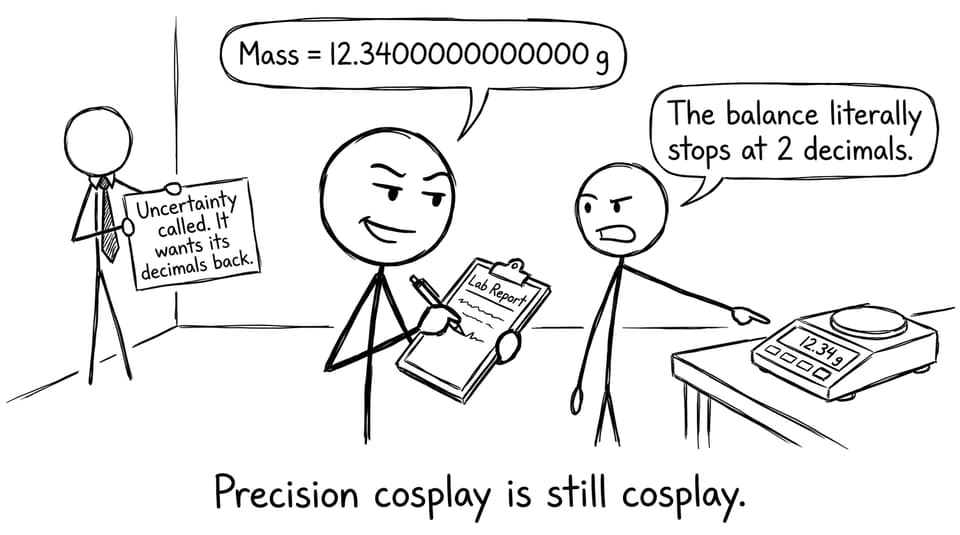
Every tool has a smallest step it can reliably show. A balance reading to 0.01 g cannot justify reporting 0.0001 g, no matter how confident you feel. In IB Chemistry, that limit is your starting point for uncertainty.
-
Digital apparatus: uncertainty is usually the smallest displayed increment.
-
Analogue apparatus: uncertainty is typically half the smallest scale division.
That logic shows up constantly in data-based questions, and it’s also the backbone of good data recording in investigations. If you want a clear IA-ready explanation of tables, units, and uncertainty notation, see 2.2 Data analysis (IB Chemistry IA guide).
Humans add variation (especially with menisci)
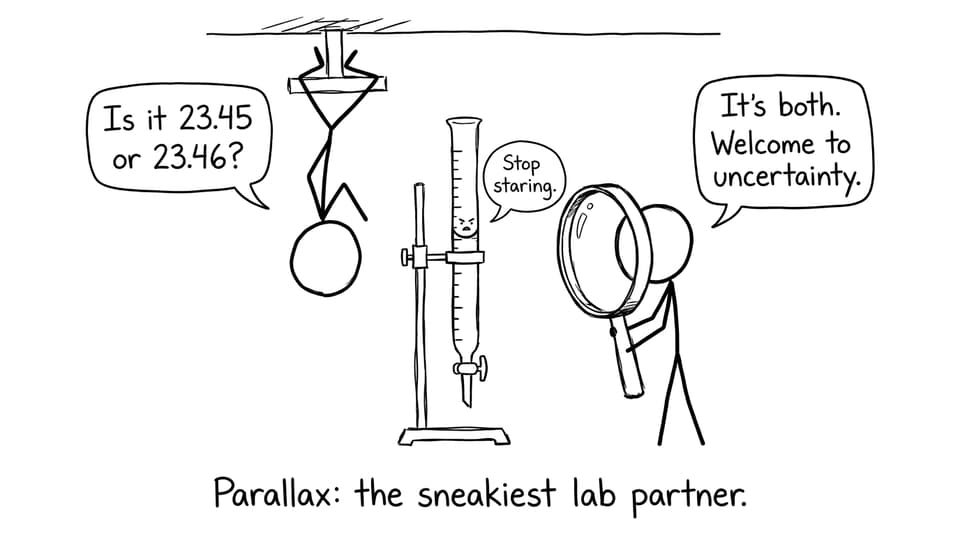
Even if the instrument is perfect, your reading might not be. Parallax error, meniscus interpretation, reaction endpoints, and timing all add tiny variations. That’s not “sloppy”; it’s normal experimental reality.
The environment refuses to hold still
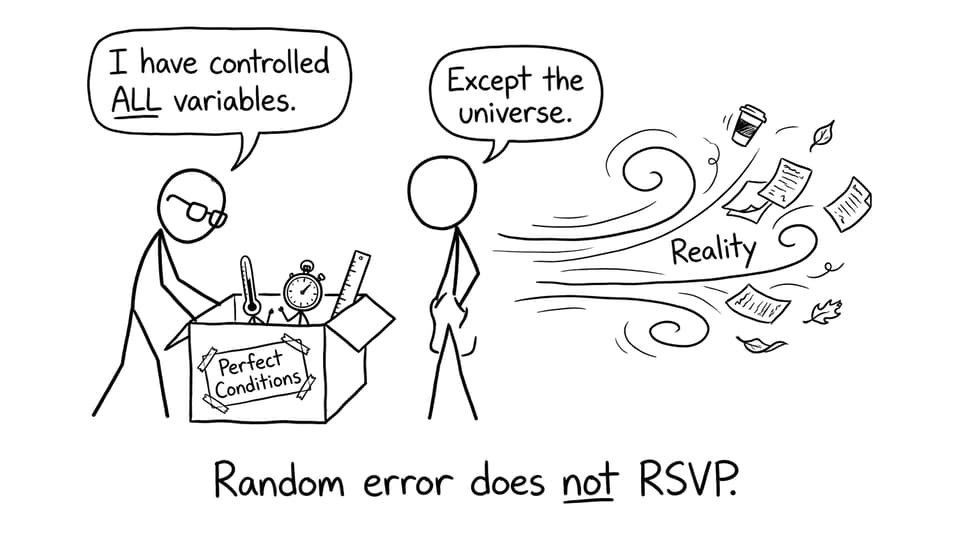
Temperature drifts, vibrations, impurities, and slight differences in technique cause repeated trials to scatter. Those are random uncertainties: unpredictable fluctuations that widen your range.
By contrast, a consistent bias (like a miscalibrated sensor) acts as a systematic uncertainty: it nudges all measurements in one direction.
Why uncertainty matters in IB Chemistry exams (and your IA)
Uncertainty isn’t an apology. It’s how chemists communicate honesty.
In IB Chemistry, uncertainty helps you:
-
Judge whether two results are meaningfully different or just within expected spread.
-
Avoid “false precision” from over-rounding or under-rounding.
-
Explain reliability and improvements in evaluation questions.
-
Handle propagation when calculating values like concentration or enthalpy change.
If you keep losing marks for presentation and analysis, it’s usually not the chemistry; it’s the structure. The checklist-style habits in How to Avoid Common Mistakes in IB Chemistry Exams pair perfectly with uncertainty questions.
Bring it back to your RevisionDojo practice loop
Once you see uncertainty as a feature (not a flaw), IB Chemistry becomes calmer. You stop chasing perfect numbers and start defending reasonable ones.
To lock this in, build a simple loop on RevisionDojo: use the Study Notes to review definitions, drill uncertainty questions in the Questionbank, refine your wording with AI Chat, and check your method with Grading tools. When you want exam realism without guesswork, use Mock Exams and Predicted Papers to practise writing uncertainty statements under time pressure. That’s how uncertainty stops being a paragraph you fear and becomes marks you can reliably collect.
For more exam-focused chemistry support, start at the main IB Chemistry hub and browse the IB Chemistry posts collection.