

Strong acids have a reputation in IB Chemistry: drop them in water and they “just work.” Weak acids feel moodier. They ionize, but only a little, and they insist on keeping most molecules intact.
That difference isn’t about how much acid you added. It’s about how strongly the acid “wants” to hand over its proton once water is present, and how comfortable the conjugate base feels after the handoff.
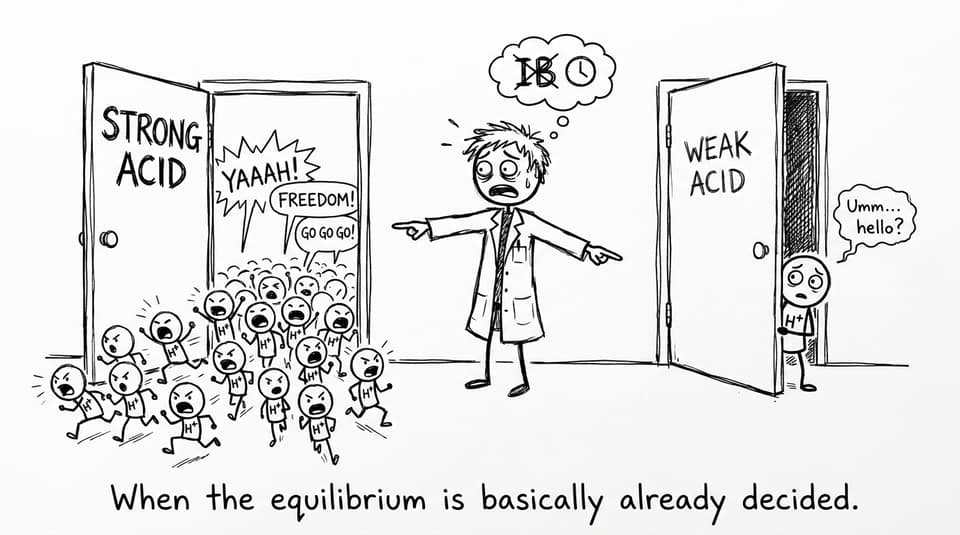
IB Chemistry snapshot: what “ionize completely” really means
In water, an acid transfers a proton to water:
-
Strong acid: essentially all HA molecules donate H⁺ to H₂O.
-
Weak acid: only some HA molecules donate H⁺; the rest stay as HA.
For weak acids, you should think “equilibrium,” not “one-way reaction”:
[\mathrm{HA(aq) \rightleftharpoons H^+(aq) + A^-(aq)}]
Want the definitions and exam phrasing in one place? See What’s the Difference Between a Strong and a Weak Acid? and the syllabus-aligned notes at R3.1.6 Strong and weak acids and bases.
Why strong acids ionize completely in water
In IB Chemistry, strong acids behave like reactions that are overwhelmingly product-favored. Two ideas usually explain most of the story.
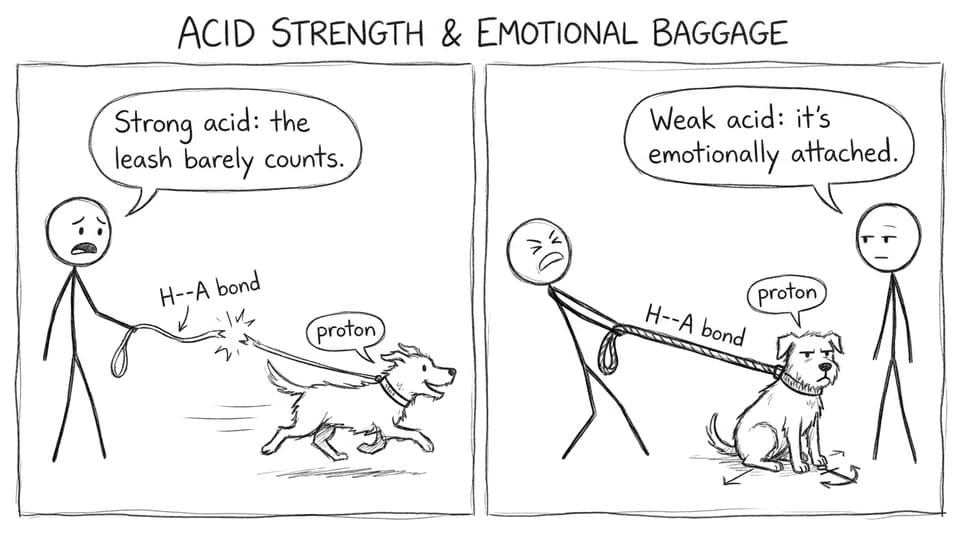
Bond polarity and H--A bond strength
If the H--A bond is highly polarized (electron density pulled away from H), the proton becomes easier to remove. Water can then stabilize that proton as hydronium, H₃O⁺, so dissociation is strongly favored.
The conjugate base is unusually stable
After dissociation, you’re left with A⁻. For strong acids, A⁻ is a weak base: it doesn’t “want” the proton back. That stability keeps equilibrium far to the right.
If you’re shaky on identifying conjugate pairs quickly, practice with Conjugate acid--base pairs explained.
Why weak acids only partially ionize
Weak acids aren’t “broken.” They’re just balanced.
Their H--A bond is harder to break (and/or less polarized)
Water can still pull off some protons, but not enough to make full dissociation energetically favorable.
Their conjugate base is less stable (more proton-hungry)
A⁻ from a weak acid is a stronger base, meaning it more readily grabs H⁺ again. So the system settles into a dynamic equilibrium with both HA and ions present.
This is exactly what the acid dissociation constant captures.
Where Ka and pKa fit (and why IB Chemistry loves them)
For weak acids:
[K_a = \frac{[H^+][A^-]}{[HA]}]
-
Large Ka (small pKa) means more ionization.
-
Small Ka (large pKa) means less ionization.
Strong acids don’t meaningfully use Ka in the same way because dissociation is essentially complete.
For the exam, connect this to calculations and interpretation using:
-
The deeper HL notes: R3.1.10 Acid and base strength and constants
Quick exam checklist (30 seconds)
Use this when you see “strong vs weak acid” in IB Chemistry:
-
Strength = degree of ionization, not concentration.
-
Strong acids: equilibrium overwhelmingly to the right.
-
Weak acids: reversible arrow, equilibrium mixture.
-
Strong acid conjugate base is very weak.
-
Weak acid conjugate base is stronger.
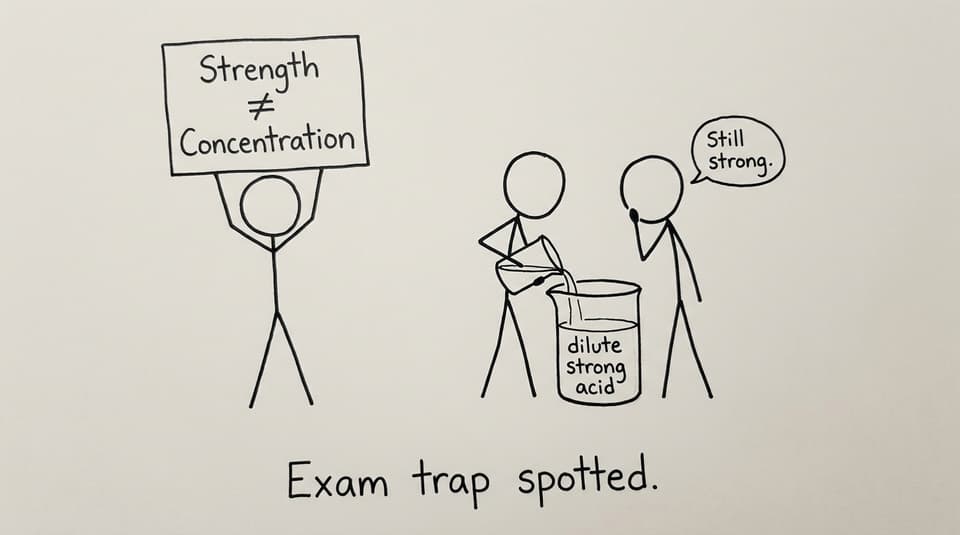
Bring it home: make this topic easy to score
Once you see that “complete vs partial ionization” is really about equilibrium position, bond polarity, and conjugate-base stability, IB Chemistry acid strength stops feeling like trivia and starts feeling like logic.
If you want this to stick under time pressure, RevisionDojo is built for that: drill acid equilibria with the Acids and Bases hub, target weak/strong acid skills in the 8.4 Strong and weak acids and bases Questionbank, and lock in definitions with Flashcards, step-by-step Study Notes, and AI Chat. When you’re ready to test it like the real thing, use Mock Exams, Predicted Papers, and Grading tools--or pull in Tutors when you want feedback that’s unmistakably human.