The moment you realize “heat released” isn’t random
One reaction warms the room like a tiny space heater. Another barely changes the thermometer. If you’ve ever stared at an energetics question in IB Chemistry and thought, Why are these energy values so different?, the answer is calmer than it looks.
Energy release isn’t luck. It’s bookkeeping.
In IB Chemistry, a reaction releases more energy when the total energy released by forming new bonds is much larger than the total energy required to break old bonds. The bigger the drop from reactants to products, the more exothermic the reaction (more negative ΔH).
Quick checklist: what makes a reaction “more exothermic” in IB Chemistry?
-
Weak bonds broken, strong bonds formed (large negative ΔH)
-
Products are more stable (lower potential energy)
-
Reactants are strained or high-energy (big energy drop when they relax)
-
Sometimes: products have greater dispersal/entropy (helps overall favorability)
-
Remember: rate is about activation energy, not ΔH
For syllabus-aligned revision, start with Energetics and Thermochemistry Notes and then drill the idea with the Energetics and Thermochemistry Questionbank.
Bond enthalpy: the “energy bill” behind every reaction
A useful mindset for IB Chemistry: bonds are like contracts. Breaking them has a fee. Forming new ones gives a payout.
-
Bond breaking is endothermic (energy in)
-
Bond formation is exothermic (energy out)
So the reaction energy change is essentially:
ΔH ≈ (sum of bond energies of bonds broken) − (sum of bond energies of bonds formed)
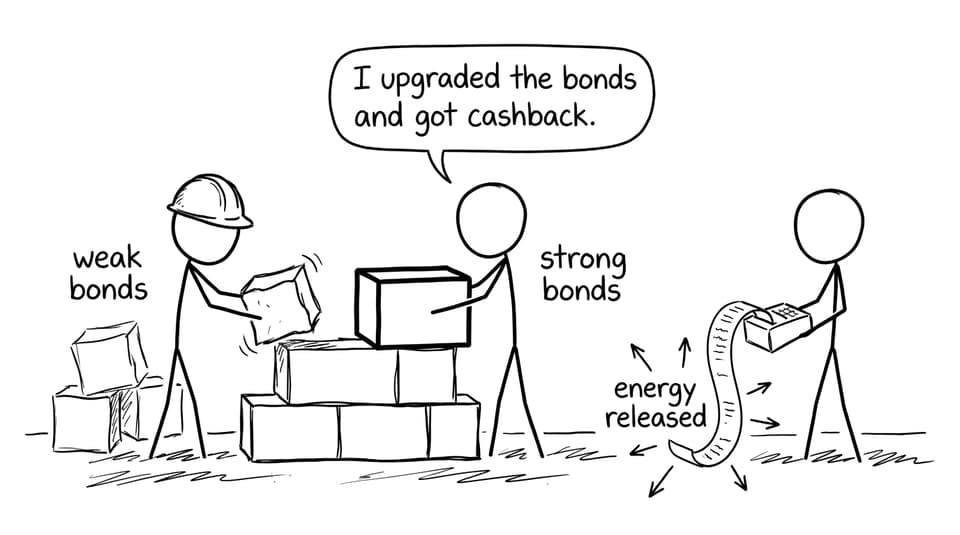
If the new bonds formed are significantly stronger (higher bond enthalpy) than the bonds you broke, the “payout” is bigger than the “fee,” and you get a larger energy release.
To tighten this explanation the way examiners like, revise Bond Enthalpy Notes (R1.2.1) and the walkthrough in Bond Enthalpy Explained for IB Chemistry.
Stability: why combustion “pays out” so much
Some products sit at unusually low energy. Combustion is the classic IB Chemistry example because products like CO₂ and H₂O contain very strong, stable bonds (notably C=O and O-H). The system “wants” to fall into that lower-energy arrangement, so it releases a lot of heat along the way.
If you want an exam-ready definition and common mistakes, see Enthalpy of Combustion Explained and keep the IB Chemistry Data Booklet handy for relevant values.
High-energy reactants: strain is stored potential energy
Another reason energy release varies: sometimes reactants are awkwardly built.
Ring strain and unstable arrangements store potential energy, like a bent spring. When a reaction converts that strained structure into something more relaxed and stable, the “spring” uncoils, and the energy difference shows up as a larger negative ΔH.
When questions get more complex than one-step bond counting, IB Chemistry expects you to use cycles. That’s where Hess’s law becomes your calm shortcut: Hess’s Law Explained Simply and R1.2 Energy Cycles in Reactions.
Don’t mix up “more energy released” with “faster”
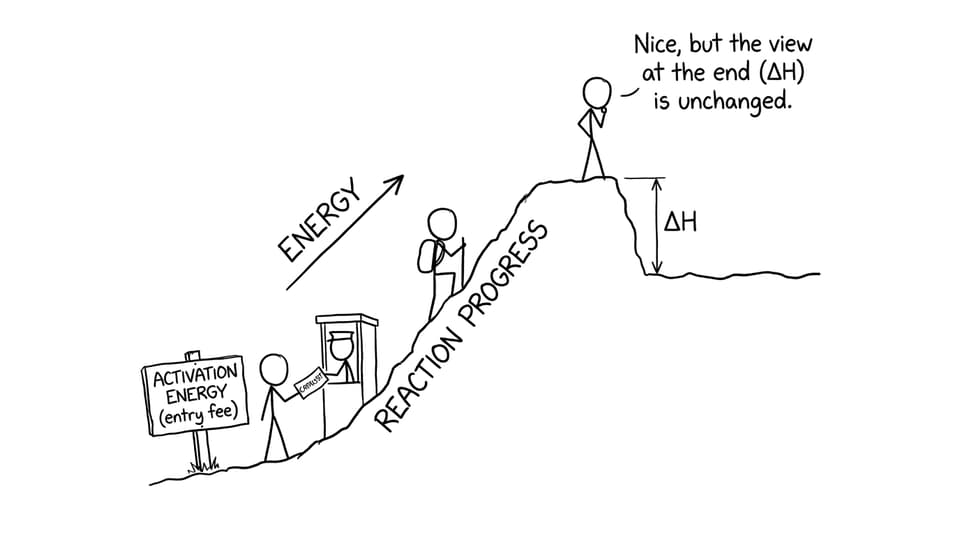
A reaction can release lots of energy and still be slow if it has a large activation energy barrier. For that distinction, revise What Is Activation Energy? IB Chemistry Explained and How Catalysts Lower Activation Energy.
Bring it back to your RevisionDojo routine
If you can explain energy release using IB Chemistry language, bonds broken vs bonds formed, stability, and activation energy vs ΔH, you stop guessing and start reasoning.
Use RevisionDojo as your home base: learn the concept with Study Notes and Flashcards, test it with the Questionbank, and then build exam stamina with Mock Exams and Predicted Papers. If you get stuck on wording, AI Chat can help you polish explanations to match command terms, and Grading tools can show what a top-mark response looks like. When you want extra support, the Tutors and Coursework Library help you turn confusion into a plan.
Ready to make energetics feel predictable? Start at IB Chemistry Resources and practise until IB Chemistry energetics becomes boring in the best way.

