


In IB Chemistry, the octet rule can feel like a comfort blanket: count electrons, draw neat dots, move on. Then you meet BF₃, SF₆, or NO₂ and suddenly the blanket has holes. It’s not that you learned the “wrong” rule. It’s that nature doesn’t grade with a rubric. Atoms settle for the lowest-energy arrangement available, even if it looks like it’s breaking your favorite guideline.
What matters for exams is being able to explain why the octet rule fails in specific cases, and how to choose the most reasonable Lewis structure under pressure.
A quick IB Chemistry checklist for octet rule exceptions
When you see a “weird” Lewis structure question in IB Chemistry, check:
-
Is the central atom electron-deficient (often Be or B)?
-
Is the central atom from Period 3 or higher, allowing an expanded octet in the IB model?
-
Is there an odd number of valence electrons (a radical)?
-
Does forcing an octet create unreasonable formal charges?
If you want the syllabus-aligned language for this, keep the IB Chemistry Key Definitions open while you practise.
Electron-deficient atoms: stable with less than eight
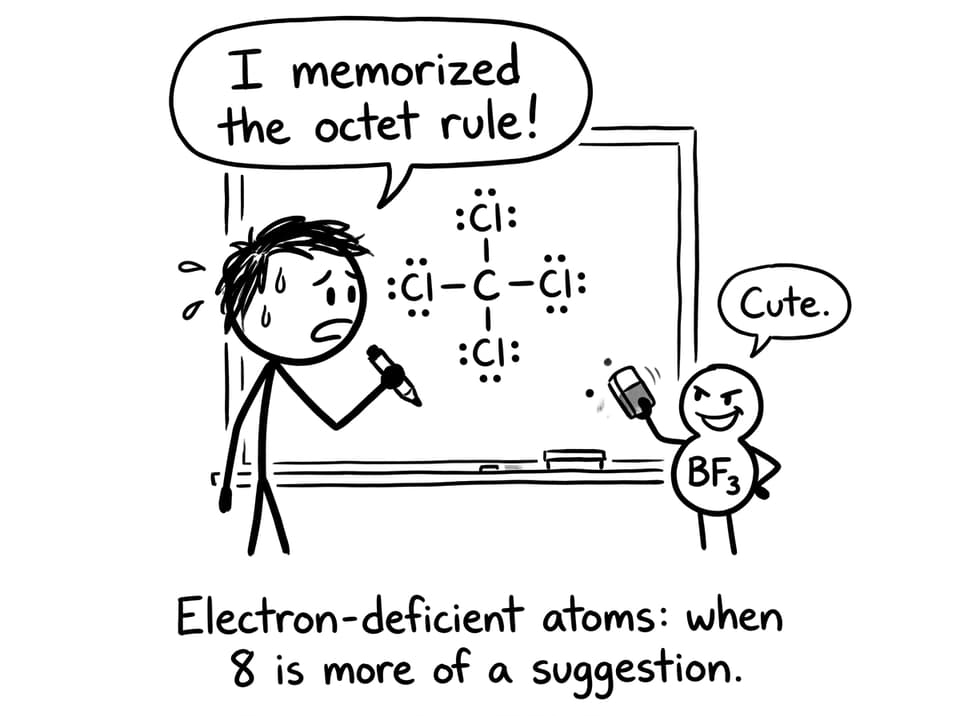
Some molecules violate the octet rule because the central atom simply ends up with fewer than eight electrons and that’s still the best option.
Classic IB Chemistry examples include boron compounds like BF₃. Boron forms three bonds, giving it six electrons around the central atom. Forcing it to “reach eight” would require awkward bonding or formal charges that don’t match the most stable picture.
This connects neatly to Lewis acid-base ideas too: electron-deficient centers often behave as electron-pair acceptors.
Expanded octets: Period 3 and beyond can exceed eight
In IB Chemistry, Period 3 elements (and below) are treated as able to accommodate more than eight electrons around the central atom. That’s why you’ll see molecules like PCl₅ and SF₆ used as standard expanded-octet examples.
The exam logic is simple: when extra electron domains reduce electron-electron repulsion and produce a more stable arrangement, the structure with more than eight electrons is preferred.
If chlorine expanded octets confuse you, this guide is worth bookmarking: Can Chlorine Have an Expanded Octet? IB Chemistry Explained. For the course-aligned notes, use S2.2.13 Expanded Octet of Electrons Notes and the matching Expanded Octet Flashcards.

Odd-electron species: radicals can’t “pair up” neatly
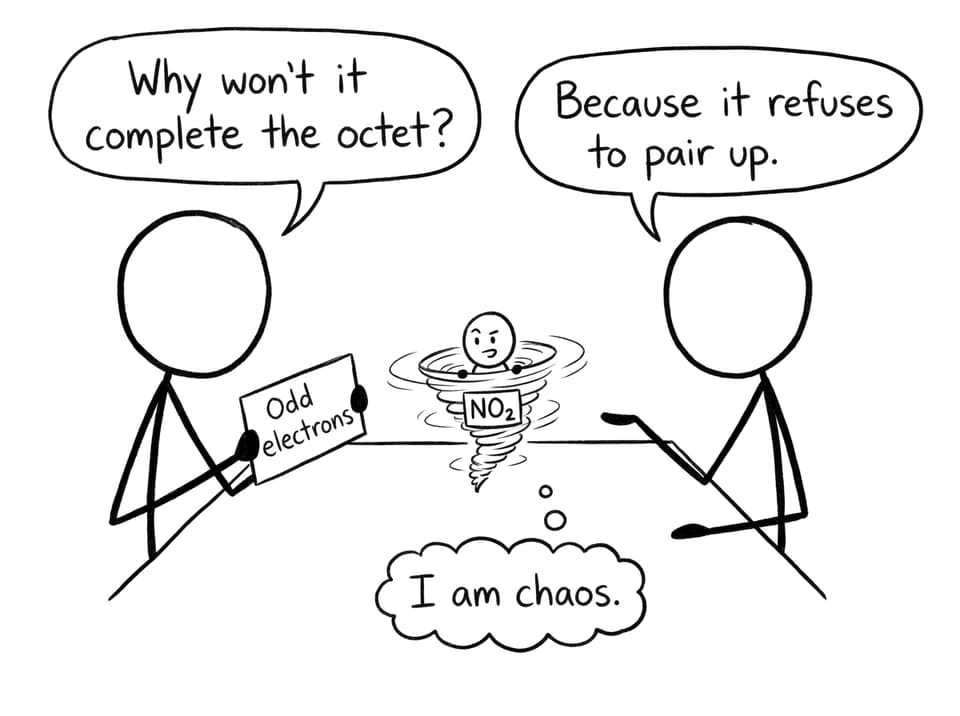
A third category is molecules with an odd number of electrons, like NO and NO₂. You cannot distribute an odd number into perfectly paired bonds and lone pairs, so something stays unpaired.
In IB Chemistry, you don’t need to overcomplicate this: the key is stating that radicals contain an unpaired electron, so a full octet on every atom is impossible. These species are often reactive precisely because unpaired electrons are energetically uncomfortable.
Formal charge: the tie-breaker examiners love
Sometimes the octet rule isn’t the main decision-maker: formal charge is. If forcing an octet produces large or unrealistic charges, an exception (expanded or incomplete) may be more reasonable.
RevisionDojo’s S2.2.14 Formal Charge and Lewis Formulas Notes and Formal Charge Flashcards are the fastest way to make this automatic.
Bring it home with RevisionDojo
Octet exceptions are where IB Chemistry starts to feel like thinking instead of colouring-in dots. To make that thinking automatic, use RevisionDojo’s Study Notes, drill the matching Flashcards, then test yourself with Questionbank items until the patterns stick. When you want fast feedback, the AI Chat can walk you through electron counting and formal charge choices, and our Grading tools help you write examiner-friendly explanations. Add Mock Exams and Predicted Papers for timing, and use the Tutors and Coursework Library when you need a human to untangle a stubborn misconception.
If you can explain electron-deficient atoms, expanded octets, and odd-electron radicals clearly, you’re not just surviving the octet rule in IB Chemistry and you’re turning it into marks.


