

The redox argument that keeps showing up on exams
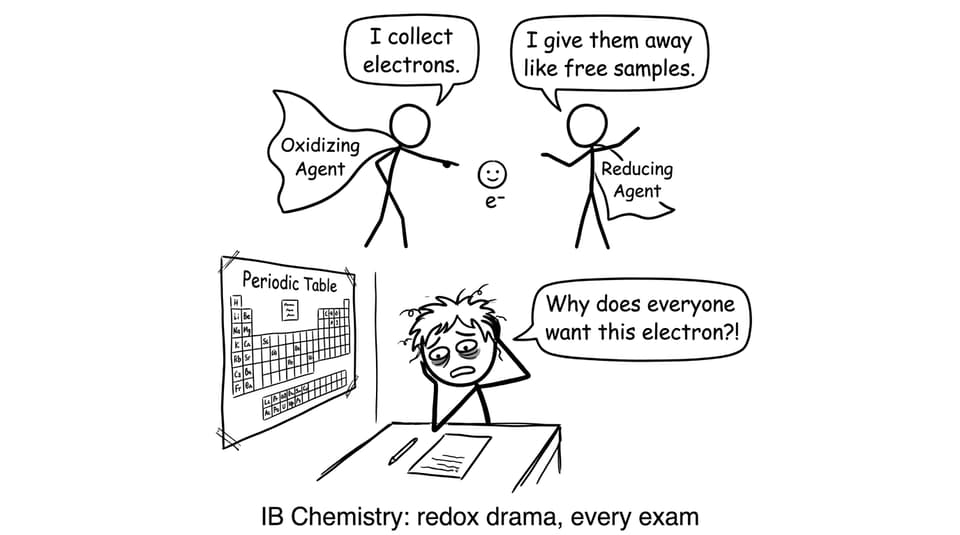
In IB Chemistry, redox can feel like a school hallway at break time: one student is desperately trying to get rid of something, while another is quietly collecting it like it’s valuable. That “something” is the electron, and the whole mystery of why some elements are better oxidizing or reducing agents than others comes down to how badly they want electrons (or how easily they can let them go) -- and how stable they feel afterward.
If you want a quick refresher on what’s actually happening in a redox reaction, pair this with What’s a Redox Reaction? IB Chemistry Explained and Oxidation and Reduction Explained for IB Chemistry.
A fast IB Chemistry checklist for redox strength
Use this IB Chemistry checklist when you’re asked to compare oxidizing vs reducing agents:
-
Electronegativity: higher EN usually means a better electron acceptor (oxidizing agent).
-
Ionization energy: lower IE means electrons are easier to remove (reducing agent).
-
Atomic/ionic radius + shielding: bigger atoms hold valence electrons less tightly.
-
Electron configuration: moving toward a noble-gas-like stability matters.
-
Stability of the products: stable ions drive redox forward.
-
Standard electrode potential (E°): the exam-friendly “summary number.”
For practice that mirrors exam phrasing, RevisionDojo’s IB Chemistry Redox Processes hub is the cleanest place to consolidate the topic.
Why strong oxidizing agents are so “electron-hungry” in IB Chemistry
In IB Chemistry, an oxidizing agent is the species that gets reduced (it gains electrons). Strong oxidizers are good at pulling electrons toward themselves because that electron gain is energetically favorable.
Two common reasons:
-
High electronegativity and effective nuclear charge: Halogens (especially fluorine) attract electrons strongly. Small radius + strong pull = strong tendency to be reduced.
-
High oxidation state species that become much more stable when reduced: For example, Mn in permanganate ends up in a more stable state after reduction in acidic conditions, which is why permanganate is such a classic oxidizer.
To lock in the definition and exam signals, see Oxidizing Agents Explained for IB Chemistry.
Why strong reducing agents let electrons go so easily
A reducing agent is the species that gets oxidized (it loses electrons). Strong reducers are “generous” with electrons because their outer electrons are weakly held.
Classic IB Chemistry pattern:
-
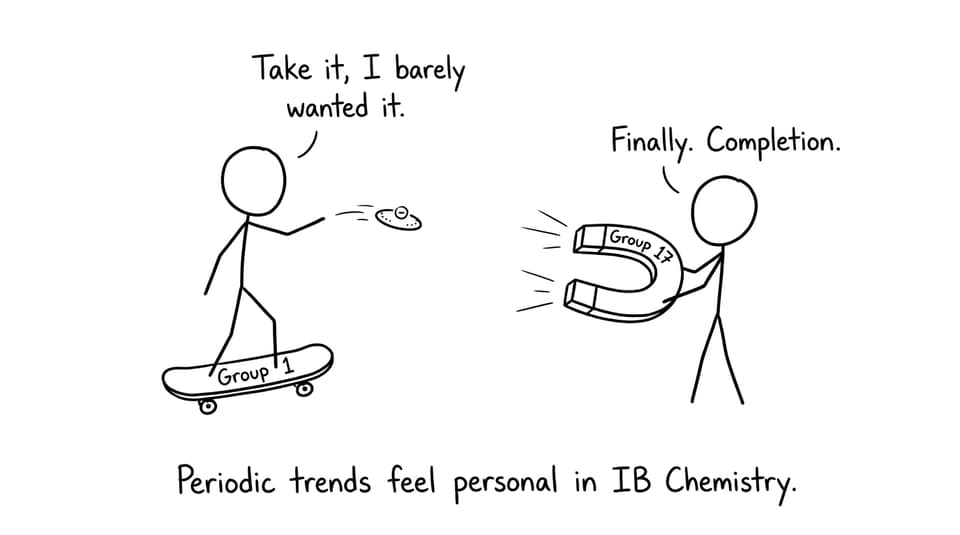
Group 1 metals have low ionization energies and one valence electron. Losing it quickly creates a stable cation with a noble-gas-like configuration.
-
Larger atomic radius and shielding (down a group) makes electron loss even easier, so reducing power tends to increase down Group 1.
These periodic trends show up constantly in paper questions, especially when they ask you to justify reactivity.
The exam shortcut: use E° values to rank oxidizers and reducers
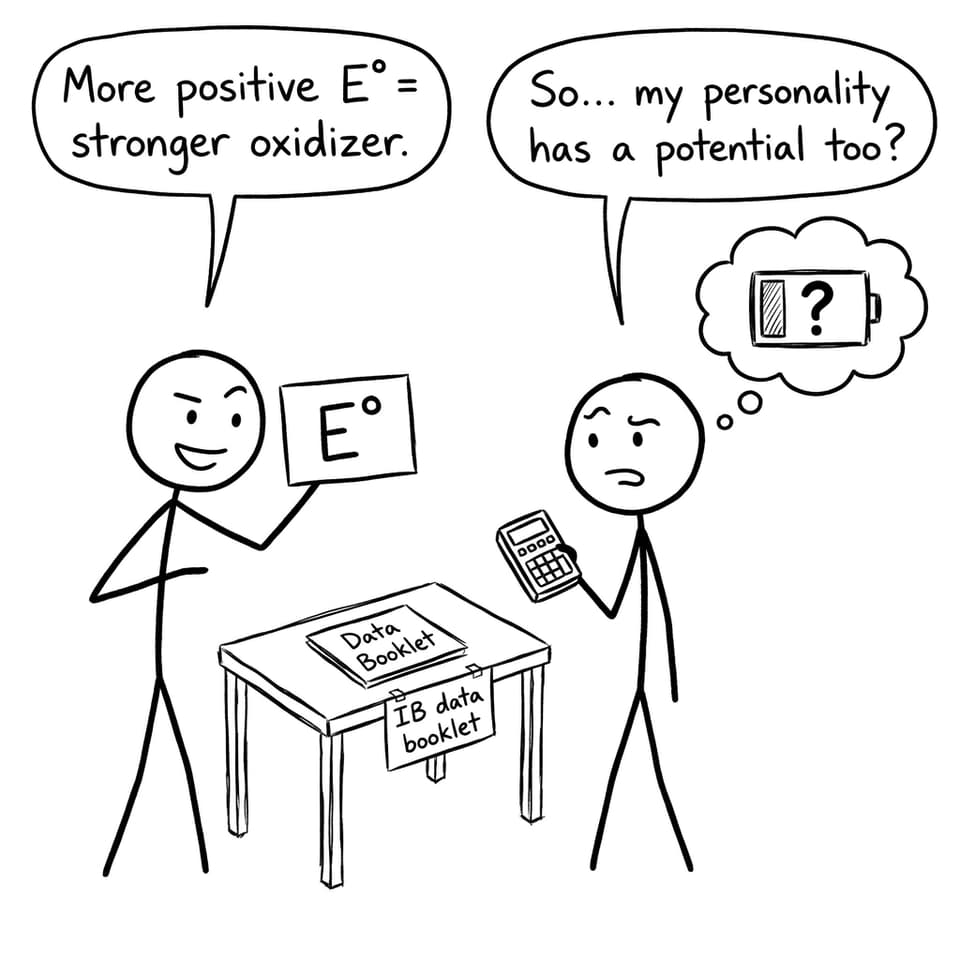
In IB Chemistry, E° values are the fastest way to compare oxidizing and reducing strength because they measure how easy reduction is.
-
More positive E° (for a reduction half-equation) means the species is more easily reduced -- a stronger oxidizing agent.
-
More negative E° means the reverse reduction is unfavorable, so the species in its reduced form tends to be oxidized -- a stronger reducing agent.
If E° is your weak spot, study it directly with Standard Electrode Potential Explained and then connect it to cell questions using IB Chemistry 9.2 Electrochemical Cells Notes.
Bring it home: how to make this easy on exam day
The deepest truth in IB Chemistry redox is simple: better oxidizing and reducing agents aren’t “more aggressive” -- they’re just moving toward greater stability through electron transfer. When you justify answers using electronegativity, ionization energy, electron configuration, and E° values, you’re not memorizing trivia; you’re explaining motivation.
If you want redox to feel predictable, build a short routine in RevisionDojo: revise with IB Chemistry Revision Notes (SL/HL), reinforce with Flashcards, then test yourself using the Questionbank and Mock Exams. And when you get stuck, AI Chat and Grading tools can help you fix the exact sentence the markscheme wants -- before the real exam asks the same idea in different clothing.