


IB Chemistry students usually meet the periodic table as a wall of colored boxes. Then, at some point (often the night before an exam), it starts to feel like a machine: predictable, repeating, and slightly judgmental. The reason those periodic patterns repeat isn’t luck or clever table design. It’s quantum structure doing what quantum structure always does: allowing only certain electron arrangements, then forcing atoms to build everything else on top of those constraints.
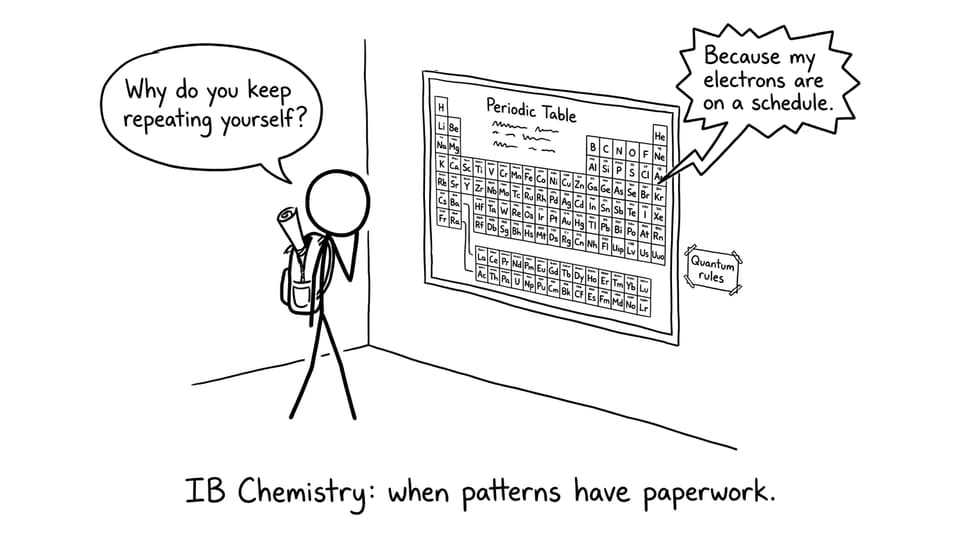
The IB Chemistry big idea: repeating valence electrons
In IB Chemistry, “periodicity” is basically the visible shadow of invisible electron structure. Electrons can’t sit anywhere they want. Quantum mechanics restricts them to discrete energy levels and sublevels (s, p, d, f). When elements build up electrons in those allowed slots, the outer configuration repeats in a pattern.
That repetition matters because chemistry happens at the edge of the atom: valence electrons control bonding, ion formation, and reactivity. So when the valence pattern repeats, properties repeat.
If you want an exam-ready refresher, pair this explanation with RevisionDojo’s Periodicity Explained Simply and the syllabus-aligned hub for IB Chemistry 3.2 Periodic Trends.
Quick checklist for exam answers (keep it causal)
When a question asks why a trend exists in IB Chemistry, aim for this chain:
-
Electron configuration changes systematically across a period
-
Valence electrons drive bonding and reactivity
-
Effective nuclear charge (Zeff) usually increases across a period
-
Shielding and distance dominate down a group
-
Orbital/sublevel details explain common “discontinuities”
For targeted practice, use the IB Chemistry 3.2 Periodic Trends Questionbank.
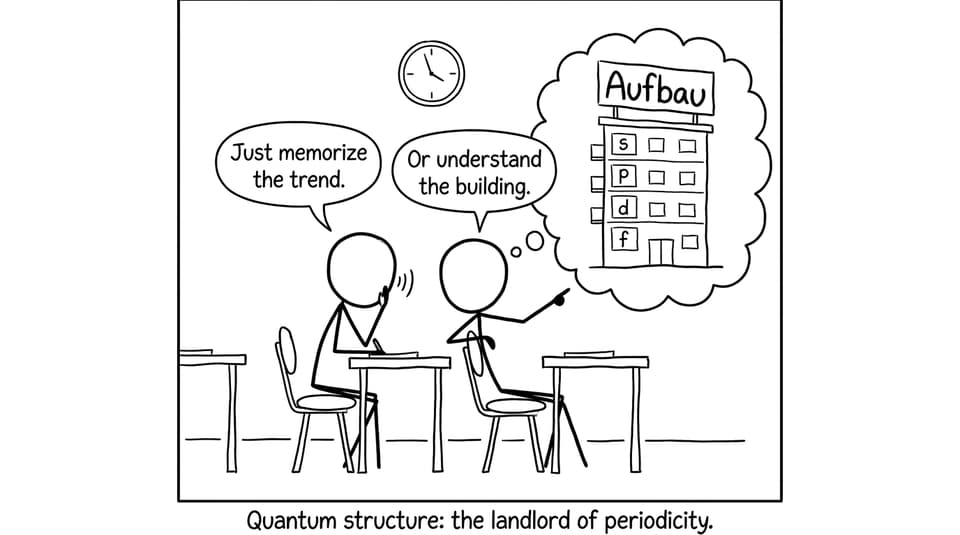
Quantum structure creates the filling pattern (Aufbau + friends)
Across a period, electrons are added to the same main energy level, but they fill different sublevels in a specific energy order (the Aufbau principle). That order is not arbitrary; it comes from quantized energies and orbital shapes.
This is why the p-block shows repeating “near-octet” behavior and why elements in the same group act like cousins. Their inner electrons differ, but their valence structures rhyme.
To tighten your explanation (and vocabulary), RevisionDojo’s notes on Orbital configurations and rules and Electrons in atoms are perfect IB Chemistry anchors.
Shielding and Zeff: the quiet engine behind trends
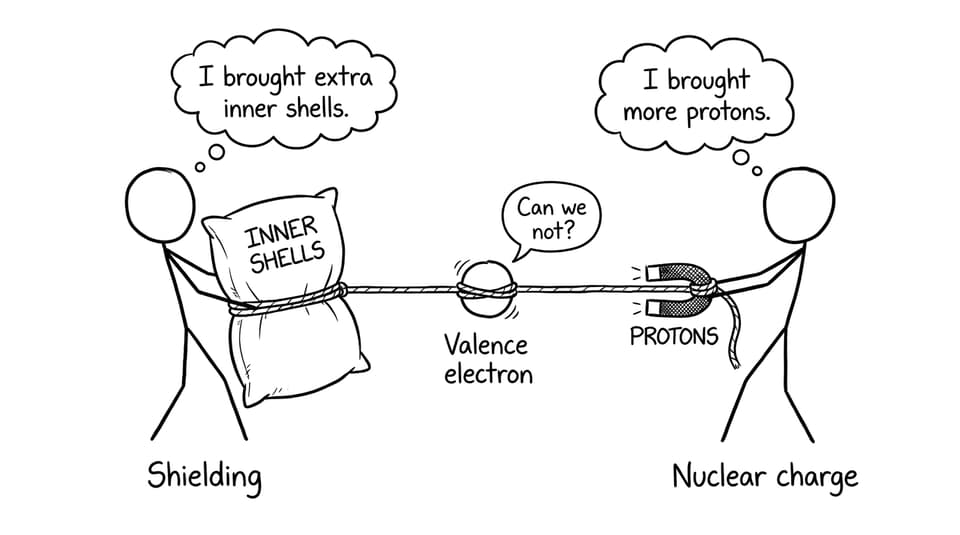
Many periodic patterns in IB Chemistry reduce to a tug-of-war: the nucleus pulling electrons in, and inner electrons getting in the way.
-
Across a period: protons increase, electrons go into the same shell, shielding changes only a little. Result: higher effective nuclear charge, smaller radius, higher ionization energy, higher electronegativity.
-
Down a group: a new shell is added, shielding increases sharply, and valence electrons are farther away. Result: larger radius, lower ionization energy, lower electronegativity.
If you want the cleanest wording for Paper 2 explanations, read Effective Nuclear Charge Explained and What Is the Shielding Effect?. For common mistakes, How do changes in electron shielding affect chemical behavior? is a strong add-on.
Why trends sometimes “break”: sublevels and stability
IB examiners love when you notice that ionization energy doesn’t rise perfectly smoothly. Those dips are still quantum structure, just more detailed quantum structure.
Examples of quantum-based “interruptions” include:
-
Moving from a filled s sublevel to a higher-energy p electron
-
Pairing electrons in a p orbital (extra repulsion)
-
The more complex behavior of d-block electrons, which shield differently and allow multiple oxidation states
RevisionDojo’s Discontinuities in ionization energy trends notes gives the exact language expected in IB Chemistry markschemes.
Bring it home: quantum structure is the reason patterns exist
Periodic patterns feel like a shortcut, but they’re actually a consequence. Quantum structure limits where electrons can live, electron configurations repeat, and IB Chemistry trends are the predictable ripple effect: radius, ionization energy, electronegativity, and reactivity all tracing the same underlying rules.
If you want to turn that understanding into exam marks, RevisionDojo is built for it: Study Notes for the model, Flashcards for definitions, the Questionbank for exam-style practice, AI Chat for “why” questions, and Grading tools plus Mock Exams to tighten your explanations. Add Predicted Papers when you’re close to the exam window, and use Tutors if you want someone to fix your reasoning in real time. In IB Chemistry, the table stops being a poster when you start using it like a map.


