

Oxidation and reduction sound like opposites you can memorize in five minutes. Then an exam question asks, “Identify the oxidizing agent,” and suddenly it feels like a logic puzzle with missing pieces.
In IB Chemistry, the confusion usually comes from one sneaky fact: the oxidizing agent gets reduced, and the reducing agent gets oxidized. That sounds backwards until you zoom in on what actually moves in every redox reaction: electrons.
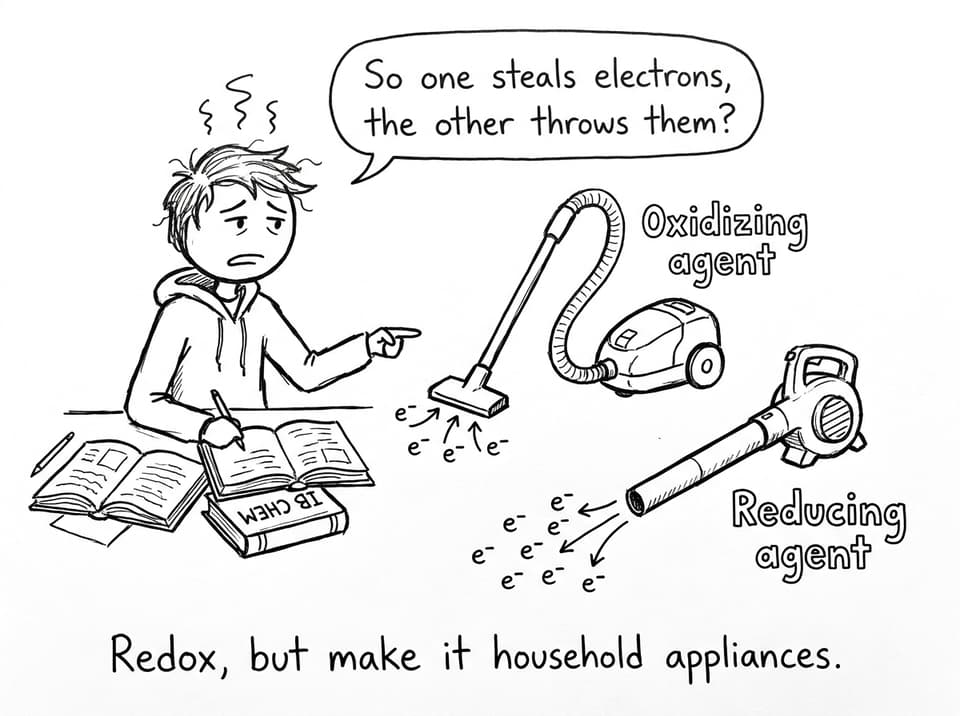
The one rule that makes IB Chemistry redox feel fair
Here’s the anchor idea you can return to under pressure:
-
Oxidation = loss of electrons
-
Reduction = gain of electrons
-
Oxidizing agent = electron acceptor (so it forces someone else to lose electrons)
-
Reducing agent = electron donor (so it forces someone else to gain electrons)
If you want the bigger picture first, pair this with What’s a Redox Reaction? IB Chemistry Explained and Oxidation and Reduction Explained for IB Chemistry.
Why oxidizing agents cause oxidation (even though they get reduced)
An oxidizing agent causes oxidation because it removes electrons from another species.
Think of it like this: if a species “steals” electrons from you, you must lose electrons. And in IB Chemistry, losing electrons is oxidation.
So:
-
The other species loses electrons → it is oxidized.
-
The oxidizing agent gains those electrons → it is reduced.
Example logic (no heavy math needed):
-
If Cu²⁺ turns into Cu(s), copper ions are gaining electrons.
-
Anything that gains electrons is being reduced.
-
Therefore Cu²⁺ is acting as the oxidizing agent because it makes something else give up electrons.
For more exam-style explanations and common oxidizers, see Oxidizing Agents Explained for IB Chemistry.
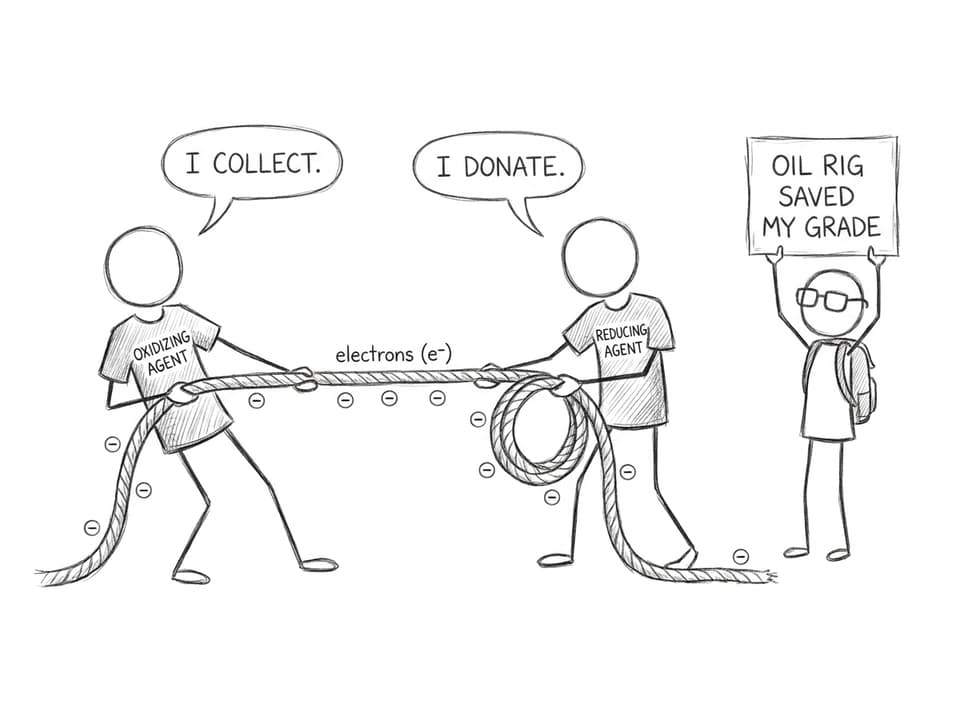
Why reducing agents cause reduction (even though they get oxidized)
A reducing agent causes reduction because it supplies electrons to another species.
That gift of electrons is what lets the other species undergo reduction.
So:
-
The other species gains electrons → it is reduced.
-
The reducing agent loses electrons → it is oxidized.
In many IB Chemistry questions, metals make this feel intuitive:
-
Reactive metals (like Na, Mg) “want” to lose electrons.
-
When they do, they reduce something else (often metal ions).
If you want to connect this to cells and electrodes, Electrolysis Explained for IB Chemistry (Fast + Clear) and IB Chemistry: How Batteries Work (Explained Simply) make the electron flow visual.
How E° values explain strength (the IB Chemistry way)
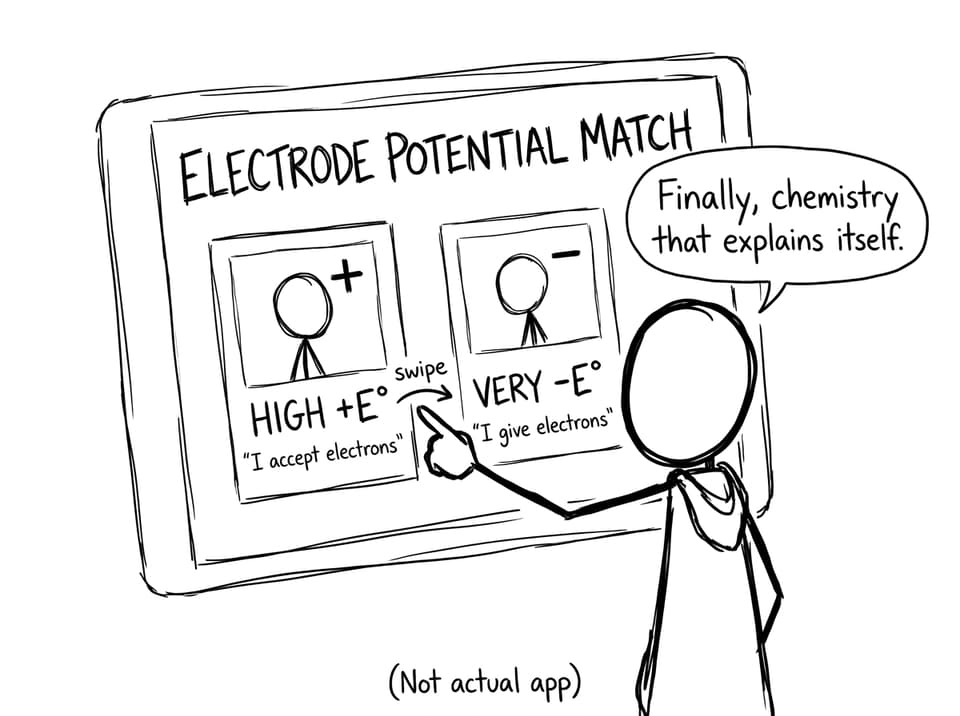
When IB Chemistry talks about “strong” oxidizing or reducing agents, it’s pointing you toward standard electrode potentials (E°).
-
More positive E° (greater tendency to be reduced) → stronger oxidizing agent
-
More negative E° (greater tendency to be oxidized) → stronger reducing agent
In plain language: species that really “like” gaining electrons tend to oxidize other things, and species that easily lose electrons tend to reduce other things.
For syllabus-aligned practice on this exact cluster of ideas, go straight to IB Chemistry Redox Processes and R3.2 Electron transfer reactions.
A quick exam checklist for identifying agents
Use this when you’re staring at a reaction and your brain goes quiet:
-
Find what is reduced (oxidation state decreases or electrons gained)
-
The thing that is reduced is the oxidizing agent
-
Find what is oxidized (oxidation state increases or electrons lost)
-
The thing that is oxidized is the reducing agent
-
If E° values are given: higher E° gets reduced
Bring it home with RevisionDojo
Redox gets easier when you stop memorizing labels and start following electrons. If you want that skill to hold under timed conditions, use RevisionDojo’s Study Notes and Flashcards to lock in definitions, then attack the Questionbank for exam-style identification drills. When you miss one, AI Chat can walk you through the electron flow step-by-step, and the Grading tools keep your explanations aligned to markscheme logic. When you’re ready to simulate pressure, build Mock Exams and use Predicted Papers to practice redox as it actually appears in IB Chemistry. If you want a human checkpoint, RevisionDojo Tutors can help you fix the one misconception that keeps repeating.
In IB Chemistry, oxidizing agents cause oxidation because they take electrons, and reducing agents cause reduction because they give electrons. Once you see that, the “backwards” naming becomes one of the most reliable shortcuts in the course.