


A hook you can feel in an exam hall
You know that moment in IB Chemistry when you spot the word oxidised and your brain tries to answer before the question finishes? That instinct is useful, but redox marks usually go to students who explain why oxidation and reduction are inseparable.
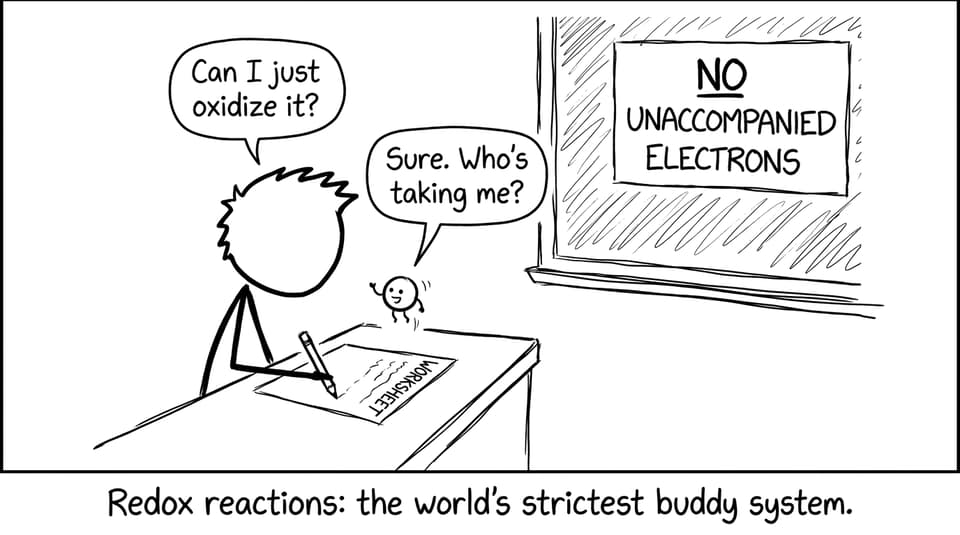
Here’s the simple idea that holds the whole topic together: electrons can’t vanish, and they can’t appear from nowhere. If one species loses electrons, something else must gain them. That “buddy system” is the reason oxidation and reduction always occur together.
The 20-second redox checklist (IB Chemistry friendly)
-
Oxidation = loss of electrons (oxidation state increases)
-
Reduction = gain of electrons (oxidation state decreases)
-
Electrons lost = electrons gained (charge is conserved)
-
Write two half-equations, then add them so electrons cancel
-
Identify oxidising agent (gets reduced) and reducing agent (gets oxidised)
For quick refreshers, pair this with Oxidation and Reduction Explained for IB Chemistry and What’s a Redox Reaction? IB Chemistry Explained.
Why oxidation and reduction always occur together (the real reason)
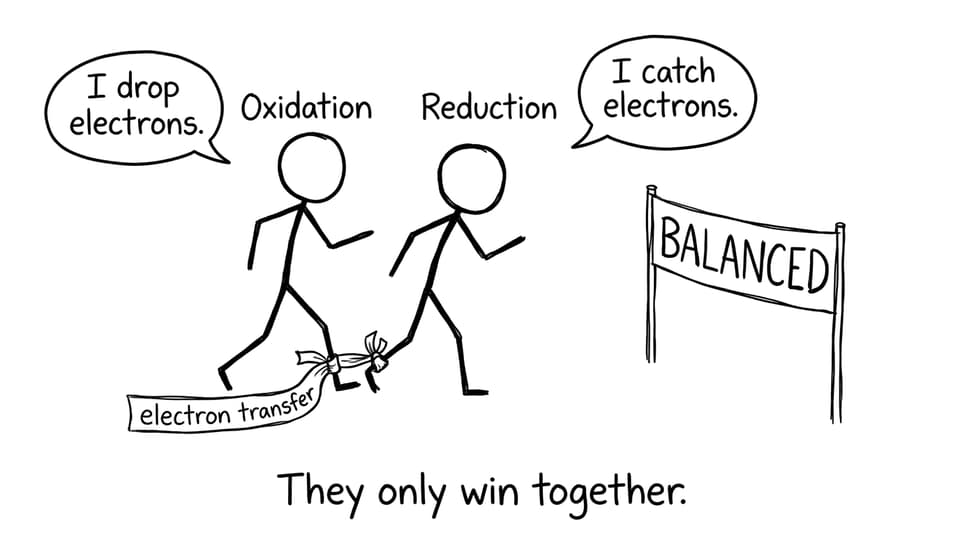
In IB Chemistry, oxidation is defined as loss of electrons. But “loss” is misleading if you picture electrons falling into empty space. In any real reaction, those electrons are transferred.
So the moment one particle is oxidised (it donates electrons), another particle must be reduced (it accepts electrons). This is not a chemistry preference; it’s conservation of charge. If electrons didn’t have a destination, your equation would imply charge appearing or disappearing, which is impossible.
A classic example is metal reacting with oxygen. Magnesium atoms lose two electrons each. Oxygen gains those electrons. The reaction is one event described from two angles: oxidation and reduction.
To practise spotting this fast, use the IB Chemistry Redox Processes topic hub.
How half-equations prove the pairing (and win marks)
Half-equations are basically the examiner saying: “Show me you understand the transfer.” You write one half for oxidation (electrons on the right) and one half for reduction (electrons on the left). Then you multiply if needed so electrons cancel.
That cancellation is the proof that oxidation and reduction occur together: the electrons produced are exactly the electrons consumed.
If your half-equations feel messy, RevisionDojo breaks the method into clean steps in IB Chemistry: Half-Equations Explained Simply and the syllabus-aligned notes page R3.2.1 Oxidation and reduction definitions Notes.
What about reactions where electrons aren’t written?
Some IB Chemistry questions hide the electrons inside covalent bonding. You may not see e⁻ in the equation, but oxidation states still change. That change is your signal that electron density has shifted enough to count as redox.
This is why oxidation numbers matter: they reveal “effective” electron loss and gain even when the reaction is written without ions.
For the next step into applications, see Redox Reactions Explained for IB Chemistry and (for real-life redox) IB Chemistry: Corrosion Explained.
Bring it home (and revise it properly)
Oxidation and reduction always occur together because electron loss only makes sense if something else gains those electrons. That one sentence anchors half-equations, oxidising agents, electrochemical cells, corrosion, and electrolysis across IB Chemistry.
If you want to turn that understanding into exam performance, RevisionDojo is built for it: use the Study Notes for clarity, the Questionbank for exam-style practice, Flashcards for definitions and agents, and AI Chat when a markscheme line feels cryptic. Then level up with Mock Exams, Predicted Papers, and Grading tools to spot weak links early. When you’re stuck, the Tutors and Coursework Library keep you moving.
Return to this rule near the end of your revision: in IB Chemistry, no electron travels alone, and neither does redox.