


A quick moment of confusion (that shows up on exams)
You look at a molecule like CO₂ or a noble gas and think: no permanent dipole, so no attraction… right? Then you remember that iodine is a solid, xenon can liquefy, and long-chain alkanes turn into wax. In IB Chemistry, that “wait, how?” moment is a gift. It points to the quiet force that shows up almost everywhere: London dispersion forces.
IB Chemistry exam questions love this because it tests whether you can move beyond “polar vs nonpolar” and explain why even nonpolar particles can stick together long enough to condense.
IB Chemistry checklist: what to mention in a full-mark explanation
When a question asks why nonpolar molecules condense, aim for this structure:
-
Name the key force: London dispersion forces (LDFs)
-
Explain the mechanism: instantaneous dipole then induced dipole
-
Link strength to polarizability (more electrons, larger electron cloud)
-
Link strength to surface area (shape matters)
-
Link condensation to temperature (lower kinetic energy)
For a clean syllabus-aligned refresh, keep Intermolecular Forces Explained open while you practise.
Why nonpolar molecules attract at all (instantaneous dipoles)
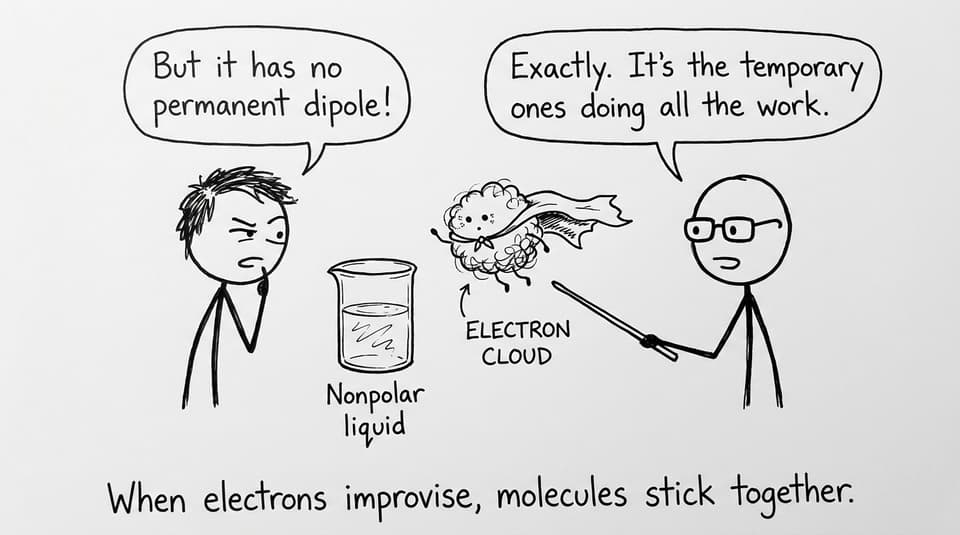
In IB Chemistry, the crucial line is: electrons are always moving. Even in a perfectly nonpolar molecule, the electron density can become uneven for an instant. That creates an instantaneous dipole.
That temporary dipole can induce a dipole in a nearby molecule (it nudges that neighbor’s electrons). Now you have two particles with opposite partial charges facing each other, and an attraction forms. It’s brief, but it happens constantly across a sample. The cumulative effect across billions of interactions is enough for condensation.
If you want the examiner language tight, the IB Chemistry glossary is a fast way to lock in definitions.
Polarizability: why heavier nonpolar substances condense more easily
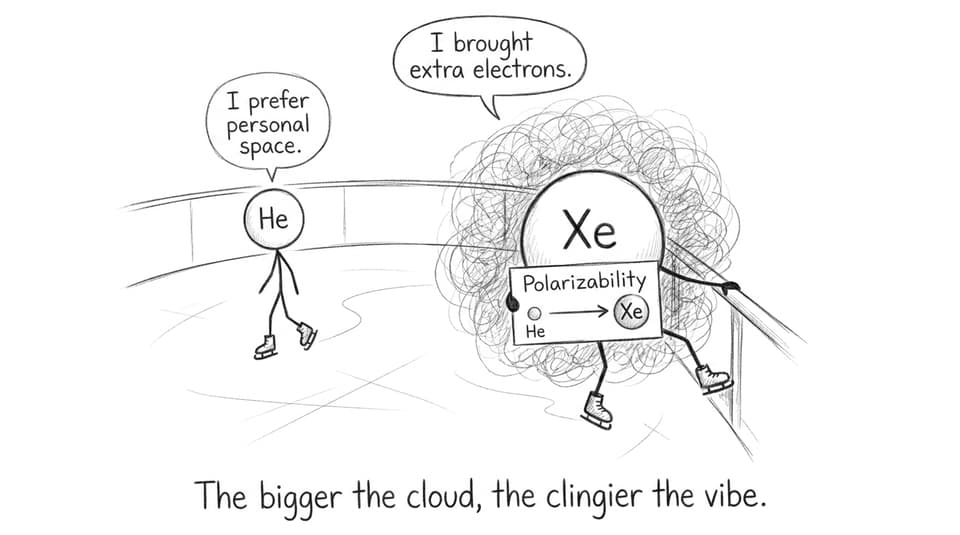
A good IB Chemistry explanation always connects LDF strength to polarizability. Bigger atoms and molecules have:
-
more electrons
-
more diffuse electron clouds
-
electron clouds that are easier to distort
So the temporary dipoles become more likely and more intense. That’s why, down Group 18, boiling points rise: helium barely condenses, xenon does so much more readily.
For deeper revision, see London Dispersion Forces Explained and the syllabus page for 4.4 Intermolecular forces.
Surface area: why “shape” can beat “mass”
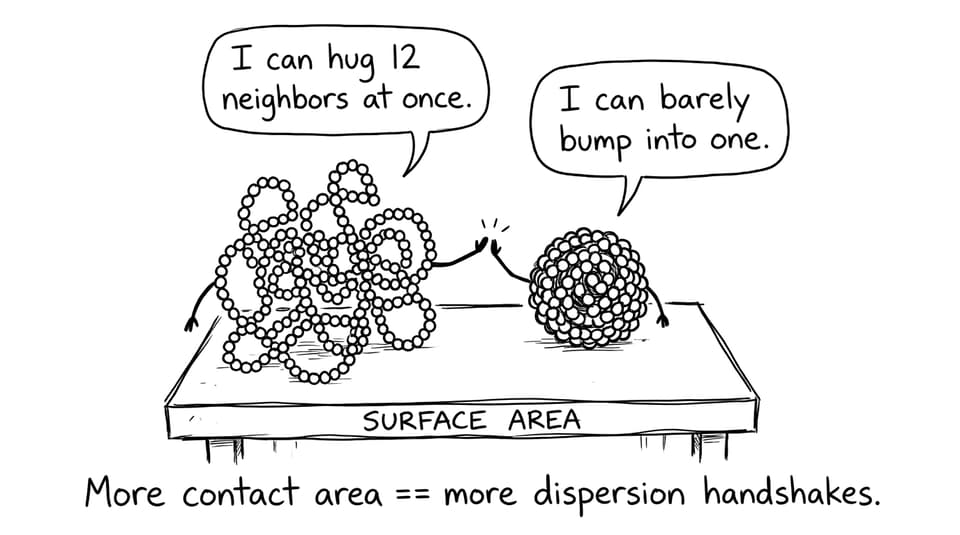
Two molecules can have the same formula but different shapes, and IB Chemistry expects you to notice that shape changes contact area.
Long, extended molecules can lie alongside each other, increasing the area where electron clouds interact. More contact means stronger total dispersion attractions. Compact, spherical molecules have less surface contact and weaker overall attraction.
This connects nicely to organic trends too. If you revise homologous series, Physical trends in homologous series notes help you phrase boiling point trends clearly.
Temperature: when motion stops overpowering attraction
Condensation is a competition:
-
LDFs pull molecules together
-
kinetic energy pulls them apart (random motion)
Lower the temperature and particles move more slowly, so even weak attractions can hold them together. That’s why many small nonpolar molecules stay gaseous at room conditions, but condense at sufficiently low temperatures.
To connect this to properties questions, read Why Intermolecular Forces Affect Physical Properties.
Closing: turn the “weak force” into a reliable scoring point
The trick is to stop treating “nonpolar” as “no attractions.” In IB Chemistry, nonpolar molecules condense because London dispersion forces are always running in the background: temporary dipoles, induced dipoles, and a cumulative pull that becomes stronger with polarizability, surface area, and lower temperature.
If you want this to feel automatic under exam pressure, RevisionDojo is built for it: revise with Study Notes and Flashcards, drill exam-style patterns in the Questionbank, test timing with Mock Exams and Predicted Papers, check explanations with AI Chat, and get sharper with Grading tools and Tutors. The goal isn’t just to remember the definition; it’s to write the explanation the markscheme is waiting for.


