


A small shortage that stops everything (IB Chemistry)
You can have a full desk of notes, a fresh calculator, and hours of motivation… and still get stuck because one tiny step is missing. Chemical reactions behave the same way. In IB Chemistry, the limiting reagent is that missing step: the single reactant that runs out first, forcing the reaction to stop and setting the maximum amount of product you can make.
That’s why limiting reagents determine the amount of product formed. Not because they’re “more important,” but because reactions can only move forward when every required particle shows up in the correct ratio.
Quick checklist: how to spot the limiting reagent
When a question feels messy, anchor yourself with this IB Chemistry routine:
-
Write the balanced equation (ratios live here)
-
Convert each reactant to moles
-
Use the mole ratio to see which reactant “runs out” first
-
Calculate product from the limiting reagent only
-
Optionally calculate leftover excess reactant
If you need a clean refresher on moles first, use The Mole Explained Clearly for IB Chemistry or the formula walkthrough in How to Calculate Moles From Mass and Molar Mass.
Why limiting reagents determine the amount of product formed
In IB Chemistry, a balanced equation is a promise about proportions. For example:
2H_2 + O_2 \u2192 2H_2O
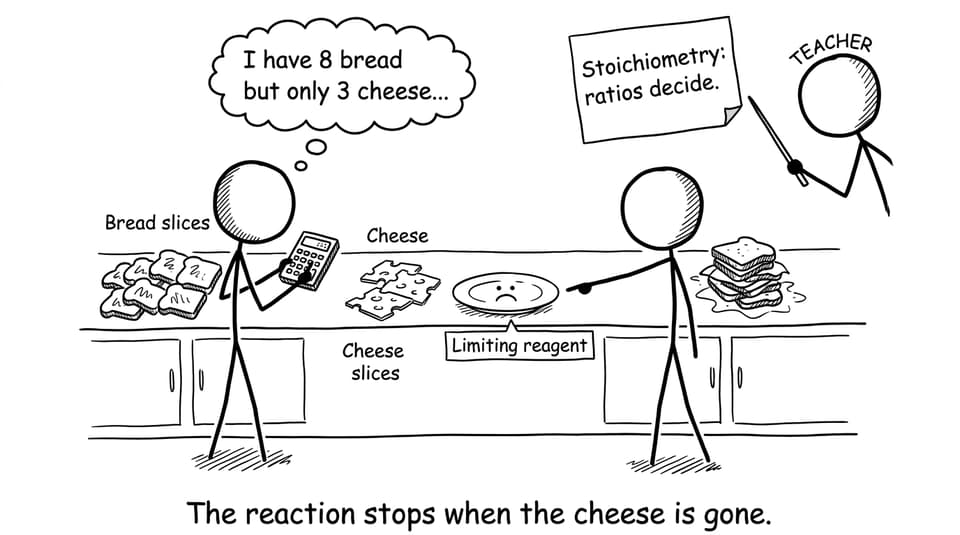
This doesn’t just say “hydrogen and oxygen make water.” It says: two moles of hydrogen are required for every one mole of oxygen. If you start with a pile of oxygen but your hydrogen supply ends, there is no chemical trick that lets oxygen create water by itself. The reaction stops at the moment the limiting reagent hits zero.
A useful way to think about it is that each product particle requires a specific “bundle” of reactant particles. When you can’t complete the bundle anymore, you can’t build more product. Extra reactant becomes the excess reagent: present, but unable to continue reacting without its partner.
For a deeper step-by-step method (with examples), see Limiting Reagent Explained for IB Chemistry and the syllabus-aligned notes in 1.3 Reacting Masses and Volumes.
The exam connection: theoretical yield starts with the limiting reagent
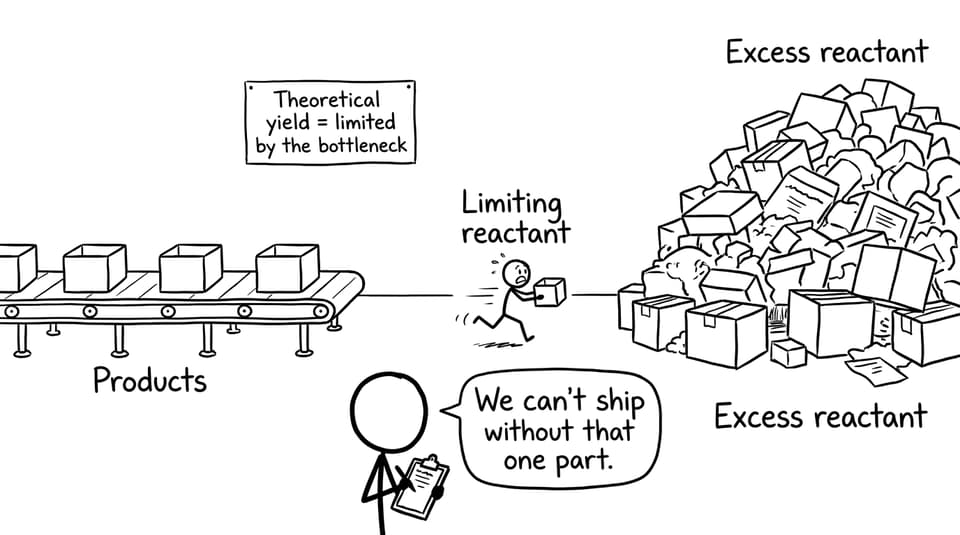
Most yield questions in IB Chemistry are really limiting reagent questions in disguise.
The theoretical yield is the maximum product possible if the limiting reagent reacts completely. So if you misidentify the limiting reagent, every number after that becomes confidently wrong.
If you want targeted practice in the exact syllabus language, try R2.1 How much? The amount of chemical change and the focused R2.1 Questionbank. RevisionDojo’s Questionbank explanations, Study Notes, and Flashcards help you build the habit of checking ratios before calculating.
Bring it home with RevisionDojo
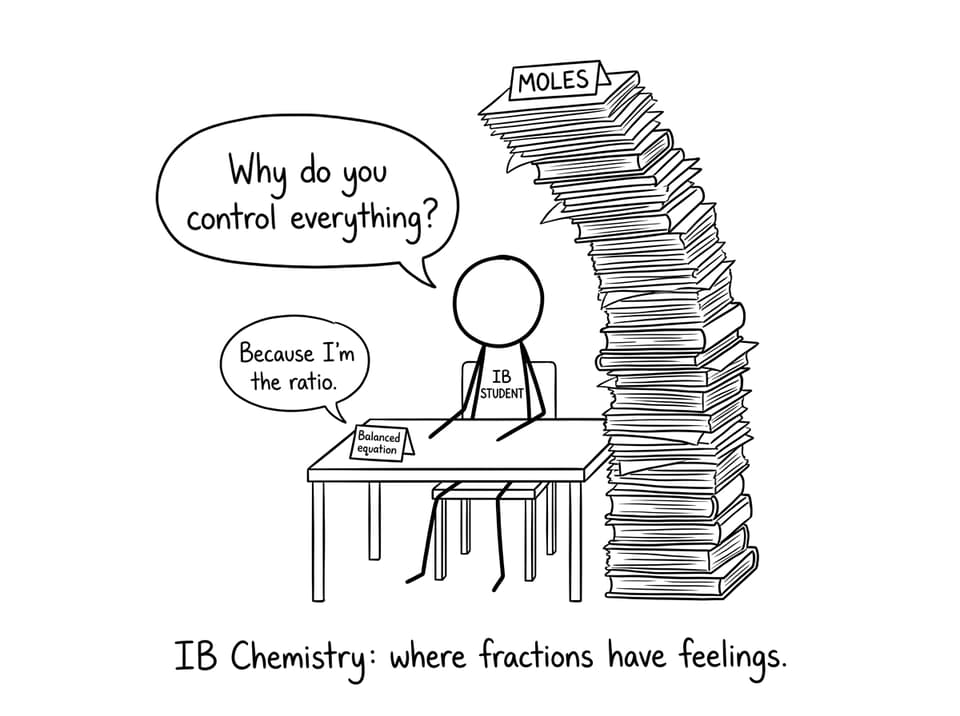
Limiting reagents determine the amount of product formed because stoichiometric ratios create a hard stopping point: when the limiting reagent runs out, product formation stops, even if everything else is in excess. In IB Chemistry, that idea shows up everywhere, reacting masses, gas volumes, and theoretical yield.
If you want this to feel automatic before exams, use RevisionDojo’s Study Notes, Flashcards, and Questionbank for ratio-heavy drills, then check your reasoning with AI Chat and marking support from Grading tools. When you’re ready to simulate exam pressure, build timed sets with Mock Exams and topic practice in the R2.1 resources. The goal is simple: spot the limiting reagent fast, and let the rest of the calculation become routine.