


IB Chemistry and the “why is water weird?” moment
If you have ever stared at a boiling point data table and felt personally attacked by water, you are not alone. In IB Chemistry, boiling point questions look simple until a tiny molecule like H_2O sits at 100°C while methane (CH_4) disappears into the gas phase at freezing-cold temperatures. That gap is the story. And the main character is hydrogen bonding.
Quick checklist (what exam questions are really testing)
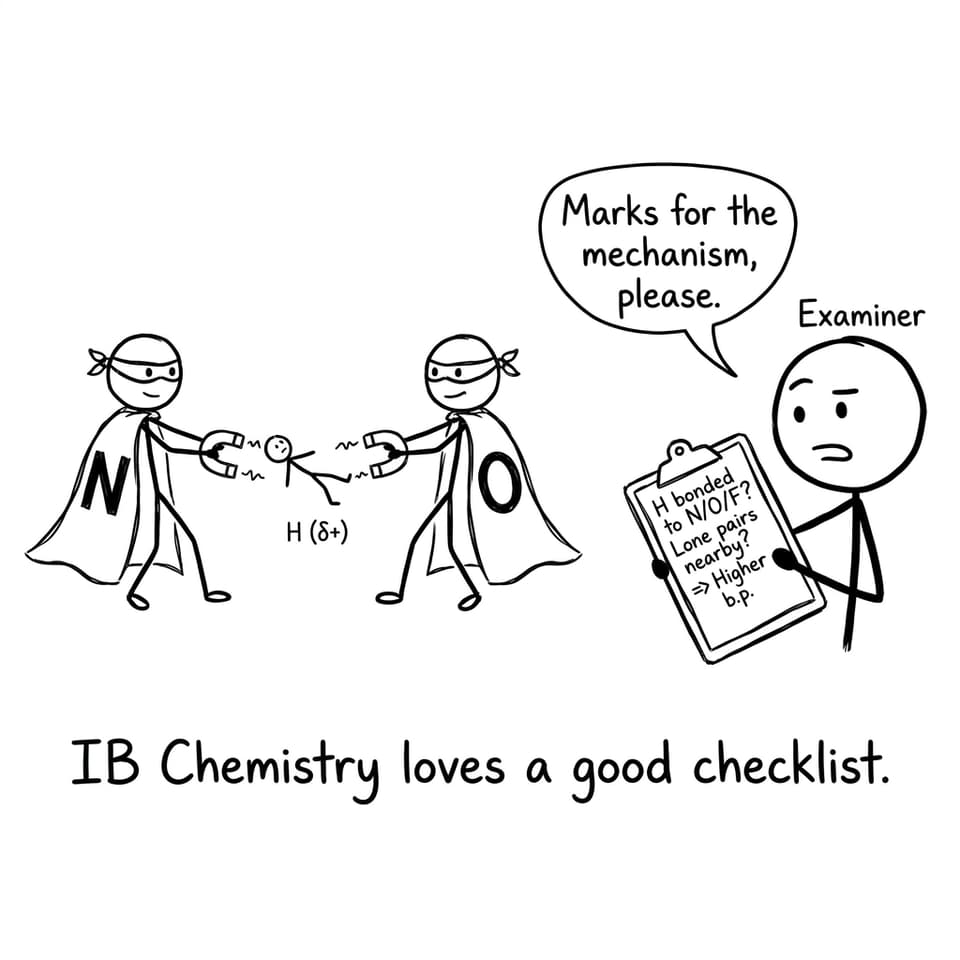
When you see a boiling point comparison in IB Chemistry, run this fast checklist:
-
Does the molecule have H directly bonded to N, O, or F?
-
Are there lone pairs on a nearby N/O/F to attract that hydrogen?
-
If yes, expect hydrogen bonding and a higher boiling point.
-
If not, compare dipole-dipole and London dispersion forces (molar mass, surface area, electrons).
If you want the clean syllabus wording, pair this with Intermolecular Forces Explained.
What a hydrogen bond is (say it like IB Chemistry markschemes)
A hydrogen bond is an intermolecular attraction between:
-
a hydrogen atom covalently bonded to N, O, or F, and
-
a lone pair on a neighboring molecule’s N, O, or F.
Why does this matter so much in IB Chemistry? Because N, O, and F are highly electronegative and small. They pull electron density away from H, making hydrogen unusually δ+. That exposed δ+ hydrogen can get very close to a lone pair on another molecule, producing a stronger attraction than ordinary dipole-dipole forces.
For a focused definition + examples list, see What Is Hydrogen Bonding? and the IB Chemistry Key Definitions.
Why hydrogen bonding produces unusually high boiling points
Boiling is not “breaking covalent bonds.” In IB Chemistry, boiling is about separating molecules from each other by overcoming intermolecular forces.
Hydrogen bonding raises boiling point for three connected reasons:
Stronger attractions mean higher energy needed
London dispersion forces are like brief, weak handshakes. Hydrogen bonds are more like a firm grip: still intermolecular, still weaker than covalent bonds, but strong enough that the liquid resists turning into gas. More energy must be supplied to pull molecules apart, so the temperature required for boiling increases.
Networks make separation a group project
In many hydrogen-bonded liquids, molecules form clusters, chains, or networks. Water is the classic IB Chemistry example because each H_2O molecule can form up to four hydrogen bonds, creating a highly connected structure. To vaporize, you are not just disrupting “one” interaction. You are weakening many interactions across the network.
For a boiling-point-focused walkthrough, use How Hydrogen Bonding Affects Boiling Point.
Lower vapor pressure pushes boiling point up
When molecules are held more tightly in the liquid, fewer escape into the gas phase at a given temperature. That means lower vapor pressure. Since boiling happens when vapor pressure equals external pressure, a lower vapor pressure at the same temperature implies you need a higher temperature to reach boiling. For a quick refresh, see Vaporization Explained Simply.
Water vs methane (the comparison examiners love)
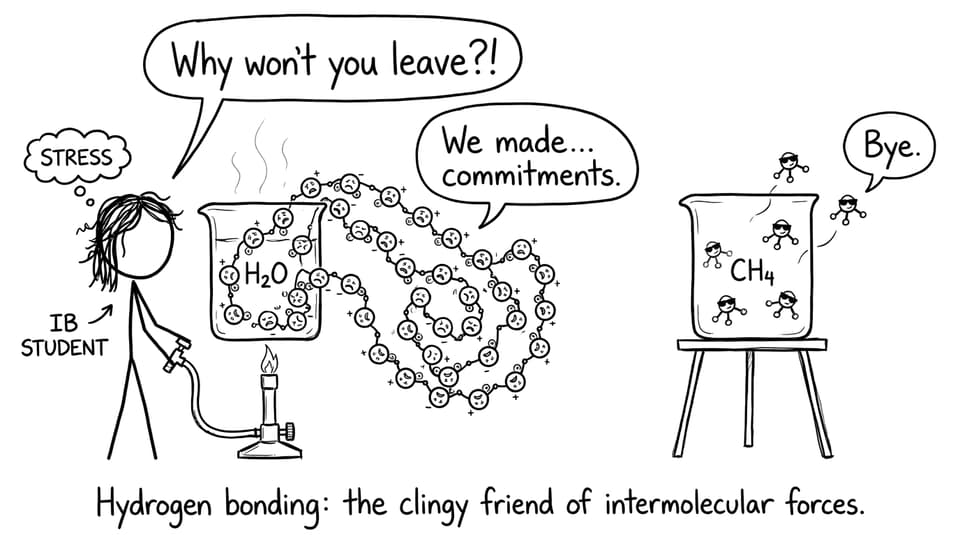
In IB Chemistry, water and methane are a perfect contrast:
-
CH_4 is nonpolar and relies only on London dispersion forces.
-
H_2O is polar and forms extensive hydrogen bonding.
So even though both are small, H_2O has much stronger intermolecular attractions, lower vapor pressure, and a much higher boiling point.
To connect this to polarity language, revise electronegativity and dipoles with Electronegativity Explained Simply for IB Chemistry and Notes for S2.2.5 Bond polarity.
Bring it home (and practise it the IB Chemistry way)
Hydrogen bonds produce unusually high boiling points because they are strong intermolecular attractions that create sticky molecular networks and lower vapor pressure. In IB Chemistry, that explanation wins marks because it links structure to property with clear cause and effect.
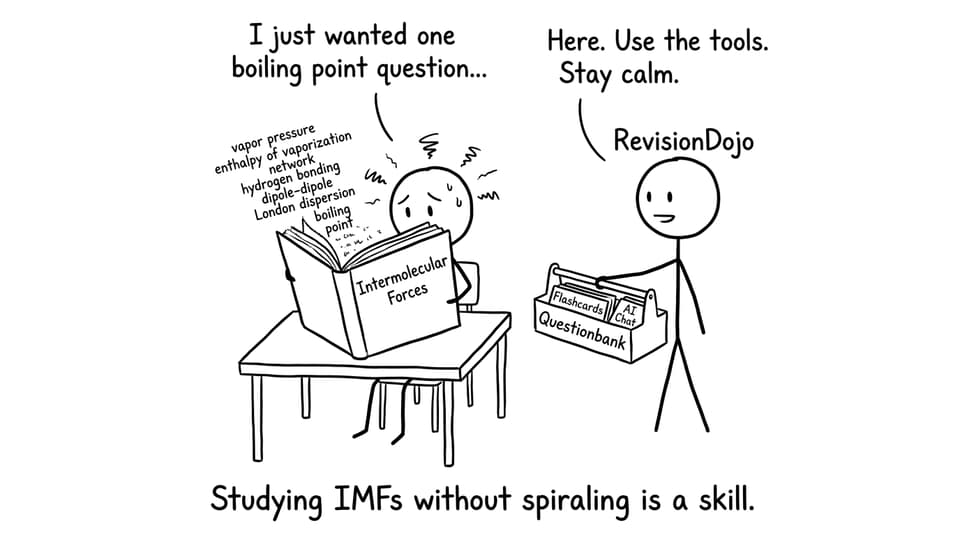
To lock this in for exams, use RevisionDojo as your system: review the S2.2.8 Intermolecular forces notes, drill the 4.4 Intermolecular forces Questionbank, and cement definitions with S2.2.8 Flashcards. When you get stuck, RevisionDojo’s AI Chat and Grading tools help you rewrite explanations into markscheme language, and Mock Exams plus Predicted Papers help you practise timing without panic. That is how IB Chemistry becomes predictable again.


