


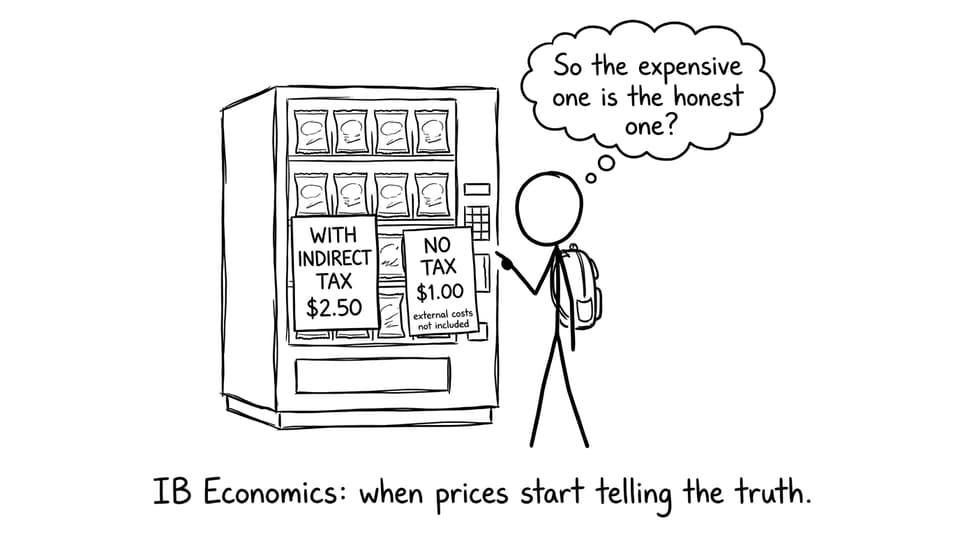
Indirect taxes rarely feel philosophical when you meet them in real life. They show up as a few extra cents on a sugary drink, a bigger jump on cigarettes, or a quietly higher total at checkout. But in IB Economics, those small line items are the start of a bigger story: governments using prices to raise money, change behaviour, and steer markets back toward efficiency.
What indirect taxes are (the exam-ready definition)
In IB Economics, an indirect tax is a tax on spending on goods and services (like VAT or excise duties). Firms collect it, consumers feel it through higher prices, and the market adjusts.
If you want crisp terminology for Paper 1 and IA style explanations, keep the key definitions page bookmarked: IB Economics Key Definitions.
Quick checklist: why governments impose indirect taxes
When you see an exam question asking “Why impose an indirect tax?” hit these points:
-
Raise government revenue
-
Reduce negative externalities (internalise external costs)
-
Discourage demerit goods and shift consumption patterns
-
Influence equity (sometimes by taxing luxury goods, though indirect taxes can be regressive)
For the wider policy context, this fits into the broader theme of the role of government in microeconomics.
Reason one: revenue that arrives quietly, every day
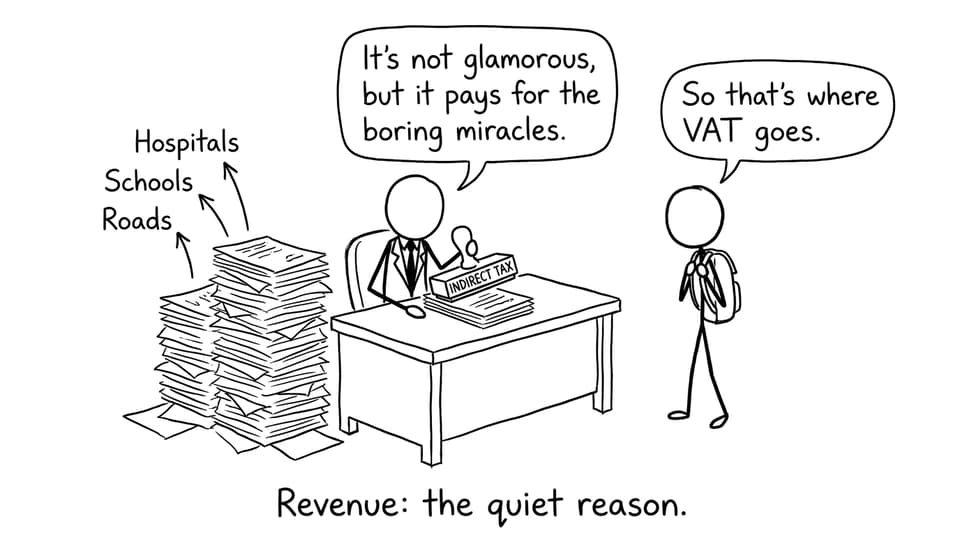
Direct taxes are visible. Indirect taxes are steady. Because they’re collected across thousands of daily transactions, they can be a reliable stream of funding for public services.
This is the unromantic logic of policy: a small tax per unit times a large quantity adds up fast. In revision terms, it’s also a great moment to write a clean formula line and earn method marks.
Reason two: correcting market failure (externalities)
Some markets produce too much of a good because the price ignores costs imposed on third parties: pollution, health system strain, second-hand smoke. In IB Economics, you describe this as a negative externality creating overconsumption or overproduction and a welfare loss.
An indirect tax can work like a Pigovian tax: it raises the private cost, pushing the market quantity closer to the socially efficient level.
To go deeper (and get evaluation points), pair this article with How Do Governments Try to Correct Negative Externalities? and the syllabus-focused page on government intervention in response to externalities.
How indirect taxes affect markets (the diagram story)
In the standard diagram explanation for IB Economics, an indirect tax increases firms’ costs per unit. That shifts the supply curve up/left (often shown as S to S+tax). The new equilibrium has:
-
Higher price paid by consumers
-
Lower price received by producers
-
Lower equilibrium quantity
That reduction in quantity is why indirect taxes can reduce harmful consumption, but it’s also why they can create deadweight loss.
If you want a clean, mark-friendly explanation of the mechanics, use Tax Incidence and Price Elasticity of Demand and Supply.
Who really pays? Tax incidence depends on elasticity
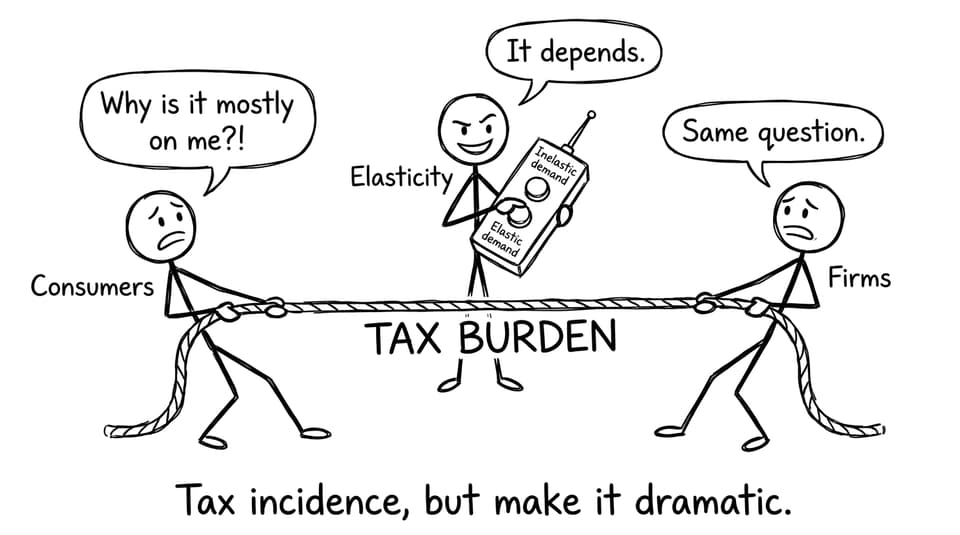
The split of the tax burden is called tax incidence. The side of the market that is more inelastic bears more of the tax.
-
If demand is inelastic (few substitutes, addictive goods), consumers pay most via higher prices.
-
If demand is elastic (many substitutes), producers may absorb more through lower revenue.
This is also why governments sometimes target goods with relatively inelastic demand: revenue is higher because quantity falls less.
To practise elasticity questions the way they appear in exams, try Elasticities of demand Questionbank.
Conclusion: make the tax do a job
Indirect taxes are not just “prices going up.” In IB Economics, they are a tool: they raise revenue, reduce negative externalities, and reshape market outcomes through a predictable shift in supply, new equilibrium, and a tax incidence story driven by elasticity.
If you want this topic to feel automatic under exam pressure, build it in layers on RevisionDojo: start with the IB Economics hub, lock in definitions, practise diagrams with Study Notes, drill exam prompts in the Questionbank, and tighten evaluation using Flashcards and AI Chat. Then test yourself under time with Mock Exams, Predicted Papers, and Grading tools, and use Tutors when you want precise feedback on your chains of reasoning.