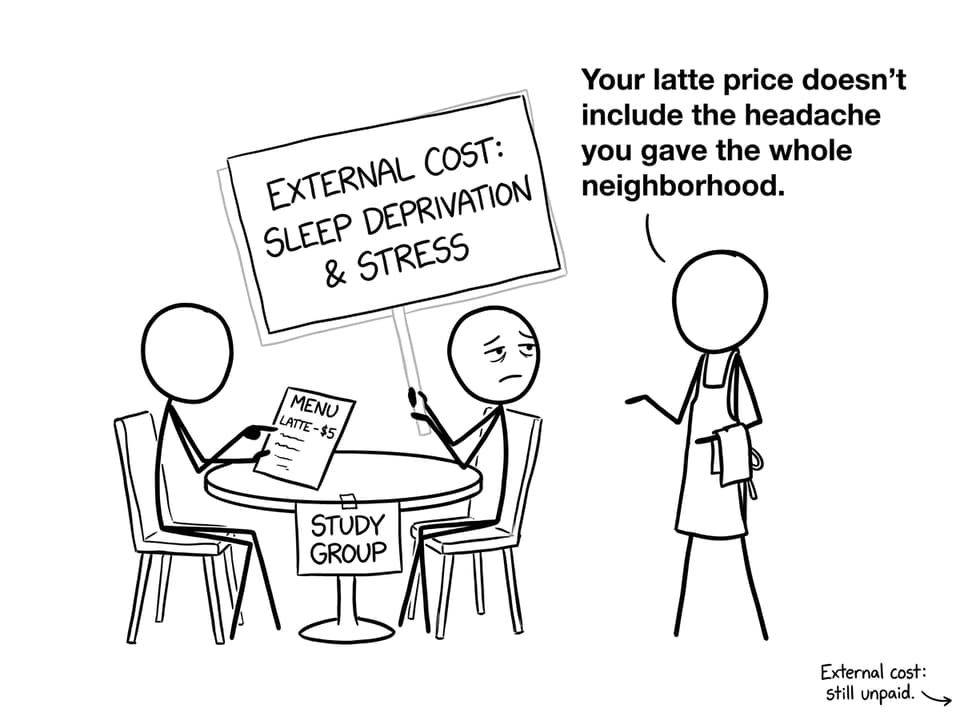
A market can look “efficient” in the moment, with busy shops, full order books, and prices moving smoothly. Then you step back and notice the part nobody paid for: the asthma downwind, the traffic everyone sits in, the future benefits of vaccination that never show up on a receipt.
That gap is the heart of why externalities cause markets to misallocate resources in IB Economics. When private decision-makers follow prices that ignore spillover effects, society gets too much of some things, too little of others, and a welfare loss triangle quietly forms in the background.
The IB Economics checklist: what to say in an exam
Use this quick checklist to structure your response (especially Paper 1):
-
Define externality: spillover costs/benefits to third parties.
-
Show the divergence between private and social costs/benefits.
-
Conclude: price signals are wrong, so output is not socially optimal.
-
Explain the direction of misallocation:
-
Negative externality leads to overproduction/overconsumption.
-
Positive externality leads to underproduction/underconsumption.
-
-
Mention welfare loss and (briefly) government intervention.
For syllabus-aligned definitions, RevisionDojo’s notes on 2.8 Market failure, externalities keep the wording tight and examiner-friendly.
Why externalities break the price signal in IB Economics
In IB Economics, markets allocate resources efficiently only when the price reflects the full social costs and benefits. Externalities interrupt that message.
Think of price as a story the market tells about scarcity and value. When an externality exists, the story leaves out a chapter.
-
Private costs/benefits are what buyers and sellers directly experience.
-
Social costs/benefits include private effects plus spillovers on third parties.
When private and social values diverge, the market equilibrium quantity is not the socially optimal quantity. Resources (labour, capital, land, entrepreneurship) get pulled into the “wrong” lines of production.
To connect this to the wider unit, it helps to frame externalities as one branch of market failure alongside public goods and market power. RevisionDojo’s overview on why market failure matters gives you language you can reuse in evaluation.
Negative externalities: why the market produces too much
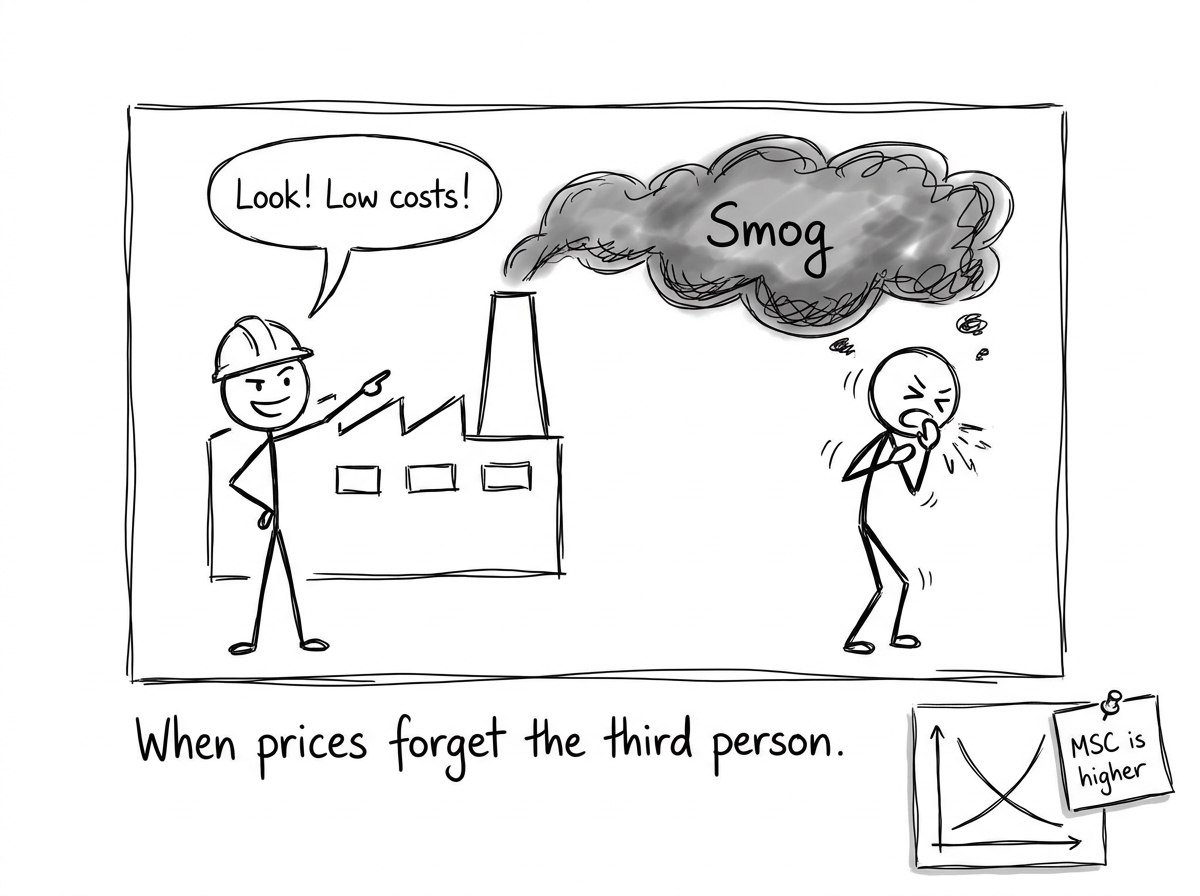
A negative externality imposes a cost on third parties (classic examples: pollution, noise, congestion). The key IB Economics logic is simple:
-
Producers/consumers consider marginal private cost (MPC) and marginal private benefit (MPB).
-
Society faces marginal social cost (MSC), which is higher when there are external costs.
Because the market price is based on private costs, it is “too low” relative to the true harm. That low price encourages higher quantity. The outcome is overproduction (or overconsumption), and a welfare loss.
If you want to extend your answer, link to policy tools and evaluation: How governments try to correct negative externalities is a clean add-on for taxes, regulation, and permits.
Positive externalities: why the market produces too little
A positive externality creates benefits for third parties (education, vaccinations, public parks). Here, the market again tells an incomplete story:
-
Consumers focus on MPB.
-
Society receives MSB, which is higher when spillover benefits exist.
Because those extra benefits do not raise the private willingness to pay enough, the market price is effectively “too high” relative to total social benefit. Quantity ends up too low. This is underproduction/underconsumption, and society misses out on net welfare gains.
This connects naturally to other underprovision topics. For contrast, RevisionDojo’s explanation of public goods in IB Economics helps you avoid mixing up “positive externalities” with “non-excludable goods.”
How to practice this fast with RevisionDojo
The fastest improvement in IB Economics usually comes from doing one more diagram and one more explanation than you feel like doing.
On RevisionDojo, you can:
-
Drill exam-style prompts in the 2.8 Externalities Questionbank.
-
Memorize key terms with 2.8 Externalities Flashcards.
-
Build broader market-failure links with Market power notes (HL).
And if you’re revising strategically, pair that with RevisionDojo’s Study Notes, AI Chat for instant feedback, Grading tools for structure, Mock Exams, Predicted Papers, and Tutors when you want a human to pressure-test your evaluation.
Closing: bring your diagrams back to the real world
Externalities misallocate resources because markets listen to private costs and private benefits, while society lives with the full consequences. In IB Economics, that is the story behind overproduction, underproduction, and welfare loss, and it is one of the most reliable essay frameworks in the syllabus.
If you want this to feel automatic under exam pressure, use RevisionDojo’s Questionbank and Flashcards, then tighten your explanations with Study Notes and AI Chat. In IB Economics, confidence isn’t a personality trait; it’s a practice outcome.