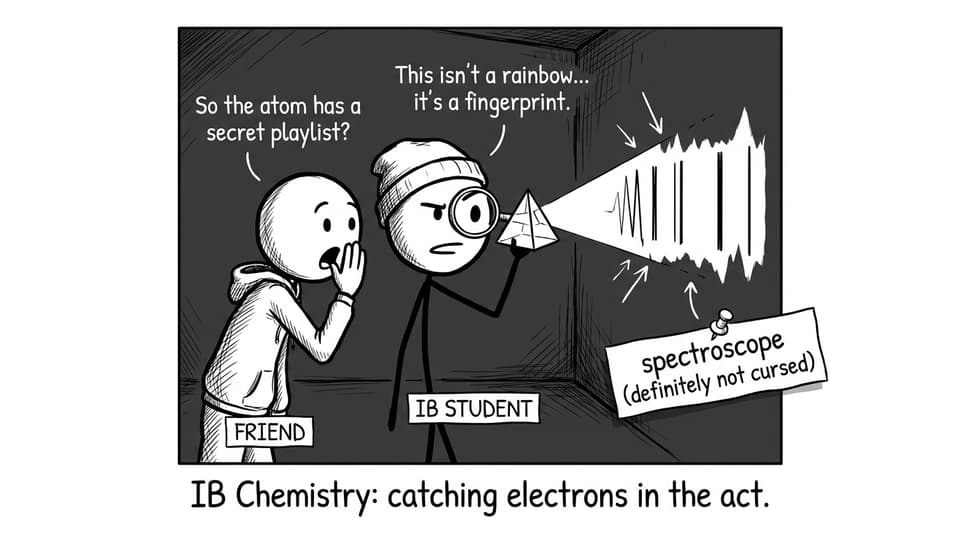
In the lab, the first time you see a discharge tube through a spectroscope, it feels like cheating.
Not because it’s easy, but because it’s specific. Neon doesn’t just glow “reddish.” It prints a set of sharp lines that looks like a barcode. And once you notice that, you can’t unsee it: each element behaves like it has its own private signature.
That’s the heart of this IB Chemistry question: why do elements emit unique line spectra? The short answer is that atoms only allow certain electron energies, and every element arranges those energies differently.
The exam checklist (what you must say in IB Chemistry)
-
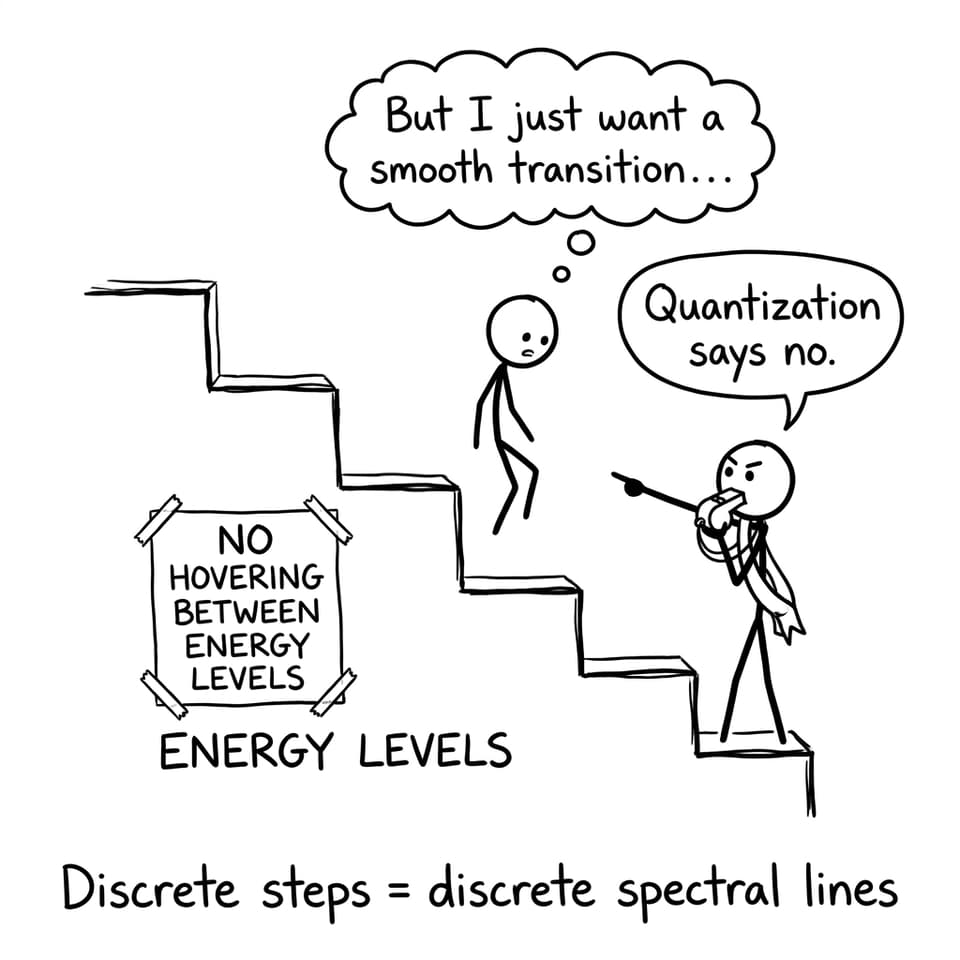
Electron energy levels are quantized (discrete).
-
Excited electrons fall to lower levels and emit photons.
-
Photon energy equals the difference between levels: (E = hf).
-
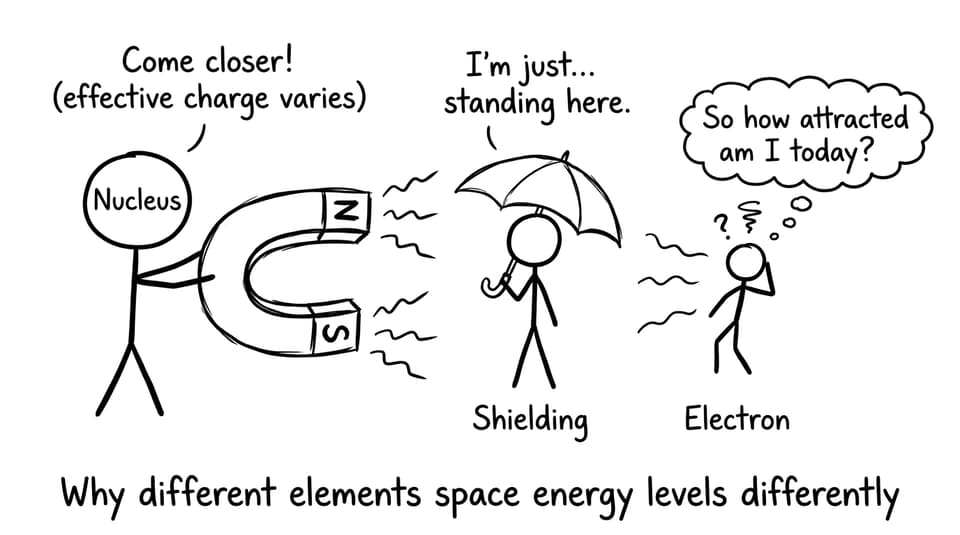
Each element has a unique energy-level spacing due to nuclear charge and shielding.
-
Only allowed transitions occur, creating a line spectrum (not continuous).
If you want the syllabus-aligned version, pair this with Emission Spectra and Energy Levels notes and then practice with the matching questionbank set.
IB Chemistry explanation: quantized levels create “line” spectra
A continuous spectrum is what you get when all wavelengths appear smoothly. But atoms don’t let electrons “slide” between energies.
Electrons occupy fixed energy levels. When an atom absorbs energy (electricity in a tube, heat in a flame), an electron can jump up. When it drops back down, it releases a photon whose energy matches the gap between the two levels.
Because only certain gaps exist, only certain photon energies exist. That’s why you see lines, not a blended rainbow.
To tighten your atomic-structure language for IB Chemistry, review Atomic Structure notes.
Why each element’s lines are unique: nuclear charge + shielding
So why doesn’t every atom share the same set of gaps?
Because the nucleus is different.
Increase proton number, and you increase nuclear attraction. Change the electron configuration, and you change how much inner electrons shield outer electrons from that attraction. The result is a different “effective pull” experienced by electrons, which shifts orbital energies and the spacing between levels.
Even small differences in nuclear charge and shielding lead to different allowed transitions, so the spectral pattern becomes a reliable fingerprint.
Want a broader revision map for IB Chemistry Structure topics? Start from IB Chemistry Resources or browse the IB Chemistry Questionbank to build targeted practice sets.
Hydrogen is the cleanest example (and IB Chemistry loves it)
Hydrogen is the simplest spectrum to discuss because there’s only one electron. That makes the line pattern easier to connect to energy levels and transitions.
Use Hydrogen Emission Spectrum notes for the story of lines converging at higher (n), and then consolidate with Hydrogen Emission Spectrum practice.
Bring it home: revise the “why,” then drill the marks
Line spectra aren’t random colors; they’re the consequence of rules. Quantized energy levels, nuclear charge, shielding, and allowed transitions combine into a spectral fingerprint that lets you identify elements with confidence.
If you’re revising IB Chemistry, don’t stop at understanding. Use RevisionDojo to turn this into marks: build practice sets with the Questionbank, lock in definitions with Flashcards, and tighten explanations with Study Notes and AI Chat. When exam week gets loud, tools like Predicted Papers, Mock Exams, and Grading tools help you stay calm and specific, exactly what spectroscopy demands.

