


IB Chemistry: Why Electrons Fill Lower-Energy Orbitals First
Picture a student walking into the exam hall convinced they “get electron configuration”… until a question asks why 4s fills before 3d, or why electrons don’t just spread anywhere there’s space. In IB Chemistry, that “why” is where marks live. Not in the list of sublevels, but in the logic that holds the list together.
At the heart of it is a simple idea: atoms behave like every other system in nature. They settle into the lowest-energy arrangement available. Electron filling is just that story, told with quantum rules.
Quick checklist for IB Chemistry exam explanations
When you’re asked why electrons fill lower-energy orbitals first in IB Chemistry, hit these points:
-
Name the Aufbau principle (lowest energy first).
-
Mention quantized energy levels (electrons can’t choose “in-between” energies).
-
Add electron-electron repulsion + Hund’s rule (spreading out lowers energy).
-
Use shielding and effective nuclear charge (Zeff) to justify stability.
-
Note that “exceptions” still aim for the lowest total energy.
For the syllabus-aligned foundation, use S1.3 Electron configurations notes.
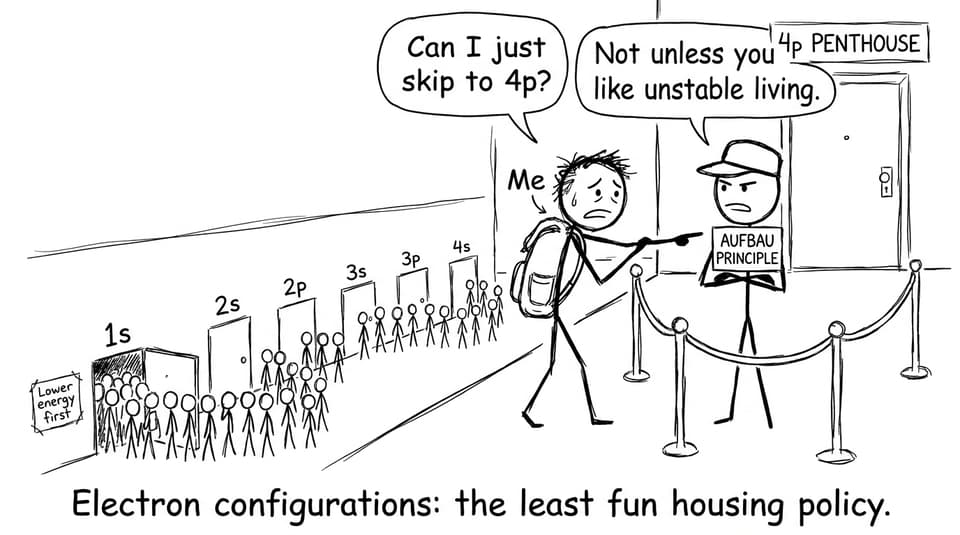
The Aufbau principle: stability is the default setting
In IB Chemistry, the Aufbau principle is the clean headline: electrons occupy the lowest-energy orbital available before higher-energy orbitals.
Why does that make sense? Because orbitals closer to the nucleus generally experience stronger electrostatic attraction. Stronger attraction lowers potential energy, which makes that orbital more stable. So electrons “prefer” those orbitals in the same way a ball “prefers” the bottom of a hill.
If you want the exact rules and the common filling order in one place, RevisionDojo’s Orbital configurations and rules notes (S1.3.5) are built for fast revision.
Quantization: electrons can’t take the middle step
A common mistake in IB Chemistry explanations is talking as if energy is continuous, like electrons can slide smoothly outward. Quantum mechanics says no: electrons occupy discrete energy levels and sublevels (s, p, d, f). That “stepped” structure forces an order.
So when an atom gains electrons, it is not choosing from an infinite range of energies. It is choosing from a menu. And it keeps picking the cheapest option until it’s full.
To reinforce the patterns you’re expected to recall quickly, the Electron configuration and group trends flashcards are ideal for short daily practice.
Repulsion matters: lower energy isn’t just distance
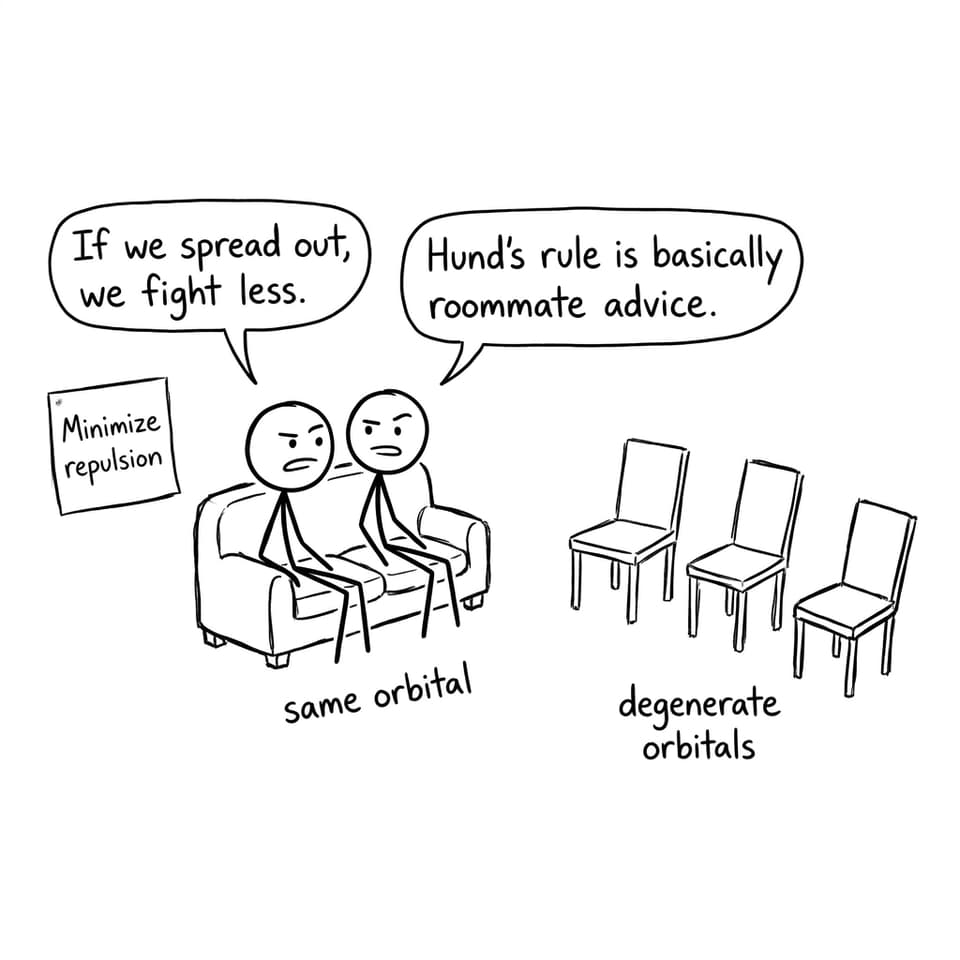
Even in a “low” orbital, electrons repel each other. That repulsion increases energy, so atoms minimize it when possible. This is where Hund’s rule becomes more than a memorized slogan: spreading electrons across degenerate orbitals reduces electron-electron repulsion and lowers total energy.
RevisionDojo breaks this down clearly in Hund’s Rule Explained for IB Chemistry, which is especially useful for Paper 1 orbital diagram questions.
Shielding and Zeff: why higher orbitals are “costlier”
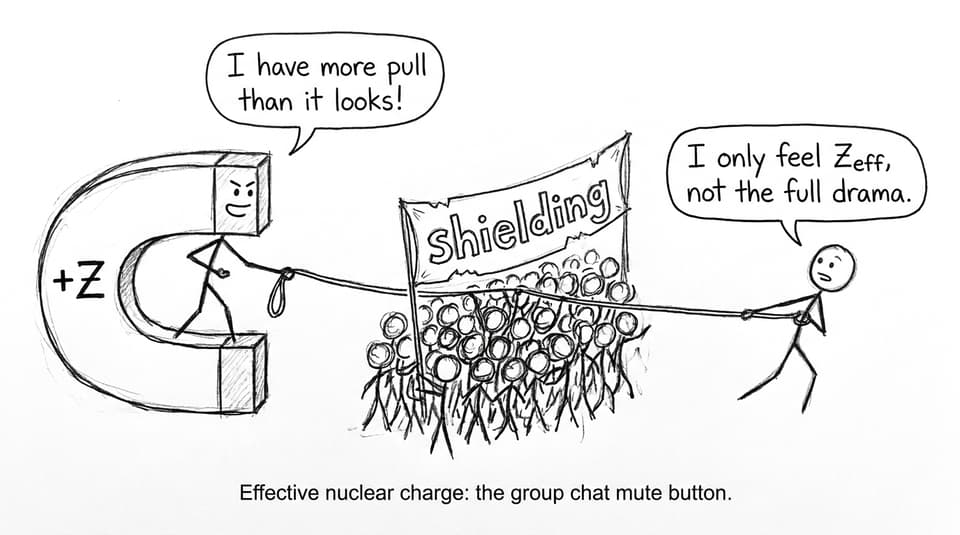
If the nucleus is positive, why don’t all electrons just crowd as close as possible? Because inner electrons shield outer electrons from the full nuclear pull. Outer electrons feel an effective nuclear charge, Zeff, not the raw +Z.
Lower-energy orbitals tend to correspond to electrons that feel stronger attraction (higher Zeff and/or less distance), so they’re more stable. Higher-energy orbitals are farther out and more shielded, so they’re less tightly held and higher in energy.
For the exam-ready wording, pair Effective nuclear charge explained with IB Chemistry: Nuclear charge and electron arrangement.
What about exceptions like chromium and copper?
In IB Chemistry, you may hear that chromium and copper are “exceptions” to the Aufbau order. The better framing is: the atom chooses the configuration with the lowest total energy once repulsion, sublevel spacing, and stability of half-filled/filled subshells are considered.
So yes, sometimes electrons shift. But the motive stays the same: lower the overall energy.
Bring it home: don’t memorise the order, understand the motive
If you treat electron filling like a list to memorise, IB Chemistry will eventually punish you with a “why” question. But if you treat it like a motive story, atoms chasing the lowest possible energy through attraction, shielding, and repulsion, the order becomes easier to rebuild from scratch.
When you’re ready to go from understanding to exam speed, RevisionDojo is built for it: use Study Notes and Flashcards to lock in the rules, the Questionbank and Mock Exams to pressure-test your recall, Predicted Papers to focus your final sprint, and AI Chat plus Grading tools to polish explanations the way examiners reward. In IB Chemistry, that combination turns a concept you “kind of know” into marks you can count on.


