


A quick mystery that chemistry can actually solve
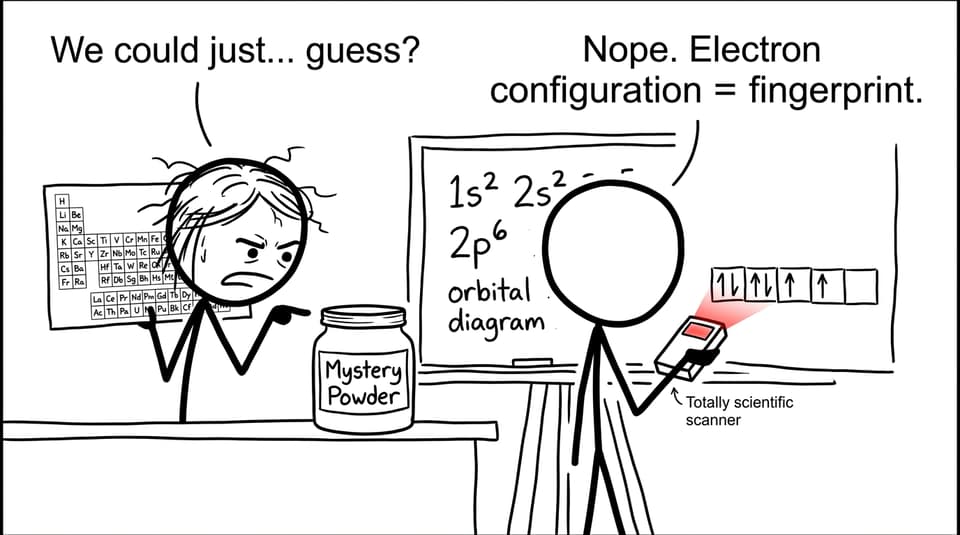
A small jar on a lab bench. No label. Just a pale powder and the quiet dread of, “What if this is the exam question?” In IB Chemistry, this is where electron configurations stop being a memorization chore and start acting like a detective’s fingerprint kit. The key idea is simple: an element’s electron configuration is locked to its atomic number, so it carries identity information in a way mass, color, or even “reactivity vibes” never can.
The exam-ready checklist
If you remember nothing else for IB Chemistry, remember these four links:
-
Atomic number (Z) fixes the number of electrons in a neutral atom.
-
Electrons fill quantized energy levels (shells, subshells, orbitals).
-
That structure creates unique energy gaps, which create unique spectral lines.
-
The valence electron configuration predicts chemical behavior, narrowing down candidates fast.
For a clean syllabus-aligned refresher, keep these open while you revise:
Electron configuration as an “atomic fingerprint”
In IB Chemistry, you’re often asked to connect structure to evidence. Electron configuration is powerful because it’s not just a diagram; it’s a count. A neutral atom with Z protons must have Z electrons, and those electrons arrange themselves in a specific order (following the aufbau principle, Pauli exclusion, and Hund’s rule).
That means the full configuration is unique to that element. Two elements can share inner shells (for example, many elements share a noble-gas core), but the complete pattern, especially the outer electrons, points you to one identity.
If this topic still feels slippery under time pressure, practise it in exam format here:
Why spectra work: electrons can only jump in specific ways
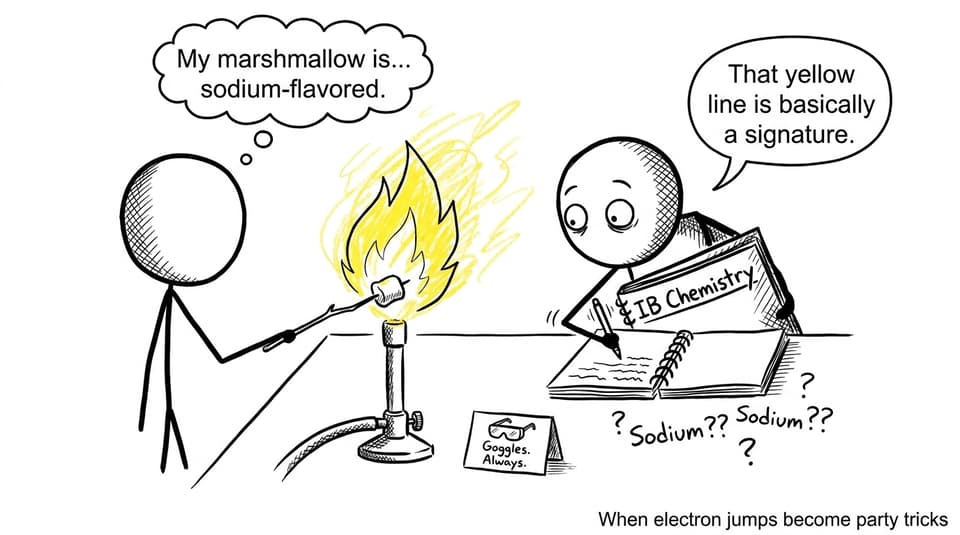
When atoms absorb energy, electrons can be promoted to higher energy levels. When they fall back down, they emit photons with energies equal to the gaps between levels. Because the allowed energy levels depend on the electron configuration and nuclear charge, each element produces a distinctive line spectrum.
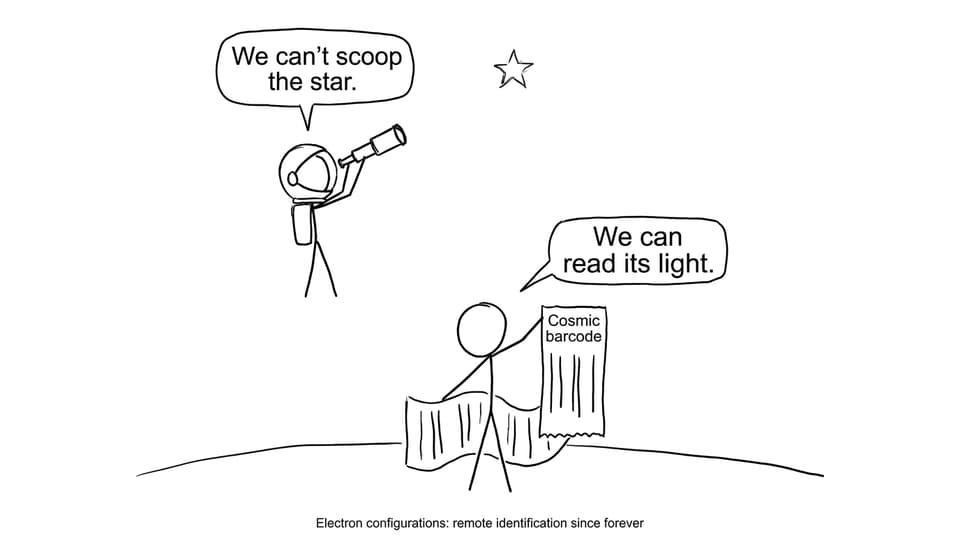
This is why chemists can identify elements in mixtures, surfaces, or even distant stars: the light is a coded message written by electron transitions. It’s one of the most satisfying moments in IB Chemistry because it turns an abstract model (orbitals) into something measurable.
For the syllabus version of that story, revise:
Why chemical behavior also helps: valence electrons steer reactions
Spectra can be the “barcode,” but chemical behavior is often the “shortlist.” The outer-shell electrons determine bonding patterns and reactivity trends. Elements in the same group share similar valence configurations, so they behave similarly (alkali metals, halogens, noble gases, etc.).
That’s why, in IB Chemistry, you can often predict what an unknown might be by looking at likely ions, typical oxidation states, and how it reacts with water, acids, or halides. It’s not always definitive, but it is fast and exam-useful.
To strengthen that link between structure and periodic behavior, these are helpful:
How RevisionDojo makes this easier to score
Electron configuration questions reward precision: correct notation, correct reasoning, correct trend explanation. RevisionDojo helps you build that accuracy using the Questionbank (exam-style practice), Study Notes (tight explanations), Flashcards (active recall of filling order and exceptions), and AI Chat (to debug your reasoning when you keep mixing up subshell rules). When you’re ready to simulate pressure, build Mock Exams and use Grading tools to see what an examiner would reward.
Explore:
Bringing it home
Electron configurations help identify elements because they tie together three exam-winning ideas in IB Chemistry: electron count (atomic number), quantized energy levels (spectra), and valence-driven behavior (reactivity). If you want this to feel automatic, build repetition the smart way: revise the model in notes, drill it in the Questionbank, and use Flashcards to make the filling order and patterns stick. RevisionDojo is built for exactly that loop, so when the “mystery sample” shows up, you don’t guess. You identify.