

In IB Chemistry, there’s a moment every student hits: you’re happily assigning oxidation numbers, and then manganese walks in with +2, +4, +7 like it’s normal. It feels unfair, almost personal. But the d-block isn’t random; it’s just flexible.
That flexibility is exactly why d-block elements show variable oxidation states. And once you understand the logic (tiny energy gaps, electron arrangement stability, and the chemical environment), exam questions stop feeling like a guessing game and start feeling like a pattern.
IB Chemistry quick checklist: what to say in an exam answer
When a marker asks “Explain why transition metals have variable oxidation states”, build your IB Chemistry answer around:
-
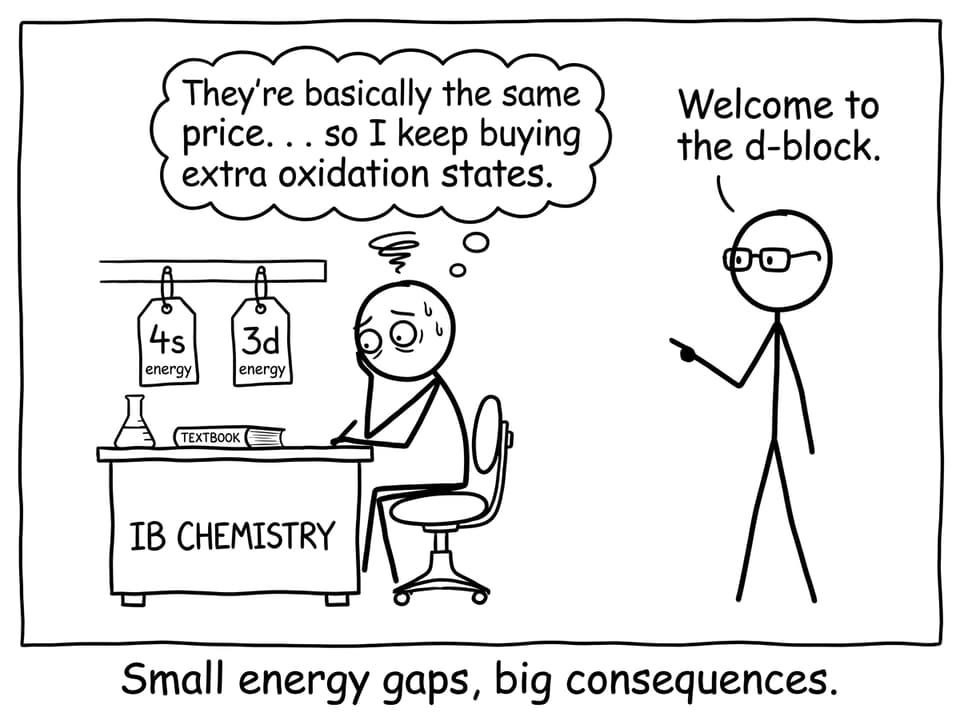
4s and 3d orbitals are close in energy
-
Electrons can be removed from 4s then 3d with relatively small extra energy
-
Partially filled d-subshells can be stabilized in different ways
-
Ligands/oxidizing agents can stabilize higher oxidation states
If you want the wider context first, revise the IB definition and core properties in What Are Transition Metals?.
4s and 3d energies are close, so electrons are “negotiable”
The heart of this topic in IB Chemistry is energy spacing. For main-group elements, the valence electrons are clearly separated in energy, so losing “one more” electron is a big step up in ionization energy.
For transition metals, the 4s and 3d sublevels are very close in energy. The atom can lose the two 4s electrons, and then (depending on conditions) also lose one or more 3d electrons without a huge jump in energy.
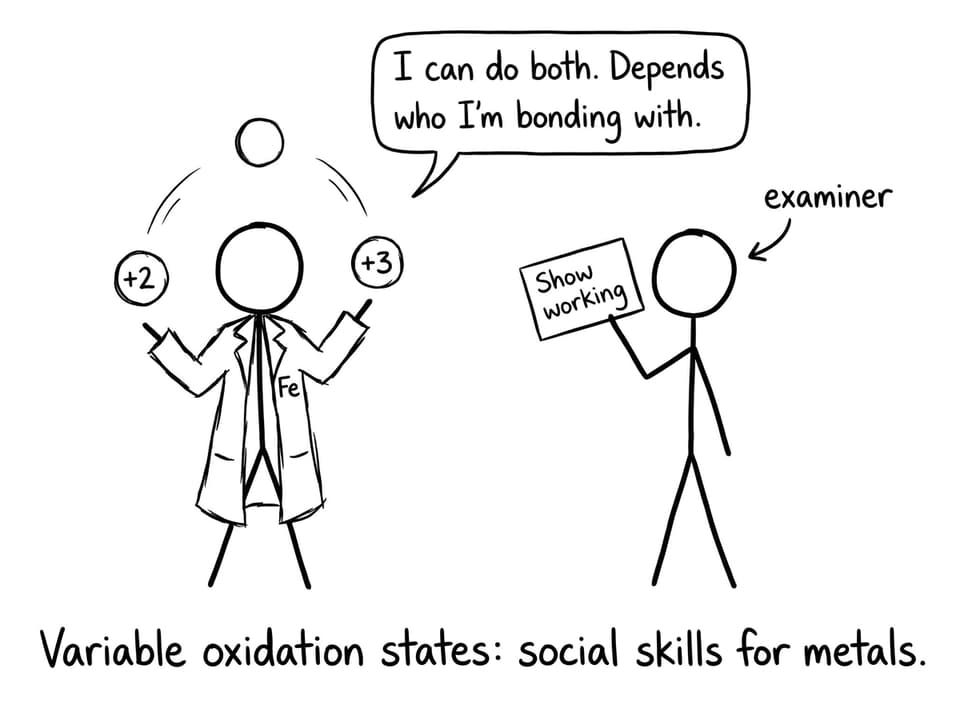
That’s why you see familiar pairs like Fe2+ and Fe3+. It isn’t that iron can’t decide. It’s that the energy cost of removing that extra d electron can be worth it if the surrounding chemistry rewards the new state.
For the syllabus-aligned wording and examples, see IB Chemistry Topic S3.1.9 Oxidation States of Transition Elements.
4s fills first, but 4s is removed first (and that matters)
A common IB Chemistry trap is mixing up filling order with removal order.
-
In neutral atoms, 4s fills before 3d.
-
When forming ions, 4s electrons are removed first.
Why? Once the 3d orbitals begin to fill, they penetrate closer to the nucleus and experience a stronger effective nuclear attraction. The 4s electrons become easier to remove, so they leave first. After that, removing a 3d electron is often only a “small extra push,” enabling multiple oxidation states.
Stability: sometimes losing more electrons creates a “nicer” arrangement
Another reason d-block elements show variable oxidation states is stability within the d-subshell. Certain electron arrangements can be relatively favorable (you’ll often hear about half-filled and fully filled patterns when learning configuration exceptions).
In practice, IB Chemistry questions don’t usually require you to calculate every micro-detail. What they want is the idea that different oxidation states can produce different d-electron counts, and some counts are stabilized by the overall bonding situation in a complex.
This links naturally to other transition metal behavior. If you understand why complexes change color, you’re already thinking in the right “energy gap” mindset: see Why Transition Metals Form Colored Compounds and Why Transition Metals Form Colored Ions.
Ligands and reagents can “choose” which oxidation state survives
In IB Chemistry, oxidation state isn’t just an internal property; it’s a relationship with the environment.
-
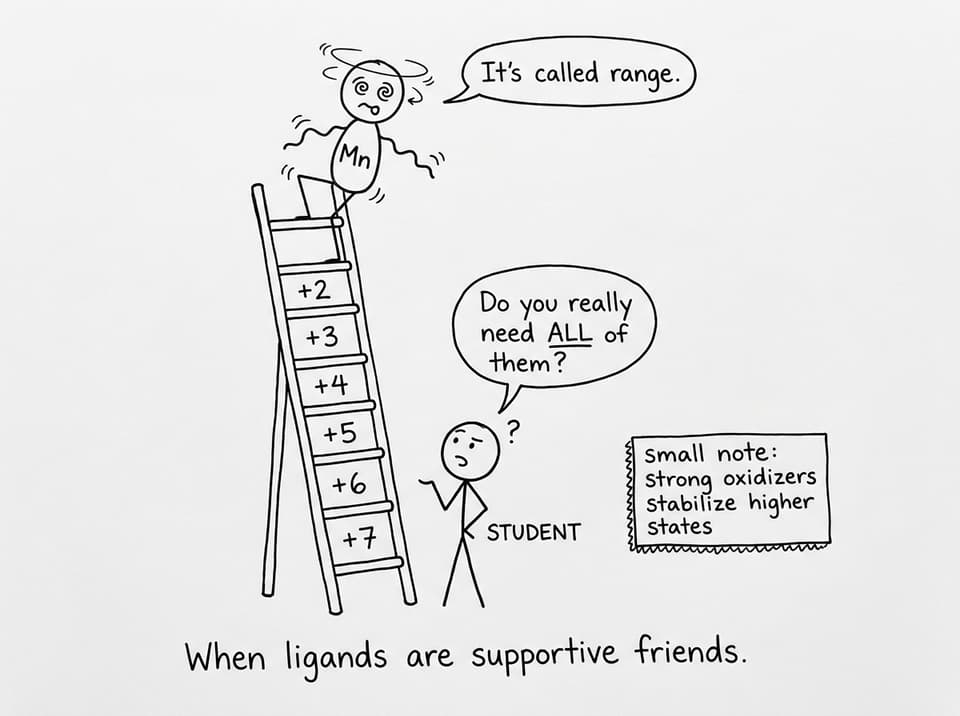
Strong oxidizing conditions (or ligands that stabilize higher charge) can support higher oxidation states.
-
Weaker conditions often leave metals in lower oxidation states.
That’s why manganese can reach +7 in the right compounds, while iron commonly sits at +2 or +3 in many contexts.
This idea also sits next to ligand behavior. If ligand swapping and stability confuse you, Ligand Exchange Explained helps connect “who’s around the metal” to “what the metal can do.”
How to study this in RevisionDojo (fast)
If you’re revising IB Chemistry under time pressure, treat this topic like a skill:
-
Read the core notes once, then practise explaining it aloud (30 seconds).
-
Drill definitions and examples using S3.1 The Periodic Table: Flashcards.
-
Then hit the RevisionDojo Questionbank for exam-style prompts, using AI Chat feedback to tighten your wording.
For a structured pathway through the whole unit, use The Periodic Table: The Transition Metals (HL). And if you want broader trend confidence (which supports oxidation-state reasoning), bookmark IB Chemistry: Using Atomic Trends to Predict Bond Types.
Closing: turn “variable” into “predictable”
The d-block looks chaotic until you see the quiet rule underneath it: in IB Chemistry, variable oxidation states come from orbitals close in energy and an environment that can stabilize different electron counts. Once you can say that clearly, you can answer the question, explain the examples, and handle follow-ups about ligands, color, and redox.
If you want to lock this in before exams, use RevisionDojo’s Study Notes, Flashcards, Questionbank, Predicted Papers, Mock Exams, and AI Chat to practise the exact phrasing examiners reward. Variable oxidation states stop being a memorization chore and become a pattern you can trust in IB Chemistry.