
A quick hook: the same coffee, two totally different worlds
Walk into a busy street market and you feel it instantly: ten stalls, similar products, tiny price differences, and sellers watching each other like hawks. Now imagine a single store in town that sells the only exam-approved calculator for your class. Same idea of “a market,” but completely different behaviour.
That contrast is exactly what IB Economics wants you to understand. Competitive markets behave differently from imperfect markets because the rules of the game change: who has power, who can enter, what products look like, and whether prices communicate real costs.
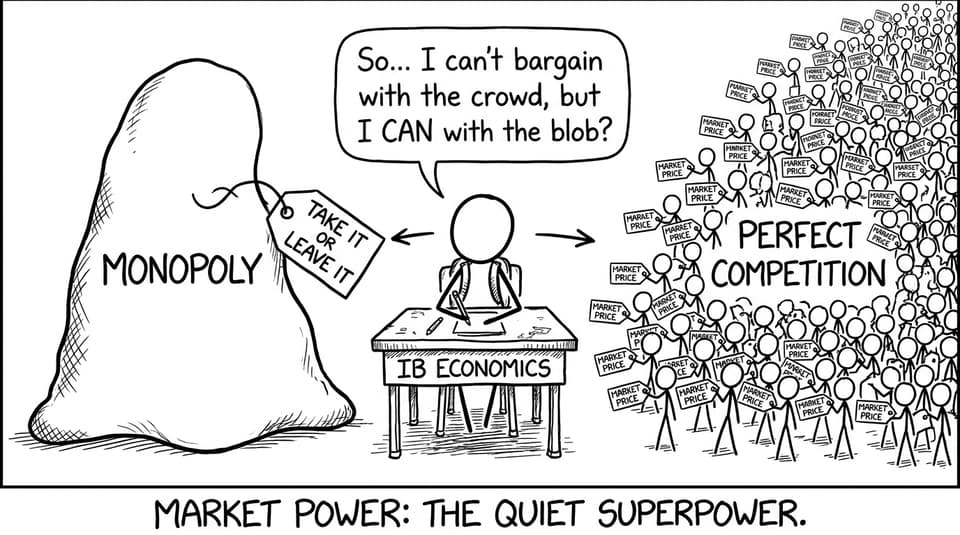
Competitive vs imperfect markets: an exam-ready checklist
Use this mini checklist when you see a market-structure question in IB Economics:
-
Number of firms: many (competitive) vs few/one (imperfect)
-
Type of product: identical vs differentiated
-
Barriers to entry: low vs high
-
Pricing power: price takers vs price makers
-
Efficiency: closer to P=MC vs P>MC (often)
For extra syllabus alignment, see IB Economics 2.11 Market Failure: Market Power.
Why competitive markets act “disciplined”
In perfect competition, firms are price takers. The market price is set by overall supply and demand, not by any single firm. If one producer tries to charge more than the market price, buyers can switch instantly because products are identical and information is easy to access.
So the firm’s strategy becomes simple: cut waste, minimise costs, and produce where P = MC. In IB Economics, that outcome matters because it’s tied to allocative efficiency (society gets the “right” quantity) and productive efficiency (production happens at the lowest feasible cost).
If you want the bigger picture of how these ideas fit into micro, read Key Microeconomic Ideas Students Must Master First.
Why imperfect markets behave strategically
Imperfect markets (monopoly, oligopoly, monopolistic competition) are defined by market power. Firms face a downward-sloping demand curve, so they can raise price without losing all customers. That single fact changes everything.
Instead of accepting price, the firm chooses output where MR = MC and then charges the price on the demand curve. In IB Economics, the key consequence is usually P > MC, which implies underproduction relative to the competitive benchmark and the possibility of deadweight loss.
A clear example is monopoly. If you need a quick definition and the logic behind the pricing diagram, use What Is a Monopoly? | IB Economics Market Structure Guide.
Barriers to entry: the quiet reason profits can last
In competitive markets, abnormal profit attracts entrants. New firms increase supply, prices fall, and long-run profit returns to normal.
In imperfect markets, barriers to entry (patents, branding, high start-up costs, economies of scale, licensing) can block that pressure. That’s why some firms can sustain abnormal profit and keep control over price and output.

Product differentiation: power built from “tiny differences”
Perfect competition assumes identical products. That makes demand for each firm perfectly elastic.
Imperfect markets often invest heavily in product differentiation: design, branding, quality, and advertising. In IB Economics, differentiation matters because it makes demand less elastic and gives firms room to set a higher price. The trade-off is that resources can shift toward marketing and away from production efficiency.
If you’re revising how market power connects to wider market failure, this broader context helps: How Market Failures Interact in Real Economies.

What to write in evaluation (the part examiners love)
In IB Economics, you get extra credit for recognising that imperfect competition is not automatically “bad.” Market power can fund R&D, improve quality, and create variety. Oligopolies can also deliver economies of scale. The evaluation move is to weigh higher prices and allocative inefficiency against innovation, choice, and dynamic efficiency.
For efficiency language that strengthens evaluation, see Why Allocative Efficiency Matters for Society.
Conclusion: turn structure into marks (and practice it fast)
Competitive markets behave differently from imperfect markets because IB Economics is really studying incentives: who can set price, who can enter, and whether firms must chase efficiency or can play strategy. If you can link pricing power, barriers to entry, product differentiation, and efficiency outcomes to the right diagram language (P=MC vs P>MC), you’re already writing like an examiner wants.
To lock it in, use RevisionDojo as your home base: practise on the Topic 2.11 Questionbank, drill definitions with 2.11 Flashcards, and consolidate with Methods for Effective IB Economics Revision. RevisionDojo’s Study Notes, AI Chat, Mock Exams, Predicted Papers, Grading tools, and Tutors make the difference between “I kind of get it” and “I can write it under pressure.”