In IB Chemistry, there’s a moment most students hit sooner or later: you look at two substances that seem “basically the same” on paper, and then the data refuses to cooperate. One boils higher. One dissolves. One reacts instantly. The frustrating part is that chemistry doesn’t change its mind; it just follows a blueprint.
That blueprint is chemical structure. In IB Chemistry, structure isn’t decoration around the edges of a molecule; it’s the reason the molecule behaves the way it does.
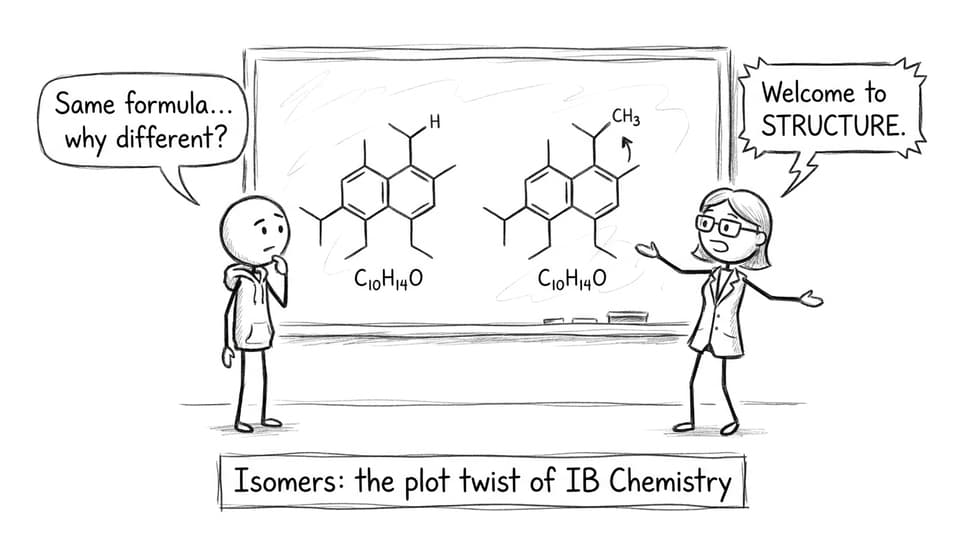
Isomers plot twist
The IB Chemistry checklist: structure to behavior
When an exam question asks you to explain a property, run this quick chain:
Bonding + electronegativity: where is electron density?
Molecular shape: do dipoles cancel or add?
Intermolecular forces: what attractions hold particles together?
Functional groups / reactive sites: where will reactions start?
If you can narrate that chain calmly, you’re doing IB Chemistry the way examiners expect.
IB Chemistry and electron distribution: polarity starts the story
Chemical behavior begins with where electrons “prefer” to sit. Differences in electronegativity create bond polarity (δ+ and δ−), and that sets up how a molecule interacts with other particles.
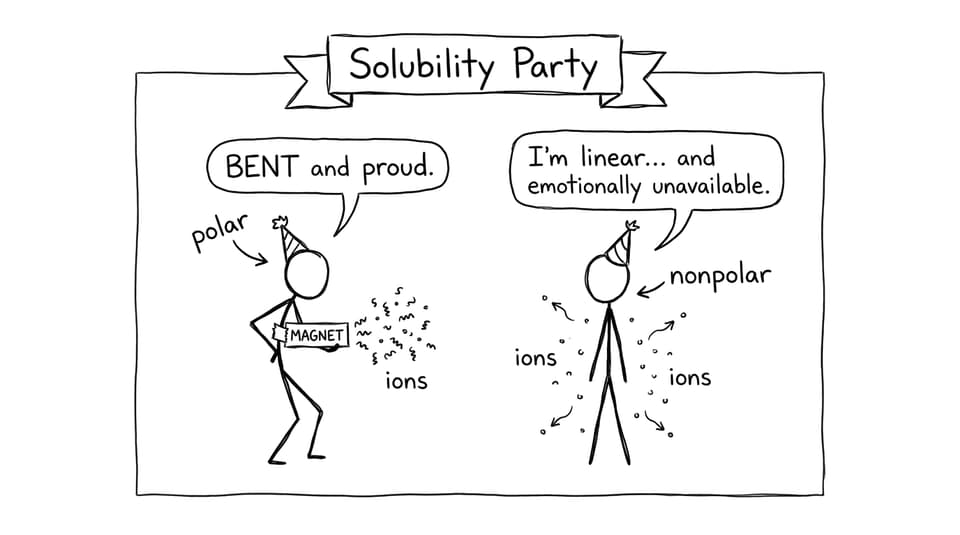
But IB Chemistry also tests the next step: depends on , not just polar bonds. Carbon dioxide has polar C=O bonds, yet its linear symmetry cancels the dipoles. Water’s bent geometry doesn’t cancel anything, so it stays strongly polar.
Intermolecular forces: the “why” behind boiling points and solubility
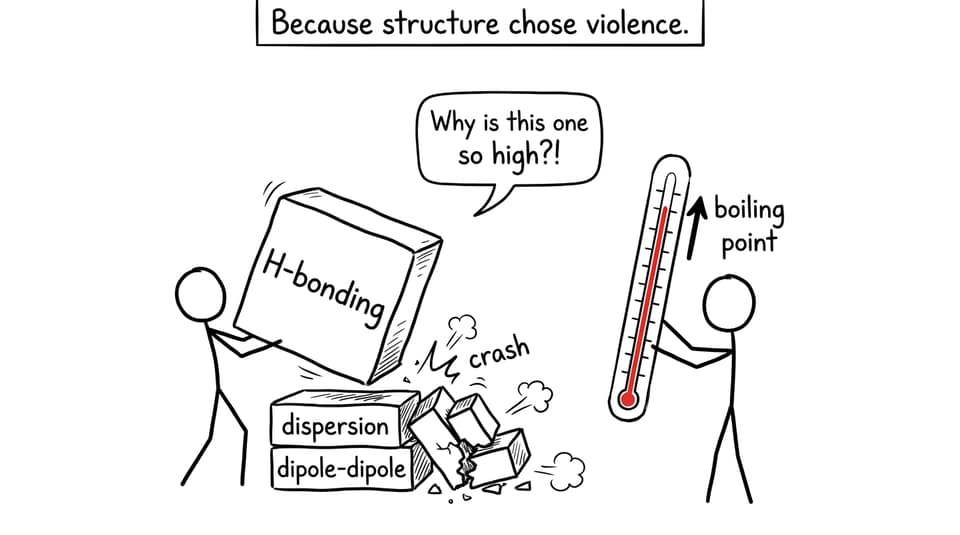
A lot of IB Chemistry marks live in the space between molecules. Intermolecular forces explain why a substance is a gas, liquid, or solid at room conditions, why it’s volatile, and why “like dissolves like” keeps showing up.
Structure determines which forces are possible:
London dispersion forces exist in all molecules, stronger with more electrons and surface area.
Dipole-dipole attractions appear when molecules have permanent dipoles.
Hydrogen bonding requires H bonded to N, O, or F, plus lone pairs nearby.
This is why isomers can be dramatic. Ethanol and dimethyl ether share a molecular formula, yet ethanol can hydrogen bond (thanks to its O--H group), raising boiling point and changing solubility patterns.
Functional groups: structure tells you where reactions happen
In IB Chemistry, organic reactions often look less like “memorize everything” and more like “recognize the hotspot.” Functional groups concentrate electron density in predictable ways.
An --OH group suggests hydrogen bonding and particular oxidation patterns. A C=O group signals a polar bond and a reactive carbon. Halogenoalkanes point toward nucleophilic substitution or elimination because of the polarized C--X bond.
This is why “same atoms, different arrangement” matters: structural isomers can have different functional groups, different shapes, and different intermolecular forces, so their macroscopic properties diverge.
3D shape and mechanisms: collisions aren’t random in IB Chemistry
At higher levels of IB Chemistry thinking, reactions depend on orientation and accessibility. Geometry affects whether reagents can approach a reactive center and whether partial charges line up in a productive collision.
That’s also why stereochemistry and shape-based reasoning can unlock multi-step questions. Structure isn’t only what a molecule is; it’s what the molecule allows to happen.
How to revise structure efficiently with RevisionDojo
Structure questions reward repetition, but not mindless repetition. You want targeted practice and fast feedback.
Build confidence with the IB Chemistry Resources hub, then focus your weak points using RevisionDojo’s Questionbank.
RevisionDojo also supports the way real students revise: Study Notes for clarity, AI Chat for “why is this wrong?” moments, Grading tools to sharpen responses, plus Mock Exams, Predicted Papers, a Coursework Library, and Tutors when you need a human to untangle the knot.
Conclusion: the IB Chemistry idea that keeps paying you back
Chemical structures determine how substances behave because structure controls electron distribution, polarity, intermolecular forces, reactive sites, and 3D accessibility. In IB Chemistry, that one sentence translates into marks across bonding, energetics, organic reactions, and data-based explanations.
If you want this to feel automatic before exams, practice it the RevisionDojo way: learn the story in Study Notes, test it in the Questionbank, lock it in with Flashcards, and use AI Chat and Grading tools to turn “almost” answers into examiner-ready ones. IB Chemistry becomes calmer when structure stops being a drawing and starts being a reason.
IB Chemistry · 6 min read
IB Chemistry: Why Calibration Improves Accuracy
IB Chemistry students: learn why calibration improves measurement accuracy, reduces systematic error, and strengthens titrations, curves, and exam answers.