


A balanced equation can feel like a tidy line of symbols until you try to use it like a recipe.
Two grams of hydrogen. Two grams of oxygen. It sounds fair. It sounds balanced.
And yet in IB Chemistry, that “fair” instinct is exactly what creates leftover reactant, confusing yields, and the kind of stoichiometry mistakes that cost easy marks. Balanced equations represent mole ratios rather than mass ratios because reactions are negotiations between particles, not between grams.
The quick exam checklist (before you calculate)
Keep this IB Chemistry checklist in your head whenever a question starts with a balanced equation:
-
Coefficients tell you the mole ratio (and particle ratio).
-
Convert given information into moles first (mass, concentration, gas volume).
-
Use the mole ratio to move from reactant moles to product moles.
-
Convert back to the unit the question wants (grams, mol dm⁻³, etc.).
If you need a clean refresher on the mole as a counting unit, this pairs well with The Mole Explained Clearly for IB Chemistry.
Why balanced equations in IB Chemistry are about particles
At the microscopic level, chemicals don’t “feel” heavy or light. They collide. They rearrange. They require specific numbers of atoms, ions, or molecules to meet at the same time.
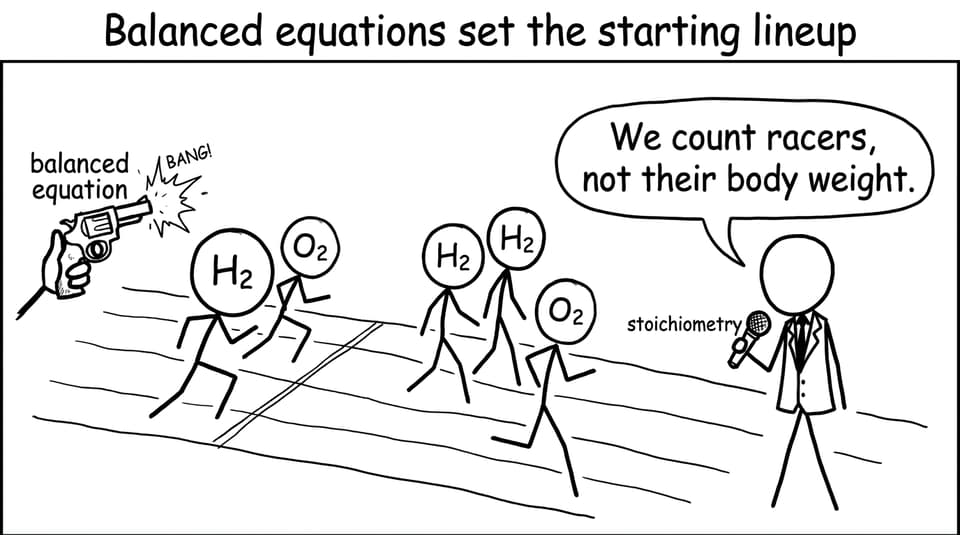
That’s why a balanced equation is really a statement about how many particles react.
Take the classic:
This means:
-
2 molecules of H(_2) react with 1 molecule of O(_2)
-
to form 2 molecules of H(_2)O
Scale that up to lab-size using moles:
-
2 mol H(_2) react with 1 mol O(_2)
-
to form 2 mol H(_2)O
That relationship stays true at every scale, which is why IB Chemistry uses balanced equations as mole ratios.
If Avogadro’s constant still feels abstract, connect it to “counting particles” with IB Chemistry: Avogadro's Constant Explained Simply.
Why mass ratios fail (even when your intuition says they shouldn’t)
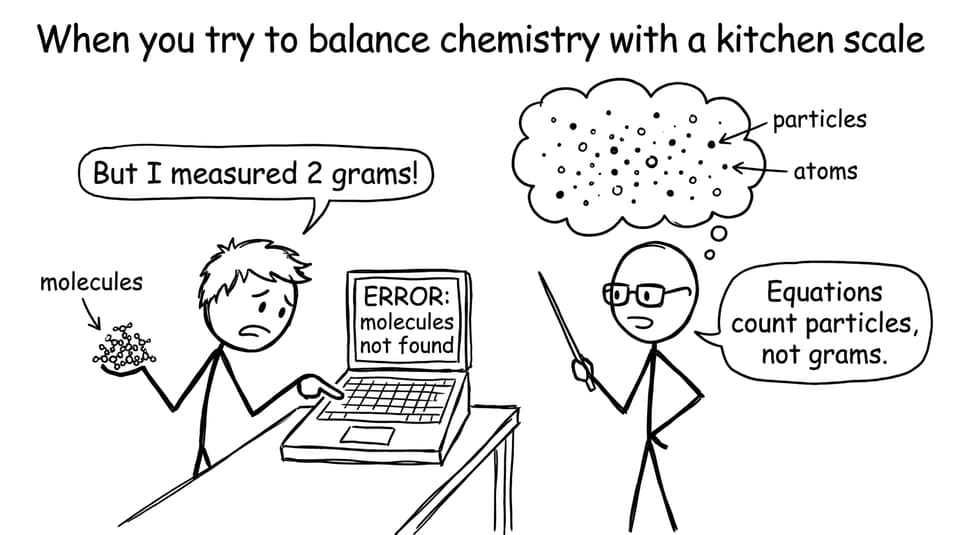
Mass is conserved, yes. But equal masses do not mean equal numbers of particles, because different substances have different molar masses.
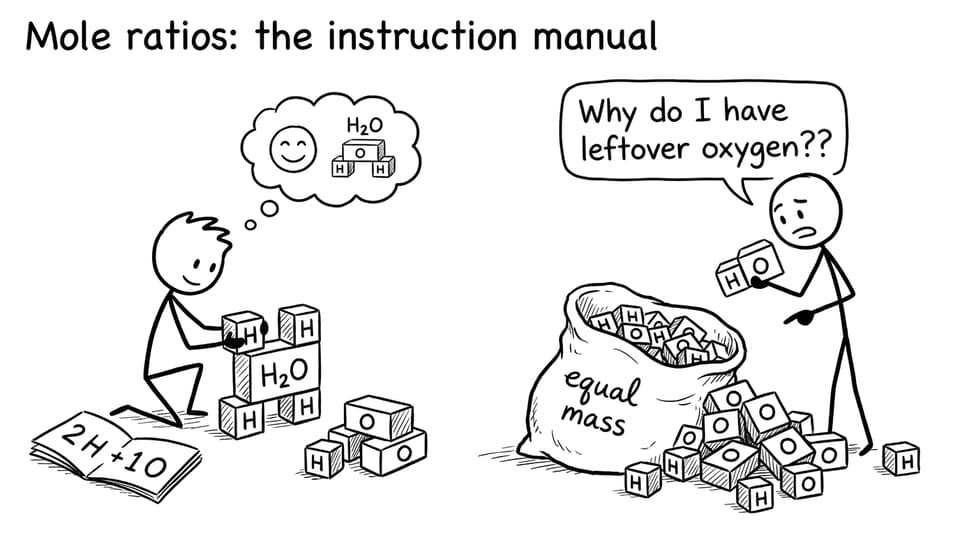
So “2 g of hydrogen” and “2 g of oxygen” represent wildly different particle counts. Hydrogen particles are light; oxygen particles are heavier. Equal mass does not produce the reacting lineup demanded by the balanced equation.
That’s the core reason balanced equations cannot represent mass ratios in IB Chemistry: mass is not the language particles use.
For a focused explanation of converting grams to moles (where many students leak marks), see How Do You Calculate the Number of Moles From Mass and Molar Mass? and Molar Mass Explained.
The real payoff: stoichiometry becomes predictable
Mole ratios are not just a philosophy; they’re the engine of every stoichiometry method you use in IB Chemistry:
-
identifying the limiting reagent
-
calculating theoretical yield
-
working with solution concentration (mol dm⁻³)
-
gas stoichiometry
When a question asks “how much product forms?”, the marker expects you to:
-
balance the equation,
-
convert to moles,
-
apply the mole ratio,
-
convert to the required unit.
If limiting reagent questions feel like they turn your brain into static, practise the exact comparison step with Limiting Reagent Explained for IB Chemistry.
And if concentration units trip you up, anchor them with What Is the Unit for Concentration in Chemistry? IB Chemistry Explained.
Where to practise this in RevisionDojo (fast)
In IB Chemistry, understanding is nice. Automatic execution under time pressure is better.
RevisionDojo makes the “mole ratio not mass ratio” idea stick because you can meet it in multiple formats:
-
Use the R2.1.1 Chemical Equations and Stoichiometry topic page to revise the full skill chain.
-
Drill it with the R2.1.1 Questionbank for exam-style stoichiometry.
-
Build speed across the wider unit using the R2.1 How Much? Questionbank.
-
If you need the core theory in one place, use the S1.4 Counting Particles by Mass: the Mole notes.
As you practise, lean on RevisionDojo features that match how you actually study: Study Notes for clarity, Flashcards for recall, AI Chat for “why did I get this wrong?”, Grading tools for structured feedback, plus Mock Exams and Predicted Papers when you’re ready to simulate pressure. If coursework is eating your time, the Coursework Library and Tutors help you regain momentum without guessing.
Conclusion: think “counting unit,” not “weighing contest”
Balanced equations represent mole ratios rather than mass ratios because chemistry happens through collisions and rearrangements of particles. Moles let IB Chemistry translate that particle reality into lab-scale numbers without distorting the relationships.
If you want this to become automatic, practise a small set of stoichiometry questions daily in RevisionDojo’s Questionbank, then tighten weak spots with Study Notes, Flashcards, and AI Chat. The goal is simple: when you see a balanced equation, you instantly see a mole ratio, and the marks start to feel predictable.