

Why Do Atoms Form Bonds Instead of Remaining Isolated?
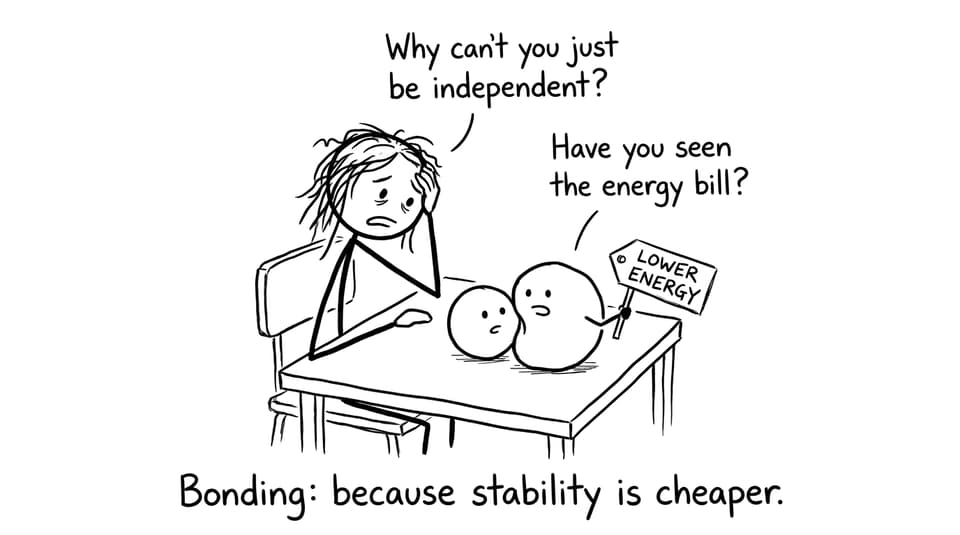
Picture two students in a library. Separately, they’re fine. Together, they share notes, split the workload, and somehow the whole system runs smoother. In IB Chemistry, atoms behave with that same quiet logic: they form bonds because the bonded state is usually lower energy and therefore more stable than being isolated.
That’s the headline you want in your exam answers. But what earns marks is explaining how bonding lowers energy, using the language of electrostatic attraction, electron arrangement, and models of bonding.
The exam-ready checklist (bonding in one minute)
When you see “why do atoms bond?” in IB Chemistry, hit these points quickly:
-
Bonding usually reduces potential energy of the system (energy is released when bonds form).
-
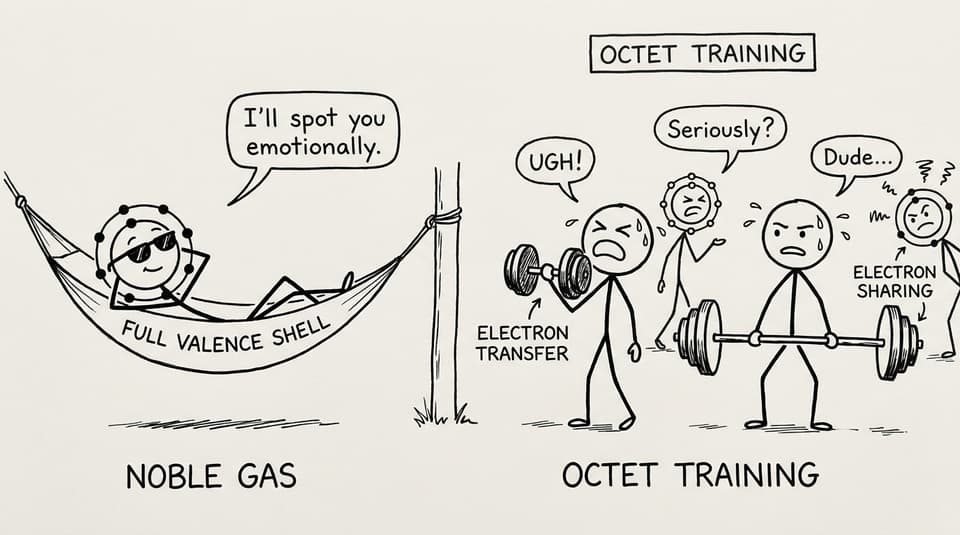
Atoms shift toward more stable valence electron arrangements (often summarized by the octet rule).
-
The final structure reflects a balance of attractions and repulsions.
-
Bonding can happen via electron transfer (ionic), electron sharing (covalent), or electron delocalization (metallic).
If you want this mapped directly to the syllabus, keep Structure 2: Models of Bonding and Structure open while you revise.
The real driver: lower energy, not “wanting”
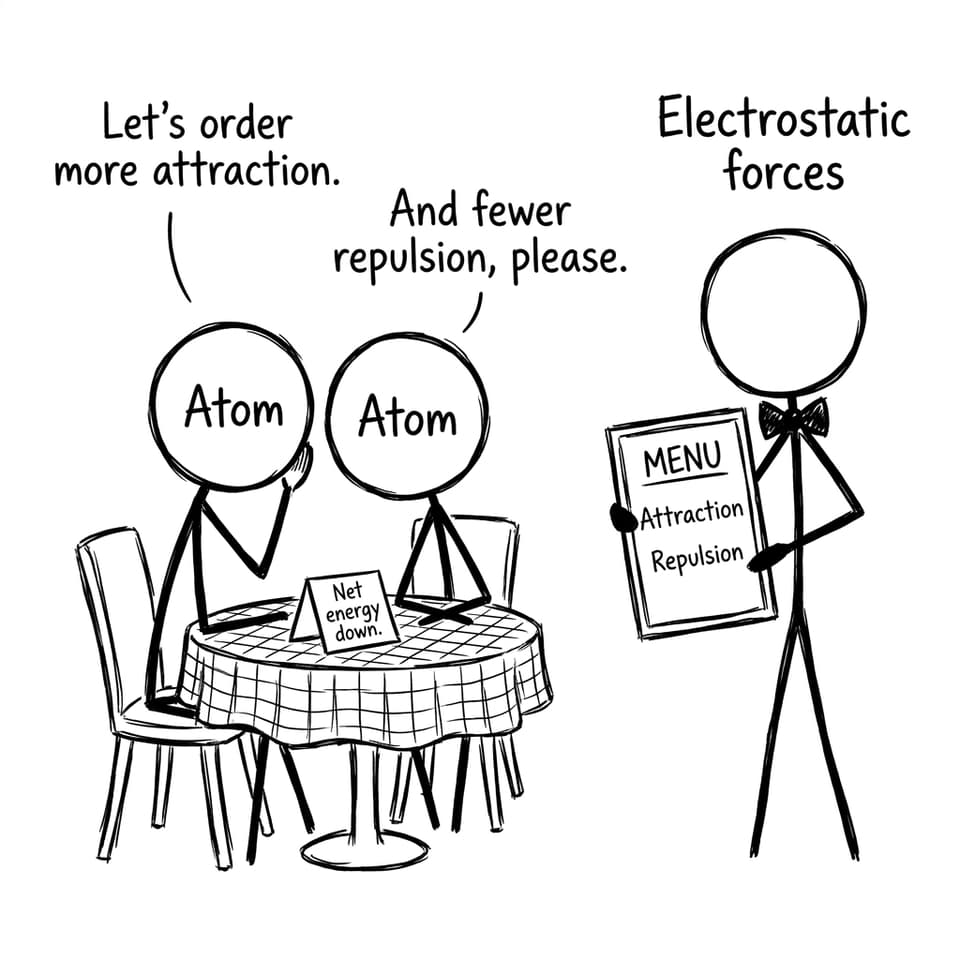
In IB Chemistry, atoms don’t bond because they have feelings or goals. They bond because, at certain distances, the electrostatic attractions between nuclei and electrons can outweigh repulsions, pulling the overall potential energy down.
The key idea is this: there’s a “sweet spot” distance where attractions dominate just enough to create a stable arrangement. Too far apart, the atoms barely interact. Too close, repulsions spike. At the sweet spot, the system sits at lower potential energy than the separated atoms.
This is why examiners like wording such as “electrostatic attraction” rather than vague phrases.
For a crisp markscheme-friendly definition of covalent bonding, revise with Covalent Bonds Explained Clearly for IB Chemistry.
How ionic bonding lowers energy (transfer + attraction)
Ionic bonding is the IB Chemistry story of trade-offs.
-
One atom (usually a metal) loses electron(s), forming a cation.
-
Another atom (usually a non-metal) gains electron(s), forming an anion.
-
The ions arrange into a lattice where opposite charges attract strongly.
Yes, making ions costs energy steps (like ionization), but the lattice formation releases a lot of energy back. The overall arrangement can be more stable than isolated atoms because the electrostatic attractions in the lattice are strong and widespread.
To see the ionic/covalent “prediction logic” students actually use under time pressure, review How Atomic Trends Predict Bond Types and pair it with targeted practice in RevisionDojo’s Questionbank.
How covalent bonding lowers energy (sharing in a stable region)
Covalent bonds form when atoms share electron pairs in a region of space that attracts both nuclei.
In IB Chemistry, you can describe a covalent bond as the electrostatic attraction between:
-
the shared pair of electrons, and
-
the two positive nuclei.
That shared electron density increases attraction without requiring full electron transfer. The molecule settles into a lower-energy arrangement, and energy is released when the bond forms.
If electronegativity is the part that blurs your explanations, use Electronegativity Explained Simply for IB Chemistry to connect “unequal sharing” to polarity.
How metallic bonding lowers energy (delocalized electrons)
Metallic bonding is the IB Chemistry model where electrons aren’t tied to one bond or one atom. Metals form a lattice of positive ions surrounded by delocalized electrons (often called a “sea”).
Delocalization spreads out electron density, reduces localized repulsions, and creates strong attraction between the ion lattice and mobile electrons. This model also explains properties like conductivity and malleability.
If you want that property link explained cleanly, see What Causes Metals to Be Malleable? IB Chemistry Explained.
Bring it home with RevisionDojo
If bonding still feels like a set of disconnected facts, treat it the way IB Chemistry exams treat it: one idea (lower energy) expressed through three models (ionic, covalent, metallic). On RevisionDojo, you can move from explanation to marks quickly using the Chemical bonding and structure notes, then cement it with the Questionbank, Flashcards, and AI Chat for instant clarification.
When you’re ready to pressure-test your understanding, build a timed set with Mock Exams, check your reasoning with the Grading tools, and use Predicted Papers for structured practice. Bonding is one of those topics where the right sentence earns the mark. RevisionDojo helps you practice that sentence until it’s automatic in IB Chemistry.