
In the middle of an IB Chemistry exam, a proton transfer equation can feel unfairly simple. Just a few symbols. A tiny H⁺. And yet your brain hesitates: Who gives the proton? Who takes it? The good news is that acids and bases are not “personalities” you memorize. They’re roles molecules play when electrons and stability push them in one direction.
The IB Chemistry definition you actually use
In IB Chemistry, the Brønsted-Lowry model is your default for proton transfer:
-
Acid = proton (H⁺) donor
-
Base = proton (H⁺) acceptor
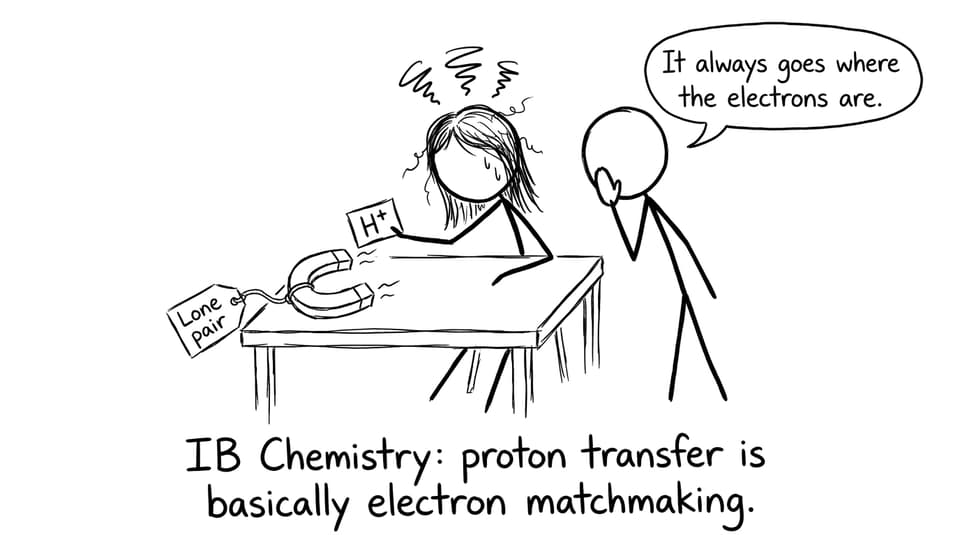
A key detail: H⁺ is just a bare nucleus. It has no electrons to form a bond by itself. So it can only attach to a species that can “host” it with available electron density (usually a lone pair).
If you want a syllabus-aligned home base for this topic, start with the IB Chemistry Acids and Bases hub and then drill questions in the Acids and Bases Questionbank.
Why acids donate protons: polarized bonds and a stable exit
An acid donates H⁺ when the hydrogen is attached in a way that makes it easy to leave.
Bond polarity makes hydrogen “ready to go”
In many acids, the H-X bond is polarized because X is more electronegative than H. Electron density is pulled toward X, leaving hydrogen partially positive (δ⁺). That means the bond can break heterolytically, and H can depart as H⁺.
Classic example: HCl. Chlorine pulls electron density strongly, so hydrogen becomes electron-poor. In water, that makes proton donation favorable.
Conjugate base stability seals the deal
In IB Chemistry, strength is really about what’s left behind. A strong acid forms a stable conjugate base, so losing H⁺ doesn’t create a high-energy, unstable species.
For a fast exam method, revise conjugate pairs using Conjugate Acid-Base Pairs Explained.
Why bases accept protons: lone pairs and “somewhere to put” H⁺
A base accepts H⁺ because it has electron density available to form a new bond.
Lone pairs (or negative charge) attract H⁺
Bases like OH⁻, NH₃, and CO₃²⁻ have lone pairs or regions of high electron density. When they bond to H⁺, they create a more stable species (a conjugate acid). Proton acceptance often lowers the energy of the system.
This links neatly to Lewis theory
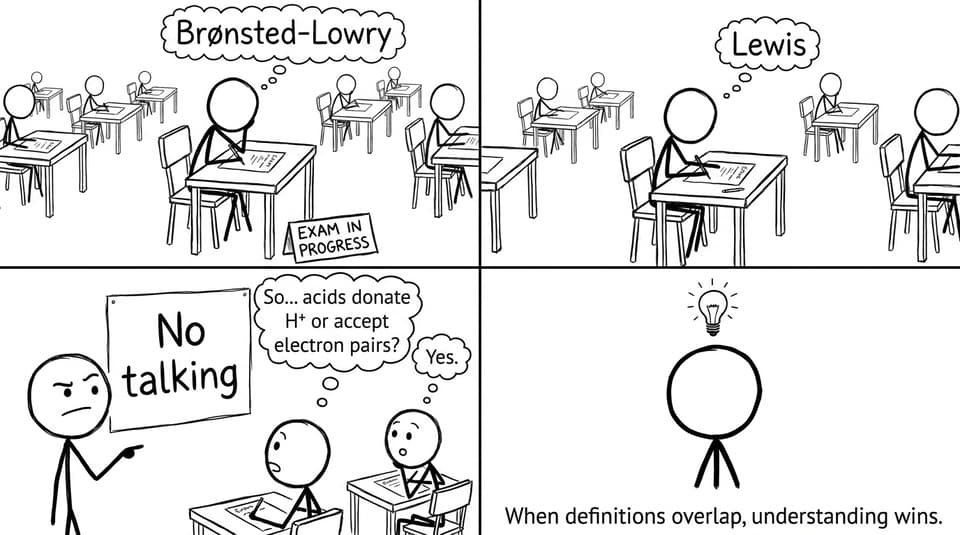
Even when the question is Brønsted-Lowry, the reason still whispers Lewis: bases donate an electron pair into a bond. That’s why lone pairs matter so much.
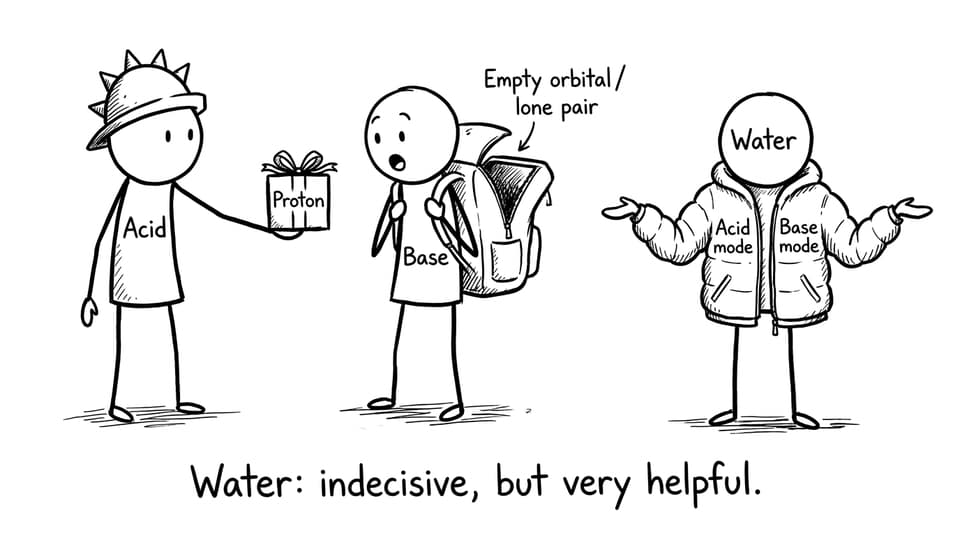
Water: the IB Chemistry “both can be true” molecule
Water is amphiprotic: it can act as an acid or base.
-
As a base, H₂O uses lone pairs on oxygen to accept H⁺ and form H₃O⁺.
-
As an acid, one O-H bond can donate H⁺, leaving OH⁻ behind.
Water’s flexibility is a reminder that in IB Chemistry, acid/base behavior is situational: it depends on the reaction partner and the stability of products.
To connect this to pH reasoning and equilibrium thinking, the R3.1 Proton Transfer Reactions Notes are a solid next step.
Quick exam checklist (30 seconds)
Use this in IB Chemistry when you see a proton transfer equation:
-
Find the species that loses H⁺ (acid)
-
Find the species that gains H⁺ (base)
-
Identify the conjugate pair (differs by exactly one H⁺)
-
Ask: is the conjugate base/acid stable?
Then practise until it’s automatic with the IB Chemistry Questionbank and check your explanations using RevisionDojo’s Questionbank feature.
Conclusion: proton transfer is really about electrons and stability
Acids donate protons in IB Chemistry because their H is electron-poor (often due to bond polarity) and because the conjugate base left behind is stable enough to “afford” the loss. Bases accept protons because they have accessible electron density (lone pairs/negative charge) that can stabilize H⁺ by forming a bond.
If you want this to hold under exam pressure, build repetition: use the Acids and Bases hub, practise with the Acids and Bases Questionbank, and lock in recall using RevisionDojo’s Flashcards and AI Chat. When your explanations start sounding calm and consistent, you’re not just learning acids and bases; you’re learning the language of IB Chemistry.