A tiny squeeze, a big consequence (IB Chemistry)
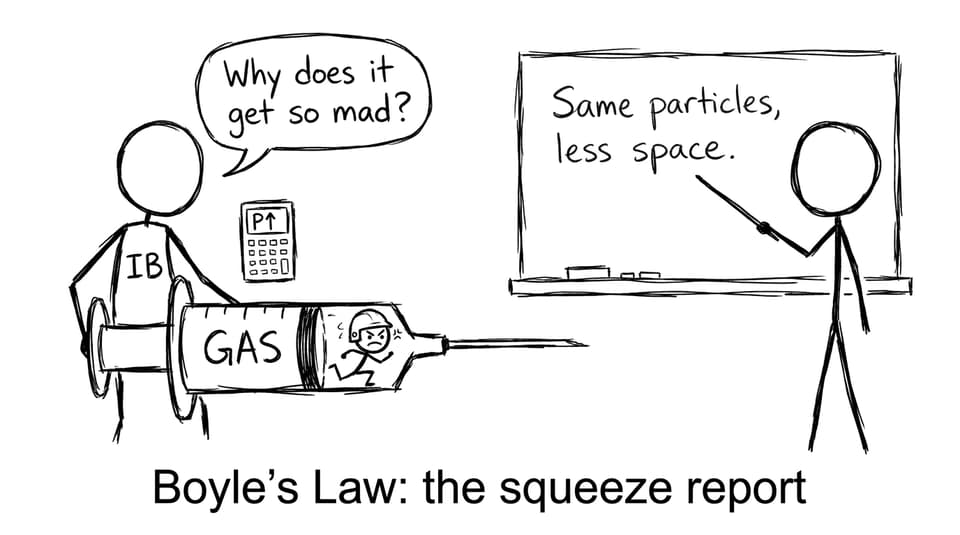
Push the plunger on a syringe and you feel it immediately: resistance. Nothing “mystical” happens inside, just a few invisible particles suddenly getting less room to move. In IB Chemistry, that simple squeeze is one of the cleanest ways to understand why decreasing volume increases gas pressure. And it’s also one of the most common places students lose marks: they quote Boyle’s Law, but don’t explain what’s happening at the particle level.
Quick exam checklist (what the IB wants)
When a question asks why pressure increases as volume decreases, your IB Chemistry answer should hit these points:
-
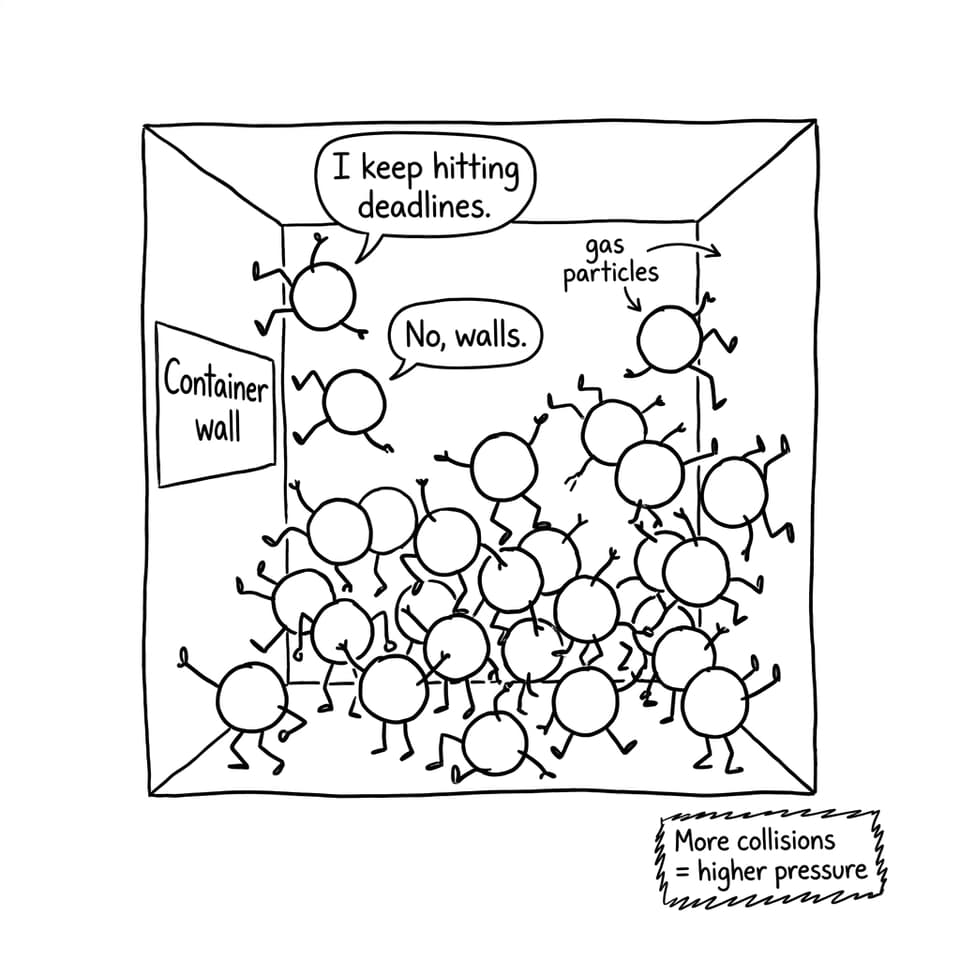
Pressure comes from particle collisions with container walls.
-
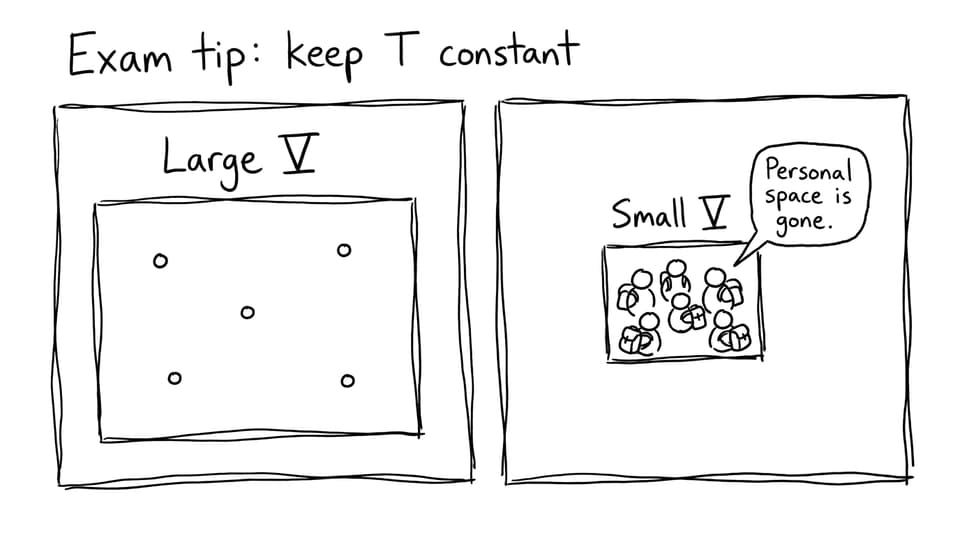
Decreasing volume puts the same number of particles in a smaller space.
-
Particles hit the walls more frequently (collision rate increases).
-
At constant temperature, average kinetic energy stays the same.
-
Therefore pressure increases (Boyle’s Law: inverse relationship).
For a syllabus-aligned refresher, see S1.5 Ideal gases and the matching Ideal Gases Revision Notes.
The particle story: pressure is wall-collisions
In IB Chemistry, pressure is not a “property” floating in the gas. It’s the result of particles striking the walls and transferring momentum. If you want a crisp particle explanation (the kind that earns explanation marks), anchor it to collision frequency.
When you decrease volume, the particles have less distance to travel before they meet a wall. Even if their speeds don’t change (constant temperature), they arrive at the walls more often. More hits per second means a bigger total force on the walls, and force per unit area is pressure.
If you want to tighten that logic, this article is a strong companion: Why pressure increases when gas particles collide more frequently.
Boyle’s Law in one sentence (and why it’s true)
Boyle’s Law says that for a fixed amount of gas at constant temperature:
-
P ∝ 1/V
-
Or P₁V₁ = P₂V₂
In IB Chemistry, the key is not memorizing the equation; it’s explaining why the inverse relationship exists. The equation is just the macroscopic summary of the microscopic story: smaller volume means more frequent wall collisions.
To connect it to the broader toolkit, review The Ideal Gas Equation Explained and the particle reasoning behind laws here: How do gas laws emerge from microscopic particle behavior?.
Common trap: “collisions are more forceful” (only sometimes)
Students often write: “pressure increases because collisions are more forceful.” In IB Chemistry, that’s only automatically true if temperature increases, because higher temperature means higher average kinetic energy.
But the typical Boyle’s Law setup says temperature is constant. That means average particle speed (and average kinetic energy) stays the same. What changes is how often particles collide with the walls, not how energetic each collision is on average.
If you need to separate “volume changes” from “temperature changes,” compare with IB Chemistry: How Temperature Changes Gas Volume.
Bring it home with RevisionDojo
The fastest way to get confident with this in IB Chemistry is to practice the exact explanation style the exam rewards. Use the S1.5 Ideal Gases Questionbank to drill volume-pressure questions, then lock in the definitions with S1.1.2 Kinetic Molecular Theory Notes and the Kinetic Molecular Theory Questionbank.
If you want this to feel automatic before mocks, RevisionDojo’s Questionbank, Study Notes, Flashcards, AI Chat, predicted papers, mock exams, and grading tools help you practice the idea from every angle, until “decreasing volume increases pressure” stops being a fact you recall and becomes a picture you can explain.

