

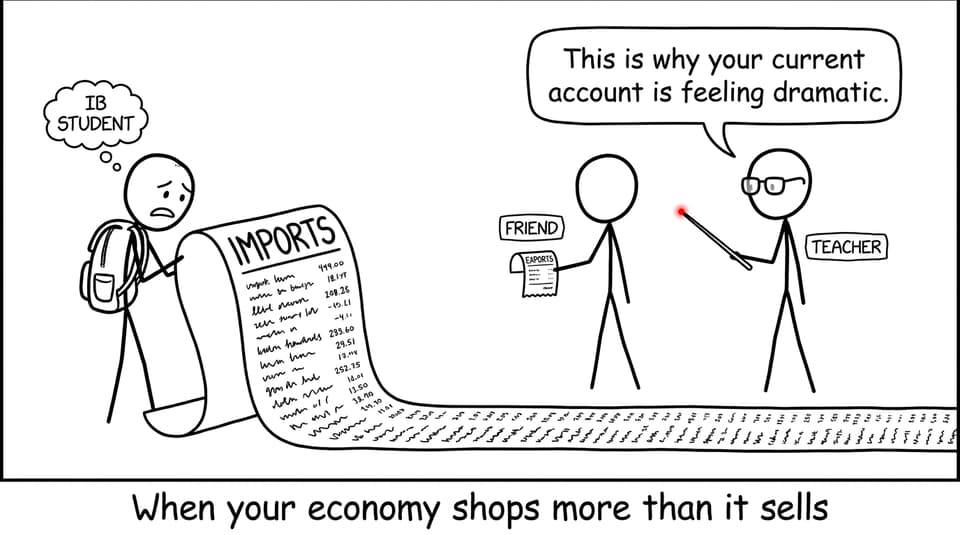
A current account deficit rarely feels real until it becomes personal: your currency buys a little less online, imported snacks quietly cost more, and headlines start using words like “confidence” and “pressure.” In IB Economics, that’s the moment you realise the current account isn’t just an accounting line. It’s a story about how an economy lives today, and what it might owe tomorrow.
A current account deficit happens when a country’s spending on imports plus net income payments and transfers abroad is larger than what it earns from exports plus income from abroad. The deficit itself isn’t automatically “bad.” But it matters because it reveals sustainability, vulnerability, and competitiveness -- three themes examiners love.
Quick IB Economics checklist: what to say in an answer
When you see “current account deficit” in IB Economics, build your response around:
-
How it’s financed (foreign borrowing, FDI, portfolio inflows)
-
External debt and future income payments (interest/dividends leaving the country)
-
Exchange rate effects (depreciation pressure, imported inflation)
-
Competitiveness (structural vs cyclical reasons)
-
Evaluation: size, duration, and what the deficit funds (investment vs consumption)
For definitions and full Balance of Payments structure, anchor your revision with What the Balance of Payments Reveals and the IB Economics 4.6 Balance of Payments hub.
Why current account deficits matter in IB Economics
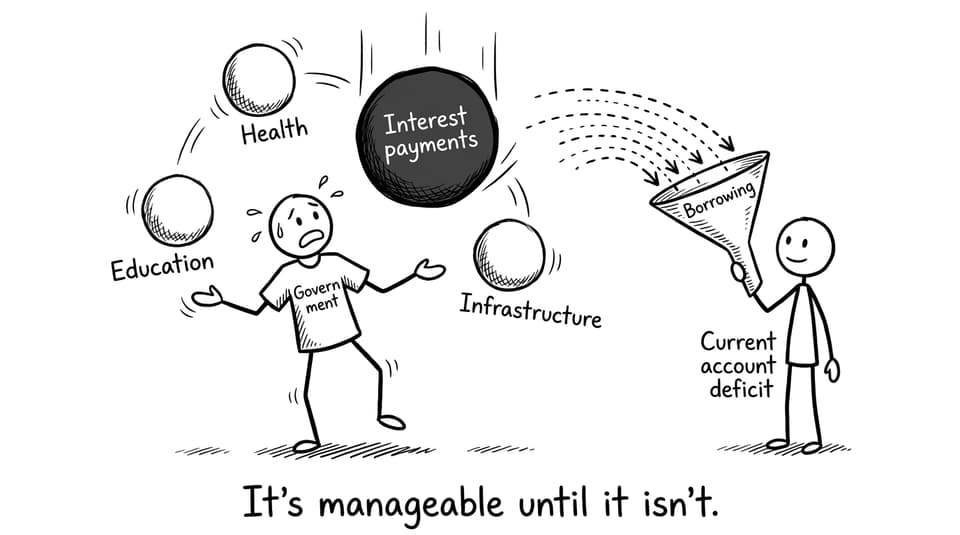
They can build external debt (and a bigger “future problem”)
A deficit must be matched by a surplus elsewhere in the Balance of Payments, often the financial account. In plain terms: if a country buys more from the world than it sells, it usually finances the gap by borrowing or selling assets.
Over time, this can create rising external debt. Debt means interest payments, and those interest payments often show up as negative income flows later, which can worsen the current account further. That’s the compounding effect exam questions are really testing.
To practise explaining this chain clearly, use the IB Economics 4.6 Balance of Payments Questionbank on RevisionDojo -- it’s built for exam-style causality and evaluation.
They can weaken the exchange rate (especially if confidence changes)
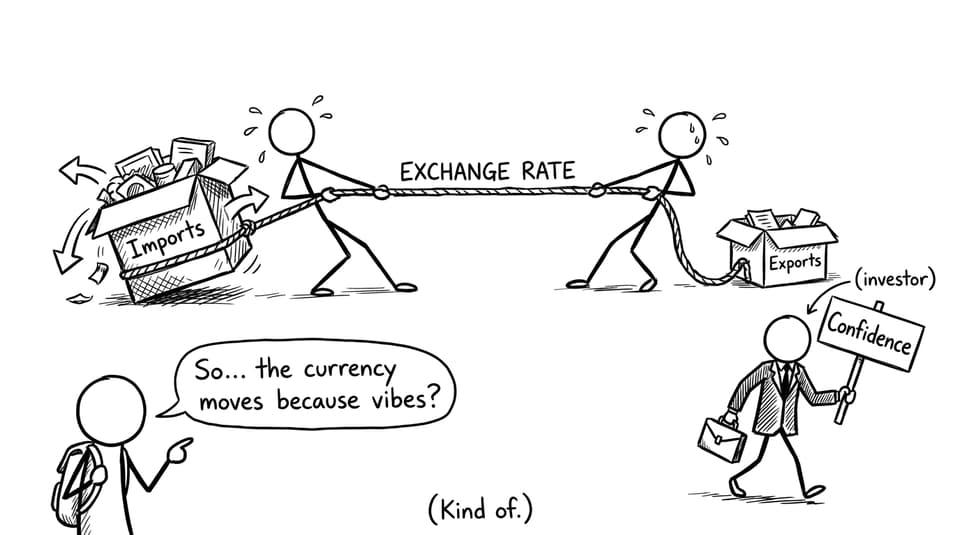
In IB Economics, you’ll often link a persistent deficit to downward pressure on the currency: more domestic currency is supplied to buy imports than foreign currency demand created by exports.
Depreciation can help exports become cheaper abroad, but it also makes imports more expensive, which can create imported inflation and reduce real purchasing power. And if investors decide the deficit looks unsustainable, capital inflows may slow or reverse, adding extra pressure.
For this syllabus link, see 4.6.4 Relationship between the financial account and the exchange rate, plus the IB Economics 4.5 Exchange Rates hub and How Exchange Rate Changes Impact the Economy.
They can signal competitiveness issues (or just a phase)
A deficit might reflect structural weaknesses: high production costs, weak productivity growth, or exports that are no longer in demand. In that case, depreciation alone may not “fix” the problem.
But deficits can also be cyclical: a strong domestic economy raises incomes, which increases import demand. That type of deficit may be less worrying if it’s temporary and financed by stable long-term inflows.
When a deficit is less worrying (evaluation that earns marks)
A current account deficit can be acceptable when it funds productive investment: infrastructure, technology, education, or capacity expansion that raises future export potential. In IB Economics, your evaluation should ask: will today’s deficit increase tomorrow’s ability to earn foreign currency?
RevisionDojo makes this kind of evaluation easier by combining Study Notes, Flashcards, and exam-style practice. You can also use AI Chat to test whether your “it depends” paragraph is actually specific enough.
Final takeaway for IB Economics students
In IB Economics, current account deficits matter because they connect today’s spending to tomorrow’s constraints: debt servicing, exchange rate stability, and competitiveness. Your goal in exams isn’t to panic about deficits. It’s to diagnose what’s driving them and evaluate whether the financing is stable and productive.
If you want this topic to feel predictable under pressure, RevisionDojo is built for it: Questionbank practice, Study Notes, Flashcards, AI Chat, Grading tools, Predicted Papers, Mock Exams, a Coursework Library, and Tutors that help you turn “it depends” into top-band evaluation.