


The decimal that quietly panics everyone in IB Chemistry
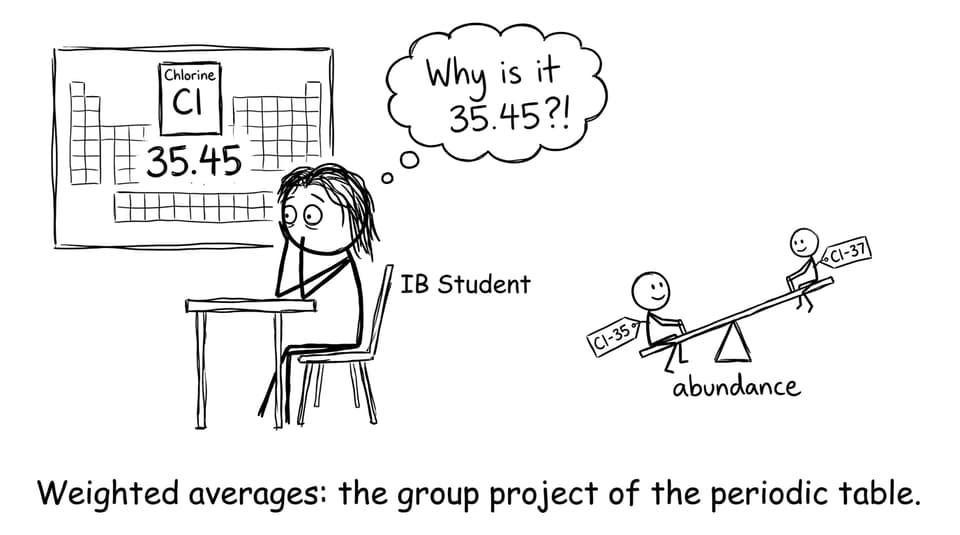
You’re revising, you glance at the periodic table, and your brain does a small double-take: chlorine isn’t 35 or 37. It’s 35.45. In IB Chemistry, that decimal is a clue, not a typo. It’s the periodic table admitting something honest about nature: elements don’t show up as one “perfect” atom. They show up as crowds.
And when a crowd contains different isotopes, the atomic mass has to behave like a fair summary of the whole group. That’s why atomic masses are weighted averages of isotopes.
Quick checklist: what to remember for IB Chemistry questions
When you see atomic mass (relative atomic mass, A_r) in IB Chemistry, run this checklist:
-
Isotopes = same protons, different neutrons (so different masses).
-
Atomic mass on the table is a weighted average, not a simple mean.
-
The “weights” come from relative abundance (how common each isotope is).
-
More abundant isotopes pull the average closer to their isotope mass.
If isotopes are still fuzzy, lock the definition first with Isotopes Explained Clearly for IB Chemistry and then reinforce it inside the syllabus pathway for IB Chemistry S1.2 the Nuclear Atom.
Why atomic mass is a weighted average of isotopes (the real reason)
Imagine an element as a jar of coins. If 3/4 of the coins are one type and 1/4 are another, your “average coin” mostly resembles the common one.
That’s exactly what happens in IB Chemistry with isotopes:
-
Each isotope has its own isotopic mass.
-
Nature provides those isotopes in certain natural abundances.
-
The listed atomic mass is the average mass you should expect if you randomly pick an atom from Earth’s supply.
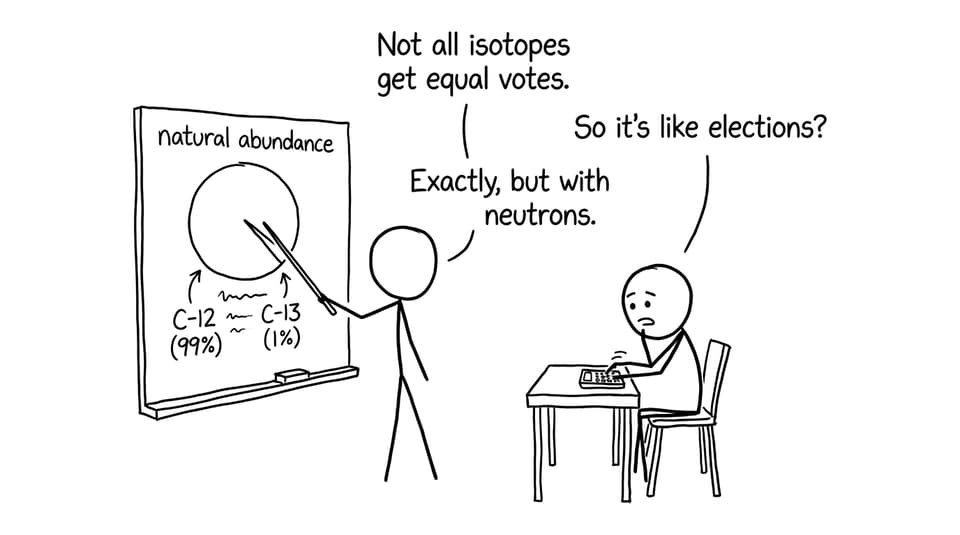
A simple average would pretend each isotope is equally common. But nature is rarely that neat. Weighted average is nature’s compromise: everyone counts, but not everyone counts equally.
The chlorine example you should be able to explain in one breath
Chlorine has two common isotopes: Cl-35 and Cl-37. In a naturally occurring sample, Cl-35 is much more abundant. So the atomic mass ends up closer to 35 than to 37, giving the familiar value around 35.45.
In exam terms for IB Chemistry, your explanation should include:
-
isotopes have different masses because neutrons differ
-
the periodic table value reflects the mixture
-
the mixture is summarized by relative abundance
For the syllabus-specific wording and worked logic, use IB Chemistry S1.2.2 Isotopes Notes and the calculation framing in Relative Atomic and Formula Masses Notes.
How do we know the abundances? Mass spectrometry (and why it matters)
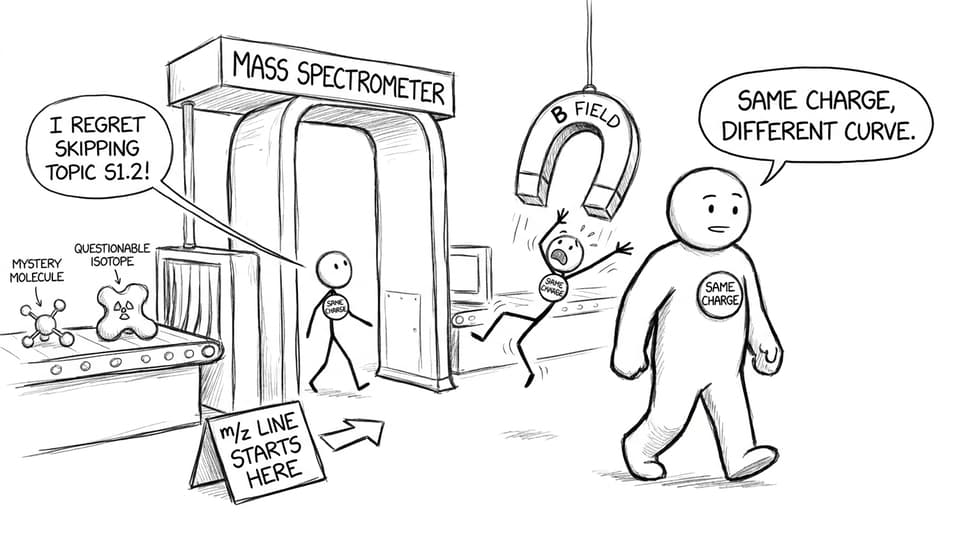
A weighted average is only as good as the data behind it. In IB Chemistry, that data often comes from mass spectrometry: isotopes separate into different peaks, and peak sizes tell you relative abundance.
If you want the cleanest explanation for Paper 2 style reasoning, read Why Does Mass Spectrometry Allow Us To Determine Isotope Composition.
How RevisionDojo helps you turn this into marks
A lot of IB Chemistry mistakes here are not about math. They’re about explanation: using “average” without saying “weighted,” forgetting abundance, or mixing up mass number vs relative atomic mass.
RevisionDojo makes the loop tight:
-
Use the Study Notes to nail definitions fast (start at Atomic Structure Notes).
-
Drill with the Questionbank for this exact topic: S1.2 the Nuclear Atom Questionbank.
-
Use Flashcards to keep “weighted average of isotopes” automatic.
-
Ask AI Chat to check your wording against command terms.
-
Use Grading tools to see what earns method marks.
-
Closer to exams, rehearse with Predicted Papers and Mock Exams via Chemistry Predicted Papers.
Closing: the weighted average mindset
Once you see atomic mass as a weighted average of isotopes, decimals stop feeling random. They start feeling like evidence. And in IB Chemistry, evidence is what turns memorized facts into explanations that score.
If you want this topic to become effortless under timed conditions, build the habit: learn it in RevisionDojo Study Notes, practise it in the Questionbank, and pressure-test it with Predicted Papers and Mock Exams. The periodic table isn’t trying to confuse you. It’s quietly describing the world as it is.


